Huysamen Cristal, Brown Gordon D
Clinical Laboratory Sciences, Division of Immunology, Institute of Infectious Disease and Molecular Medicine, University of Cape Town, Cape Town, South Africa.
FEMS Microbiol Lett. 2009 Jan;290(2):121-8. doi: 10.1111/j.1574-6968.2008.01418.x. Epub 2008 Jan 11.
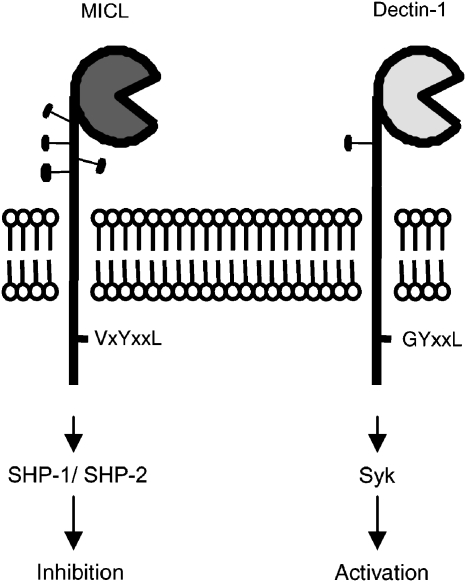
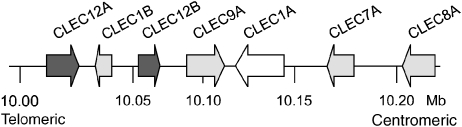
The mammalian natural killer gene complex (NKC) contains several families of type II transmembrane C-type lectin-like receptors (CLRs) that are best known for their involvement in the detection of virally infected or transformed cells, through the recognition of endogenous (or self) proteinacious ligands. However, certain CLR families within the NKC, particularly those expressed by myeloid cells, recognize structurally diverse ligands and perform a variety of other immune and homoeostatic functions. One such family is the 'Dectin-1 cluster' of CLRs, which includes MICL, CLEC-2, CLEC12B, CLEC9A, CLEC-1, Dectin-1 and LOX-1. Here, we review each of these CLRs, exploring our current understanding of their ligands and functions and highlighting where they have provided new insights into the underlying mechanisms of immunity and homeostasis.
哺乳动物自然杀伤基因复合体(NKC)包含几个II型跨膜C型凝集素样受体(CLR)家族,这些受体最为人所知的是通过识别内源性(或自身)蛋白质配体参与检测病毒感染或转化的细胞。然而,NKC中的某些CLR家族,特别是那些由髓系细胞表达的家族,识别结构多样的配体并执行多种其他免疫和稳态功能。其中一个这样的家族是CLR的“Dectin-1簇”,它包括MICL、CLEC-2、CLEC12B、CLEC9A、CLEC-1、Dectin-1和LOX-1。在这里,我们综述这些CLR中的每一个,探讨我们目前对它们的配体和功能的理解,并强调它们在哪些方面为免疫和稳态的潜在机制提供了新的见解。