Elavsky Steriani
Department of Kinesiology, The Pennsylvania State University, University Park, PA 16802 , USA.
Menopause. 2009 Mar-Apr;16(2):265-71. doi: 10.1097/gme.0b013e31818c0284.
Physical activity has been shown to enhance quality of life (QOL); however, few investigations of these effects exist in women undergoing the menopausal transition. The present study examined the long-term effects of physical activity on menopause-related QOL and tested the mediating effects of physical self-worth and positive affect in this relationship.
Middle-aged women previously enrolled in a 4-month randomized controlled trial involving walking and yoga, and a control group completed a follow-up mail-in survey 2 years after the end of the trial. The survey included a battery of psychological and physical activity measures, including measures of menopausal symptoms and menopause-related QOL. Longitudinal linear panel analysis was conducted within a covariance modeling framework to test whether physical self-worth and positive affect mediated the physical activity-QOL relationship over time.
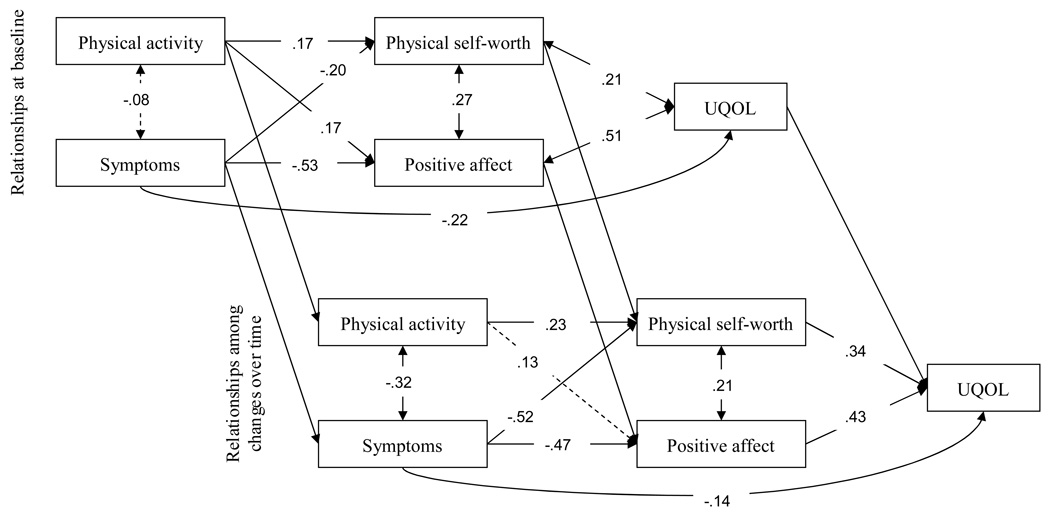
At the end of the trial, physical activity and menopausal symptoms were related to physical self-worth and positive affect, and in turn, greater levels of physical self-worth and positive affect were associated with higher levels of menopause-related QOL. Analyses indicated that increases in physical activity and decreases in menopausal symptoms over the 2-year period were related to increases in physical self-worth (betas = 0.23 and -0.52, physical activity and menopausal symptoms, respectively) and, for symptoms, also to decreased positive affect (beta = -0.47), and both physical self-worth (beta = 0.34) and affect (beta = 0.43) directly influenced enhancements in QOL (R = 0.775).
The findings support the position that the effects of physical activity on QOL are mediated, in part, by intermediate psychological outcomes and that physical activity can have long-term benefits for women undergoing the menopausal transition.
体育活动已被证明可提高生活质量(QOL);然而,对于处于绝经过渡阶段的女性,此类影响的研究较少。本研究考察了体育活动对绝经相关生活质量的长期影响,并检验了身体自我价值感和积极情绪在这种关系中的中介作用。
中年女性曾参与一项为期4个月的随机对照试验,内容包括步行和瑜伽,试验结束2年后,对照组完成了一项后续邮寄调查。该调查包括一系列心理和体育活动测量指标,包括绝经症状和绝经相关生活质量的测量指标。在协方差建模框架内进行纵向线性面板分析,以检验随着时间推移,身体自我价值感和积极情绪是否介导了体育活动与生活质量之间的关系。
在试验结束时,体育活动和绝经症状与身体自我价值感和积极情绪相关,反过来,更高水平的身体自我价值感和积极情绪与更高水平的绝经相关生活质量相关。分析表明,在两年期间,体育活动的增加和绝经症状的减少与身体自我价值感的增加(β值分别为0.23和 -0.52,对应体育活动和绝经症状)相关,对于症状而言,还与积极情绪的减少(β值 = -0.47)相关,并且身体自我价值感(β值 = 0.34)和情绪(β值 = 0.43)都直接影响了生活质量的提高(R = 0.775)。
研究结果支持以下观点,即体育活动对生活质量的影响部分是由中间心理结果介导的,并且体育活动对处于绝经过渡阶段的女性可能具有长期益处。