Velentzis L S, Cantwell M M, Cardwell C, Keshtgar M R, Leathem A J, Woodside J V
Department of Surgery, Breast Cancer Research Group, University College London, Charles Bell House, 67-73 Riding House St, London W1W 7EJ, UK.
Br J Cancer. 2009 May 5;100(9):1492-8. doi: 10.1038/sj.bjc.6605003. Epub 2009 Mar 31.
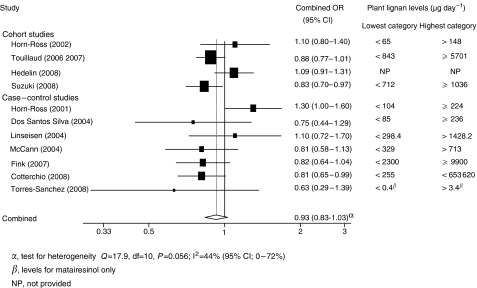
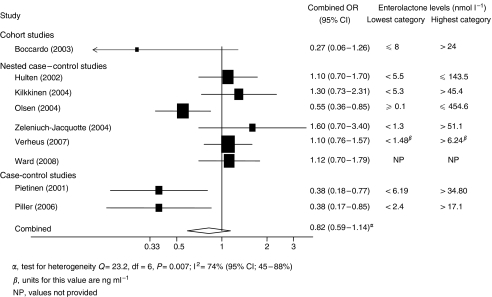
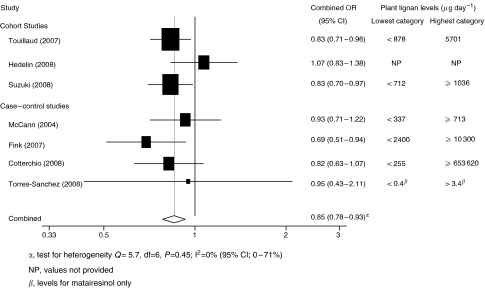
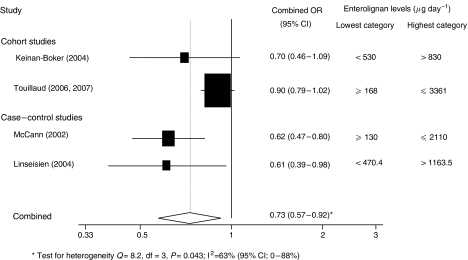
Phyto-oestrogens are plant compounds structurally similar to oestradiol, which have been proposed to have protective effects against breast cancer. The main class of phyto-oestrogens in the Western diet is lignans. Literature reports on the effect of lignans in breast cancer risk have been conflicting. We performed three separate meta-analyses to examine the relationships between (i) plant lignan intake, (ii) enterolignan exposure and (iii) blood enterolactone levels and breast cancer risk. Medline, BIOSIS and EMBASE databases were searched for publications up to 30 September 2008, and 23 studies were included in the random effects meta-analyses. Overall, there was little association between high plant lignan intake and breast cancer risk (11 studies, combined odds ratio (OR): 0.93, 95% confidence interval (95% CI): 0.83-1.03, P=0.15), but this association was subjected to marked heterogeneity (I(2)=44%). Restricting the analysis to post-menopausal women, high levels of plant lignan intake were associated with reduced breast cancer risk (7 studies, combined OR: 0.85, 95% CI: 0.78, 0.93, P<0.001) and heterogeneity was markedly reduced (I(2)=0%). High enterolignan exposure was also associated with breast cancer (5 studies, combined OR: 0.73, 95% CI: 0.57, 0.92, P=0.009) but, again, there was marked heterogeneity (I(2)=63%). No association was found with blood enterolactone levels (combined OR: 0.82, 95% CI: 0.59-1.14, P=0.24). In conclusion, plant lignans may be associated with a small reduction in post-menopausal breast cancer risk, but further studies are required to confirm these results.
植物雌激素是结构上与雌二醇相似的植物化合物,有人提出其对乳腺癌具有保护作用。西方饮食中植物雌激素的主要类别是木脂素。关于木脂素对乳腺癌风险影响的文献报道相互矛盾。我们进行了三项独立的荟萃分析,以研究(i)植物木脂素摄入量、(ii)肠木脂素暴露量和(iii)血液中肠内酯水平与乳腺癌风险之间的关系。检索了Medline、BIOSIS和EMBASE数据库中截至2008年9月30日的出版物,随机效应荟萃分析纳入了23项研究。总体而言,高植物木脂素摄入量与乳腺癌风险之间几乎没有关联(11项研究,合并比值比(OR):0.93,95%置信区间(95%CI):0.83 - 1.03,P = 0.15),但这种关联存在显著异质性(I(2)=44%)。将分析限制在绝经后女性中,高植物木脂素摄入量与降低乳腺癌风险相关(7项研究,合并OR:0.85,95%CI:0.78,0.93,P < 0.001),且异质性显著降低(I(2)=0%)。高肠木脂素暴露也与乳腺癌相关(5项研究,合并OR:0.73,95%CI:0.57,0.92,P = 0.009),但同样存在显著异质性(I(2)=63%)。未发现与血液中肠内酯水平有关联(合并OR:0.82,95%CI:0.59 - 1.14,P = 0.2)。总之,植物木脂素可能与绝经后乳腺癌风险的小幅降低有关,但需要进一步研究来证实这些结果。