Kamioka Hiroharu, Nakamura Yosikazu, Okada Shinpei, Kitayuguchi Jun, Kamada Masamitsu, Honda Takuya, Matsui Yuzuru, Mutoh Yoshiteru
Faculty of Regional Environment Science, Tokyo University of Agriculture, Tokyo 156-8502, Japan.
J Epidemiol. 2009;19(5):219-30. doi: 10.2188/jea.je20081020. Epub 2009 Aug 15.
Physical activity is known to prevent obesity and metabolic syndrome in middle-aged and elderly people; however, the effectiveness of a comprehensive health education program for male white-collar employees is uncertain.
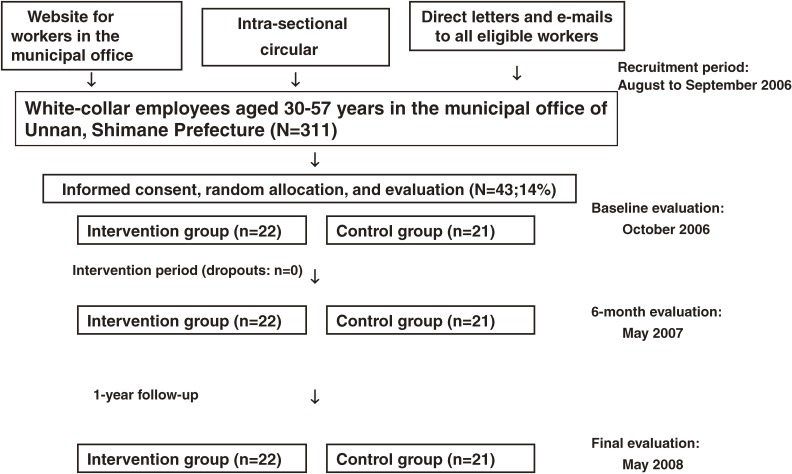
Forty-three men volunteered to participate in this study and were randomly assigned into 2 groups. The intervention group participated in a 2-hour program comprising comprehensive health education and hot spa bathing, offered once every 2 weeks, in addition to individualized programs once a week, for 24 weeks. The control group received only general health guidance. We compared their lifestyle characteristics and physical and mental health criteria at baseline, immediately after the intervention, and 1 year after the end of the intervention.
Rates of adherence to individualized programs were 60.0 +/- 27.2% and 30.5 +/- 29.6% at the end of the intervention and at 1 year after the end of the intervention, respectively. Significant (P < 0.05) interaction of criteria was observed for cluster of differentiation 4+ (CD4+) cells and the ratio of cluster of differentiation 4+ to 8+ (CD4/8) cells, which were used to represent the participants' immunological function. We divided the intervention group into 2 subgroups on the basis of their attendance. Among the resulting 3 groups, significant interaction of criteria was observed for CD4+ and CD4/8 cells. In addition, the high attendance group had the highest CD4+ count and CD4/8 ratio.
Participants who attended classes and/or performed the supplementary individualized programs tended to maintain their immunological function and to experience a decrease in body fat percentage. However, few effects were noted in participants with poor adherence, even in the intervention group.
已知体育活动可预防中老年人肥胖和代谢综合征;然而,针对男性白领员工的综合健康教育计划的效果尚不确定。
43名男性自愿参与本研究,并被随机分为2组。干预组参加了一个为期2小时的项目,包括综合健康教育和温泉浴,每2周进行一次,此外每周还有个性化项目,共持续24周。对照组仅接受一般健康指导。我们比较了他们在基线、干预结束后即刻以及干预结束后1年时的生活方式特征以及身心健康指标。
在干预结束时和干预结束后1年,个性化项目的依从率分别为60.0 +/- 27.2%和30.5 +/- 29.6%。用于代表参与者免疫功能的分化簇4 +(CD4 +)细胞以及分化簇4 +与8 +(CD4/8)细胞的比例,观察到标准的显著(P < 0.05)交互作用。我们根据出勤情况将干预组分为2个亚组。在这3组中,观察到CD4 +和CD4/8细胞标准的显著交互作用。此外,高出勤组的CD4 +计数和CD4/8比例最高。
参加课程和/或进行补充个性化项目的参与者倾向于维持其免疫功能,并使体脂百分比降低。然而,即使在干预组中,依从性差的参与者也几乎没有观察到效果。