Nilsson Dan-Eric
Department of Cell and Organism Biology, Lund University, 22362 Lund, Sweden.
Philos Trans R Soc Lond B Biol Sci. 2009 Oct 12;364(1531):2833-47. doi: 10.1098/rstb.2009.0083.
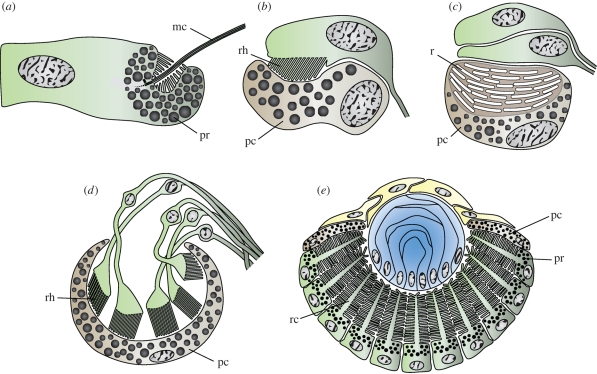
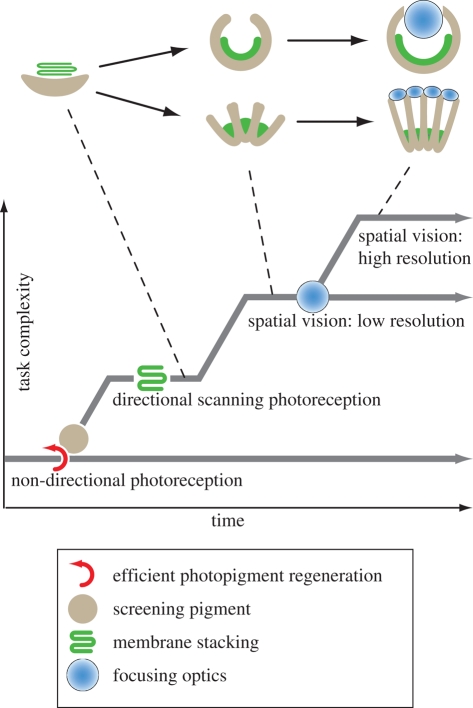
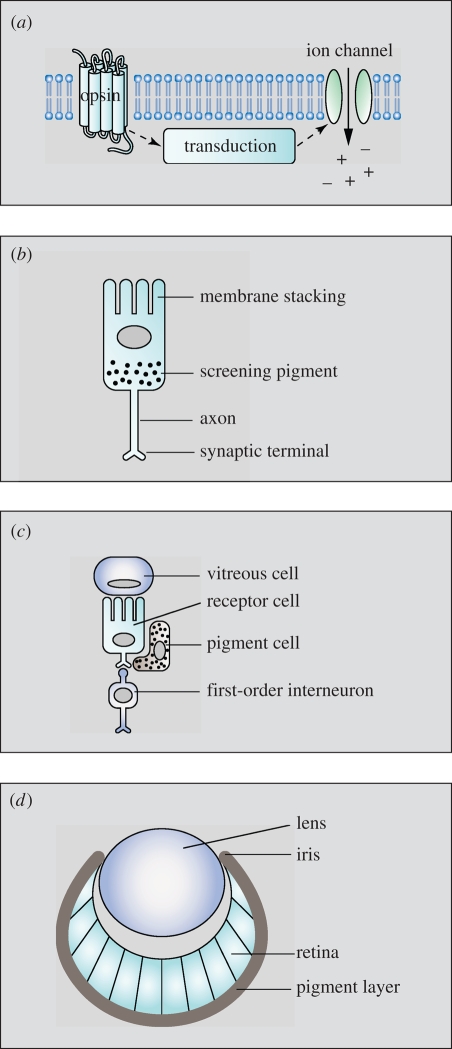
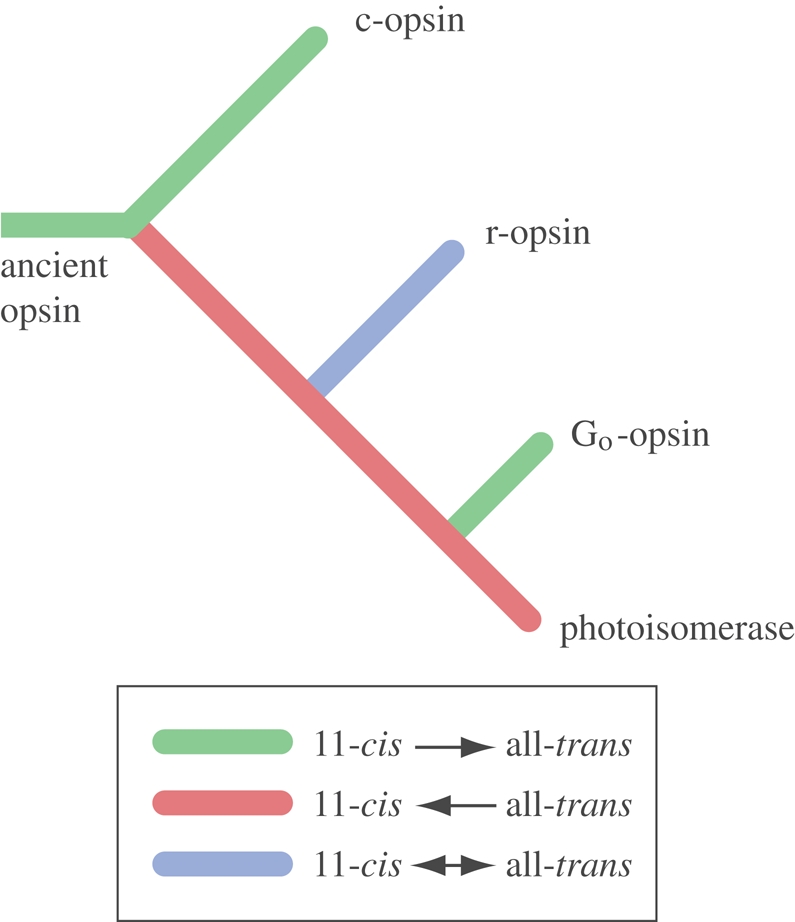
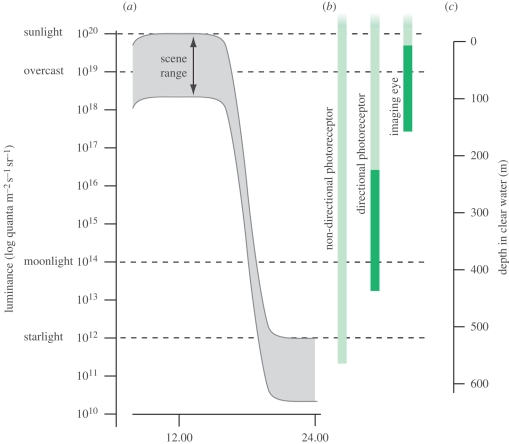
The morphology and molecular mechanisms of animal photoreceptor cells and eyes reveal a complex pattern of duplications and co-option of genetic modules, leading to a number of different light-sensitive systems that share many components, in which clear-cut homologies are rare. On the basis of molecular and morphological findings, I discuss the functional requirements for vision and how these have constrained the evolution of eyes. The fact that natural selection on eyes acts through the consequences of visually guided behaviour leads to a concept of task-punctuated evolution, where sensory systems evolve by a sequential acquisition of sensory tasks. I identify four key innovations that, one after the other, paved the way for the evolution of efficient eyes. These innovations are (i) efficient photopigments, (ii) directionality through screening pigment, (iii) photoreceptor membrane folding, and (iv) focusing optics. A corresponding evolutionary sequence is suggested, starting at non-directional monitoring of ambient luminance and leading to comparisons of luminances within a scene, first by a scanning mode and later by parallel spatial channels in imaging eyes.
动物光感受器细胞和眼睛的形态学及分子机制揭示了基因模块复制和共同选择的复杂模式,从而产生了许多共享众多组件的不同光敏感系统,其中明确的同源性很少见。基于分子和形态学研究结果,我讨论了视觉的功能需求以及这些需求如何限制了眼睛的进化。眼睛的自然选择通过视觉引导行为的后果起作用这一事实,引出了任务间断进化的概念,即感觉系统通过依次获取感觉任务而进化。我确定了四项关键创新成果,它们依次为高效眼睛的进化铺平了道路。这些创新成果是:(i)高效光色素;(ii)通过遮光色素实现的方向性;(iii)光感受器膜折叠;(iv)聚焦光学。本文提出了一个相应的进化序列,从对环境亮度的非定向监测开始,进而在场景内比较亮度,最初是通过扫描模式,后来是通过成像眼睛中的平行空间通道。