Academic Research Centre for Health and Social Care (TRANZO), Tilburg University, Tilburg, The Netherlands.
J Occup Rehabil. 2009 Dec;19(4):323-32. doi: 10.1007/s10926-009-9198-8.
To investigate which factors predict return to work (RTW) after 3 and 6 months in employees sick-listed due to minor mental disorders.
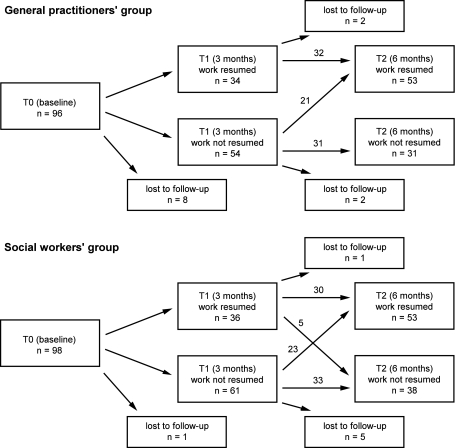
Seventy GPs recruited 194 subjects at the start of sick leave due to minor mental disorders. At baseline (T0), 3 and 6 months later (T1 and T2, respectively), subjects received a questionnaire and were interviewed by telephone. Using multivariate logistic regression analyses, we developed three prediction models to predict RTW at T1 and T2.
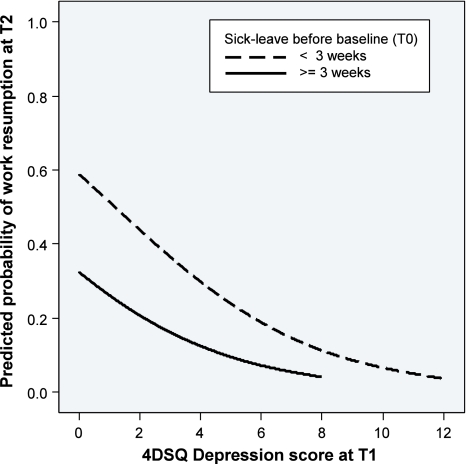
The RTW rates were 38% after 3 months (T1) and 61% after 6 months (T2). The main negative predictors of RTW at T1 were: (a) a duration of the problems of more than 3 months before sick leave; and (b) somatisation. The main negative predictors of RTW at T2 were: (a) a duration of the problems of more than 3 months before sick leave; (b) more than 3 weeks of sick leave before inclusion in the study; and (c) anxiety. The main negative predictors of RTW at T2 for those who had not resumed work at T1 were: (a) more than 3 weeks of sick leave before inclusion in the study; and (b) depression at T1. The predictive power of the models was moderate with AUC-values between 0.695 and 0.763.
The main predictors of RTW were associated with the severity of the problems. A long duration of the problems before the occurrence of sick leave and a long duration of sick leave before seeking help predict a relatively small probability to RTW within 3-6 months. High baseline somatisation and anxiety, and high depression after 3 months make the prospect even worse. Since these predictors are readily assessable with just a few questions and a symptom questionnaire, this opens the opportunity to select high-risk employees for a
调查哪些因素可预测因轻度精神障碍而请病假的员工在 3 个月和 6 个月后重返工作岗位(RTW)。
70 名全科医生在因轻度精神障碍开始请病假时招募了 194 名受试者。在基线(T0)、3 个月后(T1)和 6 个月后(T2),受试者接受了问卷调查,并通过电话接受了访谈。我们使用多变量逻辑回归分析,针对 T1 和 T2 分别建立了三个预测模型来预测 RTW。
3 个月后(T1)的 RTW 率为 38%,6 个月后(T2)为 61%。T1 时 RTW 的主要负面预测因素是:(a)病假前问题持续时间超过 3 个月;和(b)躯体化。T2 时 RTW 的主要负面预测因素是:(a)病假前问题持续时间超过 3 个月;(b)在纳入研究前休病假超过 3 周;和(c)焦虑。对于那些在 T1 时仍未恢复工作的人,T2 时 RTW 的主要负面预测因素是:(a)在纳入研究前休病假超过 3 周;和(b)T1 时的抑郁。模型的预测能力为中度,AUC 值在 0.695 到 0.763 之间。
RTW 的主要预测因素与问题的严重程度有关。病假前问题持续时间长和寻求帮助前休病假时间长,预计在 3-6 个月内 RTW 的可能性较小。基线时较高的躯体化和焦虑水平,以及 3 个月后的高抑郁水平使情况更加恶化。由于这些预测因素可以通过几个问题和症状问卷来评估,这为选择高风险员工提供了机会。