Der Geoff, Batty G David, Deary Ian J
MRC Social and Public Health Sciences Unit, University of Glasgow, Glasgow, UK.
Intelligence. 2009 Nov;37(6):573-580. doi: 10.1016/j.intell.2008.12.002.
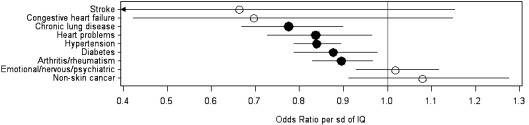
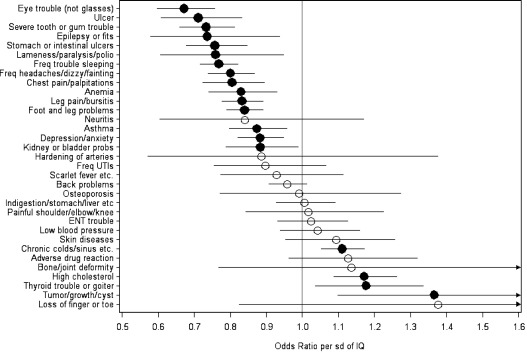
A link between pre-morbid intelligence and all cause mortality is becoming well established, but the aetiology of the association is not understood. Less is known about links with cause specific mortality and with morbidity. The aim of this study is to examine the association between intelligence measured in adolescence and a broad range of health outcomes ascertained at 40 years of age. We use data on 7476 participants in the US National Longitudinal Survey of Youth 1979 who had their cognitive ability measured at baseline and completed the 'Health at 40' interview module between 1998 and 2004. The Health at 40 module includes assessments of general health and depression, nine medically diagnosed conditions, and 33 common health problems. Higher mental test scores were associated with lower depression scores, better general health, significantly lower odds of having five of the nine diagnosed conditions and 15 of the 33 health problems. A health disadvantage of higher cognitive ability was evident for only three of the 33 health problems.
病前智力与全因死亡率之间的联系已逐渐明确,但该关联的病因尚不清楚。关于与特定病因死亡率及发病率之间的联系,我们了解得更少。本研究的目的是调查青少年时期测量的智力与40岁时确定的广泛健康结果之间的关联。我们使用了美国1979年全国青年纵向调查中7476名参与者的数据,这些参与者在基线时测量了认知能力,并在1998年至2004年间完成了“40岁健康”访谈模块。“40岁健康”模块包括对总体健康和抑郁状况的评估、九种医学诊断疾病以及33种常见健康问题。较高的心理测试分数与较低的抑郁分数、更好的总体健康状况相关,在九种诊断疾病中的五种以及33种健康问题中的15种方面,患病几率显著更低。在33种健康问题中,仅三种显示出较高认知能力带来的健康劣势。