Center for Evaluation Research and Surveys, Mexican School of Public Health/National Institute of Public Health (INSP), Av. Universidad 655, Cuernavaca, Mexico CP 62508.
BMC Public Health. 2009 Nov 18;9 Suppl 1(Suppl 1):S5. doi: 10.1186/1471-2458-9-S1-S5.
After more than 25 years, public health programs have not been able to sufficiently reduce the number of new HIV infections. Over 7,000 people become infected with HIV every day. Lack of convincing evidence of cost-effectiveness (CE) may be one of the reasons why implementation of effective programs is not occurring at sufficient scale. This paper identifies, summarizes and critiques the CE literature related to HIV-prevention interventions in low- and middle-income countries during 2005-2008.
Systematic identification of publications was conducted through several methods: electronic databases, internet search of international organizations and major funding/implementing agencies, and journal browsing. Inclusion criteria included: HIV prevention intervention, year for publication (2005-2008), setting (low- and middle-income countries), and CE estimation (empirical or modeling) using outcomes in terms of cost per HIV infection averted and/or cost per disability-adjusted life year (DALY) or quality-adjusted life year (QALY).
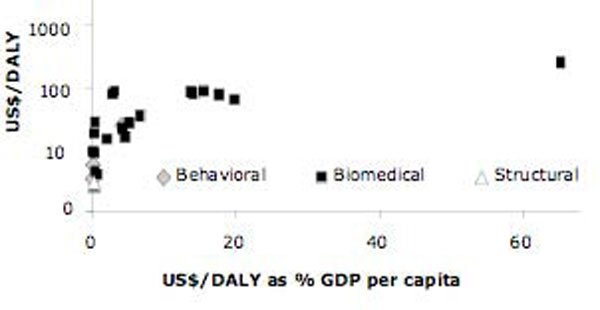
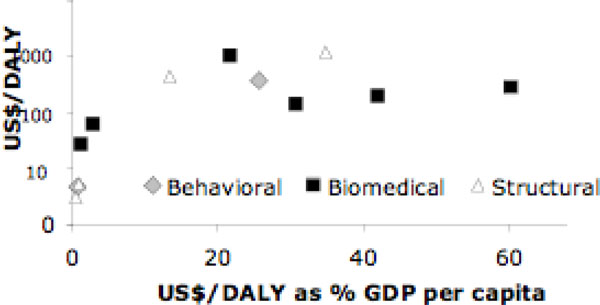
We found 21 distinct studies analyzing the CE of HIV-prevention interventions published in the past four years (2005-2008). Seventeen CE studies analyzed biomedical interventions; only a few dealt with behavioral and environmental/structural interventions. Sixteen studies focused on sub-Saharan Africa, and only a handful on Asia, Latin America and Eastern Europe. Many HIV-prevention interventions are very cost effective in absolute terms (using costs per DALY averted), and also in country-specific relative terms (in cost per DALY measured as percentage of GDP per capita).
There are several types of interventions for which CE studies are still not available or insufficient, including surveillance, abstinence, school-based education, universal precautions, prevention for positives and most structural interventions. The sparse CE evidence available is not easily comparable; thus, not very useful for decision making. More than 25 years into the AIDS epidemic and billions of dollars of spending later, there is still much work to be done both on costs and effectiveness to adequately inform HIV prevention planning.
经过 25 年以上的时间,公共卫生项目仍未能充分减少新的 HIV 感染人数。每天有超过 7000 人感染 HIV。缺乏令人信服的成本效益证据(CE)可能是有效项目实施规模不足的原因之一。本文旨在识别、总结和评价 2005-2008 年期间中低收入国家 HIV 预防干预措施的相关 CE 文献。
通过多种方法系统地识别出版物:电子数据库、国际组织和主要资助/实施机构的互联网搜索以及期刊浏览。纳入标准包括:HIV 预防干预、发表年份(2005-2008 年)、设置(中低收入国家)以及使用避免每例 HIV 感染的成本和/或每例残疾调整生命年(DALY)或质量调整生命年(QALY)的成本进行 CE 估计(实证或建模)的 HIV 预防干预。
我们发现过去四年(2005-2008 年)共发表了 21 项不同的 HIV 预防干预 CE 研究。17 项 CE 研究分析了生物医学干预措施;只有少数研究涉及行为和环境/结构干预措施。16 项研究集中在撒哈拉以南非洲,只有少数研究涉及亚洲、拉丁美洲和东欧。许多 HIV 预防干预措施在绝对意义上(使用每例 DALY 避免的成本)非常具有成本效益,在国家特定的相对意义上(以占人均 GDP 的百分比衡量的每例 DALY 成本)也是如此。
仍有几种类型的干预措施缺乏或缺乏 CE 研究,包括监测、禁欲、学校教育、普遍预防措施、对阳性者的预防和大多数结构干预措施。现有的 CE 证据稀疏且不可比,因此对决策的帮助不大。艾滋病流行 25 年多,花费数十亿美元之后,仍有许多工作要做,既要提高成本效益,又要充分告知 HIV 预防规划。