Department of Public Health Sciences, Karolinska Institute, SE-17176 Stockholm, Sweden.
J Epidemiol Community Health. 2010 May;64(5):419-25. doi: 10.1136/jech.2009.100669. Epub 2009 Dec 1.
There is growing evidence of an inverse association between intelligence (IQ) and unintentional injuries.
Analyses are based on a cohort of 1 109 475 Swedish men with IQ measured in early adulthood. Men were followed up for an average 24 years, and hospital admissions for unintentional injury were recorded.
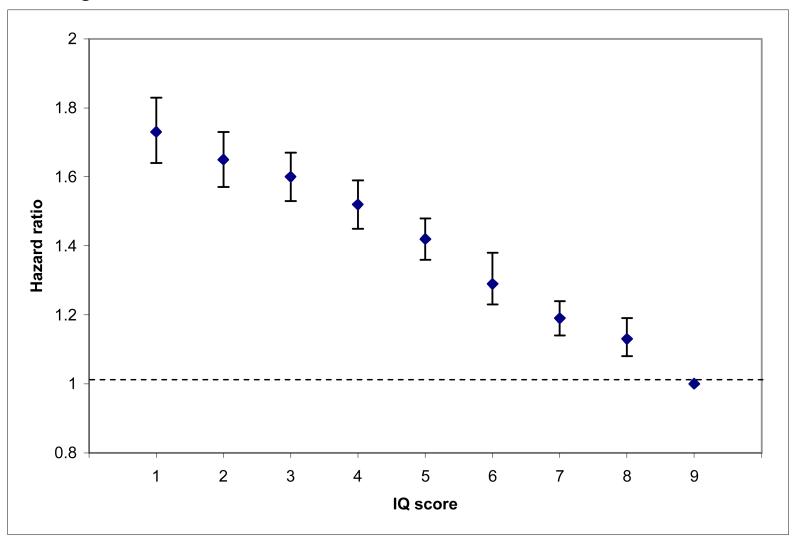
198 133 (17.9%) men had at least one hospital admission for any unintentional injury during follow-up. The most common cause of unintentional injury was falling, followed by road accidents, poisoning, fire and drowning. In addition, 14 637 (1.3%) men had at least one admission for complications of medical care. After adjusting for confounding variables, lower IQ scores were associated with an elevated risk of any unintentional injury (HR (95% CI) per SD decrease in IQ: 1.15 (1.14 to 1.15)) and of cause-specific injuries other than drowning (poisoning (1.53 (1.49 to 1.57)), fire (1.36 (1.31 to 1.41)), road traffic accidents (1.25 (1.23 to 1.26)), medical complications (1.20 (1.18 to 1.22)) and falling (1.17 (1.16 to 1.18))). These gradients were stepwise across the full IQ range.
Low IQ scores in early adulthood were associated with a subsequently increased risk of unintentional injury. A greater understanding of mechanisms underlying these associations may provide opportunities and strategies for prevention.
越来越多的证据表明,智力(智商)与意外伤害呈负相关。
分析基于一项有 1109475 名瑞典男性的队列研究,这些男性在成年早期接受了智商测试。男性的平均随访时间为 24 年,记录了因意外伤害住院的情况。
在随访期间,有 198133(17.9%)名男性至少有一次因意外伤害住院。意外伤害最常见的原因是跌倒,其次是道路交通事故、中毒、火灾和溺水。此外,有 14637(1.3%)名男性至少有一次因医疗并发症住院。在校正了混杂因素后,较低的智商得分与意外伤害风险增加相关(每降低一个标准差的智商,任何意外伤害的 HR(95%CI):1.15(1.14 至 1.15))和除溺水以外的特定原因伤害(中毒(1.53(1.49 至 1.57))、火灾(1.36(1.31 至 1.41))、道路交通碰撞事故(1.25(1.23 至 1.26))、医疗并发症(1.20(1.18 至 1.22))和跌倒(1.17(1.16 至 1.18)))。这些梯度在整个智商范围内呈逐步上升趋势。
成年早期的低智商得分与随后意外伤害风险增加相关。更深入地了解这些关联的潜在机制可能为预防提供机会和策略。