Section of Cell and Developmental Biology, Division of Biological Sciences, Department of Mechanical and Aerospace Engineering, and Department of Bioengineering, University of California, San Diego, La Jolla, CA 92093, USA.
Mol Biol Cell. 2010 Feb 1;21(3):405-17. doi: 10.1091/mbc.e09-08-0703. Epub 2009 Dec 2.
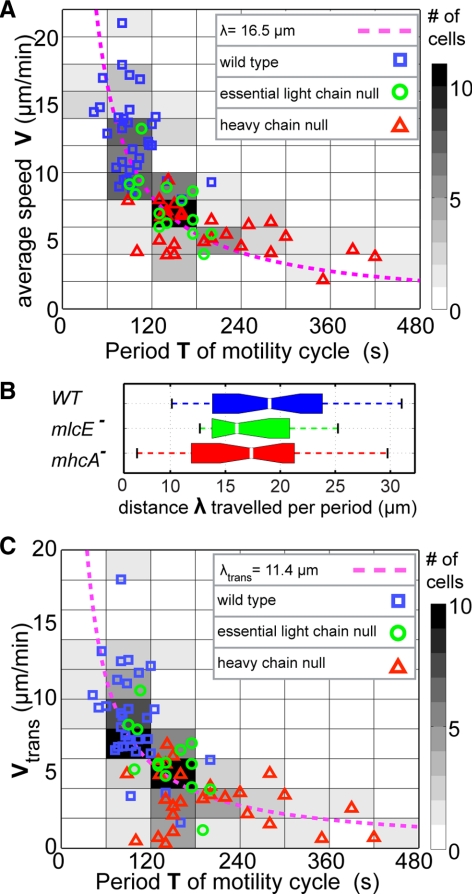
Amoeboid motility requires spatiotemporal coordination of biochemical pathways regulating force generation and consists of the quasi-periodic repetition of a motility cycle driven by actin polymerization and actomyosin contraction. Using new analytical tools and statistical methods, we provide, for the first time, a statistically significant quantification of the spatial distribution of the traction forces generated at each phase of the cycle (protrusion, contraction, retraction, and relaxation). We show that cells are constantly under tensional stress and that wild-type cells develop two opposing "pole" forces pulling the front and back toward the center whose strength is modulated up and down periodically in each cycle. We demonstrate that nonmuscular myosin II complex (MyoII) cross-linking and motor functions have different roles in controlling the spatiotemporal distribution of traction forces, the changes in cell shape, and the duration of all the phases. We show that the time required to complete each phase is dramatically increased in cells with altered MyoII motor function, demonstrating that it is required not only for contraction but also for protrusion. Concomitant loss of MyoII actin cross-linking leads to a force redistribution throughout the cell perimeter pulling inward toward the center. However, it does not reduce significantly the magnitude of the traction forces, uncovering a non-MyoII-mediated mechanism for the contractility of the cell.
阿米巴样运动需要时空协调生化途径调节力的产生,由肌动蛋白聚合和肌球蛋白收缩驱动的运动周期的准周期性重复组成。使用新的分析工具和统计方法,我们首次对周期每个阶段(突起、收缩、回缩和松弛)产生的牵引力的空间分布进行了具有统计学意义的定量分析。我们表明细胞始终处于张应力下,野生型细胞在前部和后部形成两个相反的“极点”力,将其拉向中心,其强度在每个周期中周期性地上下调节。我们证明非肌肉肌球蛋白 II 复合物(MyoII)交联和运动功能在控制牵引力的时空分布、细胞形状的变化以及所有阶段的持续时间方面具有不同的作用。我们表明,改变 MyoII 运动功能的细胞完成每个阶段所需的时间大大增加,这表明它不仅对收缩而且对突起都是必需的。MyoII 肌动蛋白交联的同时丧失导致整个细胞周界向内朝向中心的力重新分配。然而,它并没有显著降低牵引力的大小,揭示了细胞收缩的非 MyoII 介导机制。