Cluster for Molecular Imaging, Faculty of Health Sciences, University of Copenhagen, Copenhagen, Denmark.
PLoS One. 2009 Dec 4;4(12):e8170. doi: 10.1371/journal.pone.0008170.
Increased prevalence of atherosclerotic cardiovascular disease in HIV-infected patients has been observed. The cause of this accelerated atherosclerosis is a matter of controversy. As clinical studies are complicated by a multiplicity of risk-factors and a low incidence of hard endpoints, studies in animal models could be attractive alternatives.
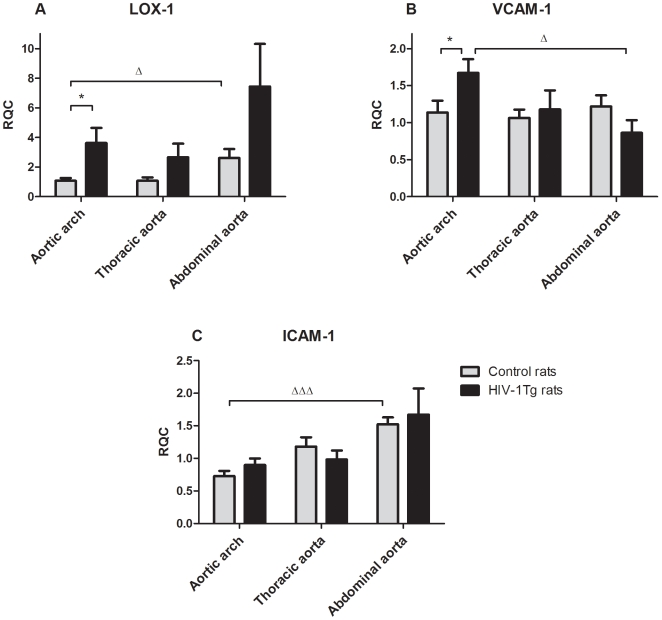
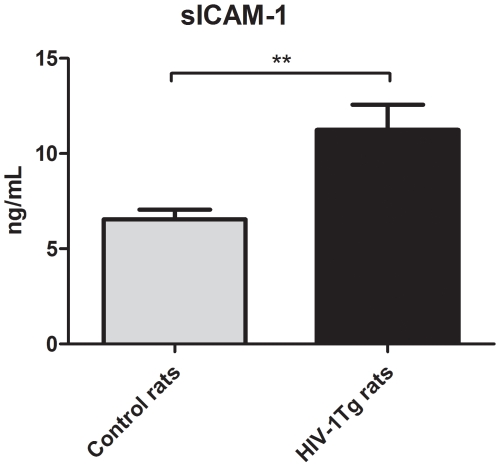
METHODOLOGY/PRINCIPAL FINDINGS: We evaluated gene expression of lectin-like oxidized-low-density-lipoprotein receptor-1 (LOX-1), vascular cell adhesion molecule-1 (VCAM-1), and intercellular adhesion molecule-1 (ICAM-1) in HIV-1 transgenic (HIV-1Tg) rats; these genes are all thought to play important roles in early atherogenesis. Furthermore, the plasma level of sICAM-1 was measured. We found that gene expressions of LOX-1 and VCAM-1 were higher in the aortic arch of HIV-1Tg rats compared to controls. Also, the level of sICAM-1 was elevated in the HIV-1Tg rats compared to controls, but the ICAM-1 gene expression profile did not show any differences between the groups.
CONCLUSIONS/SIGNIFICANCE: HIV-1Tg rats have gene expression patterns indicating endothelial dysfunction and accelerated atherosclerosis in aorta, suggesting that HIV-infection per se may cause atherosclerosis. This transgenic rat model may be a very promising model for further studies of the pathophysiology behind HIV-associated cardiovascular disease.
已观察到 HIV 感染患者动脉粥样硬化性心血管疾病的患病率增加。这种加速动脉粥样硬化的原因存在争议。由于临床研究受到多种风险因素的复杂性和硬终点发生率低的影响,动物模型研究可能是有吸引力的替代方法。
方法/主要发现:我们评估了 HIV-1 转基因(HIV-1Tg)大鼠中凝集素样氧化型低密度脂蛋白受体-1(LOX-1)、血管细胞黏附分子-1(VCAM-1)和细胞间黏附分子-1(ICAM-1)的基因表达;这些基因都被认为在早期动脉粥样硬化形成中发挥重要作用。此外,还测量了 sICAM-1 的血浆水平。我们发现,与对照组相比,HIV-1Tg 大鼠主动脉弓中的 LOX-1 和 VCAM-1 基因表达更高。此外,与对照组相比,HIV-1Tg 大鼠的 sICAM-1 水平升高,但两组间的 ICAM-1 基因表达谱没有差异。
结论/意义:HIV-1Tg 大鼠具有表明主动脉内皮功能障碍和动脉粥样硬化加速的基因表达模式,表明 HIV 感染本身可能导致动脉粥样硬化。这种转基因大鼠模型可能是进一步研究 HIV 相关心血管疾病背后的病理生理学的非常有前途的模型。