Department of International Health, Immunology and Microbiology, Faculty of Health, University of Copenhagen, Øster Farimagsgade 5, PO Box 2099, 1014 Copenhagen K, Denmark.
Environ Health. 2009 Dec 16;8:57. doi: 10.1186/1476-069X-8-57.
For centuries farmers in Vietnam have fertilized their fields with human excreta collected directly from their household latrines. Contrary to the official guideline of six-month storage, the households usually only store human excreta for three to four months before use, since this is the length of time that farmers have available to produce fertilizer between two cropping seasons. This study aimed to investigate whether hygienically safe fertilizer could be produced in the latrines within this period of time.
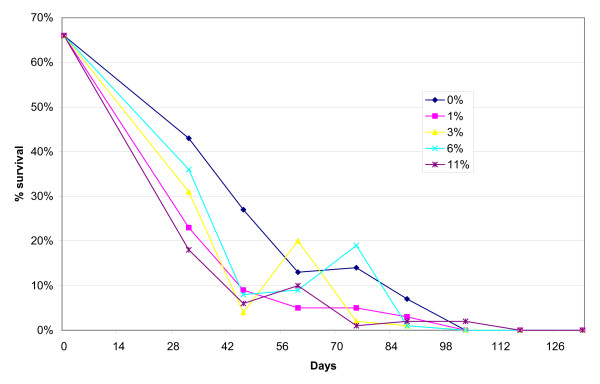
By inoculating eggs of the helminth parasite indicator Ascaris suum into heaps of human excreta, a die-off experiment was conducted under conditions similar to those commonly used in Vietnamese latrines. Half a ton of human excreta was divided into five heaps containing increasing concentrations of lime from 0% to 11%.
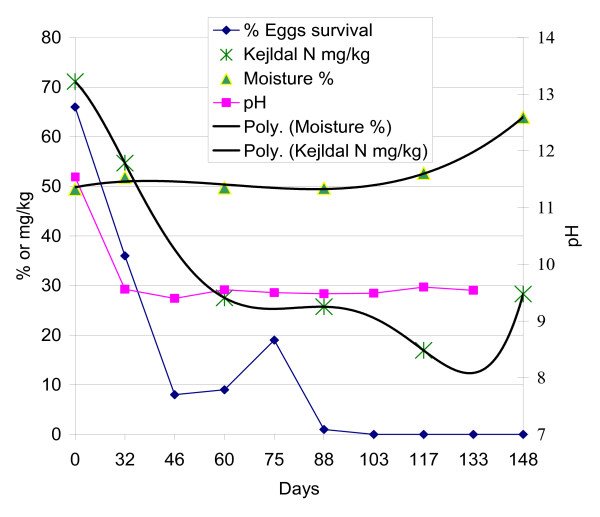
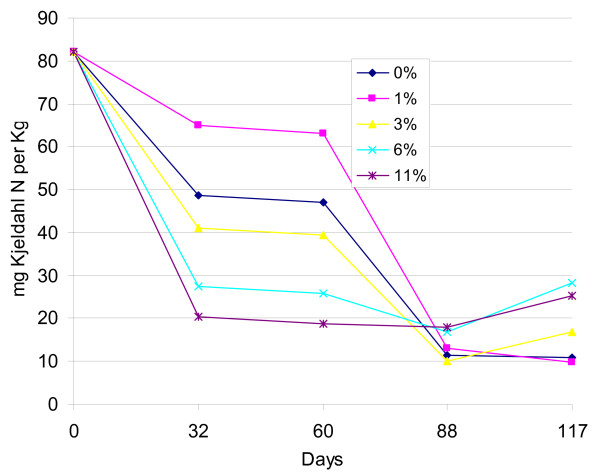
Regardless of the starting pH, which varied from 9.4 to 11.6, a >99% die-off of eggs was obtained after 105 to 117 days of storage for all lime concentrations and 97% of eggs were non-viable after 88 days of storage. The most critical parameter found to determine the die-off process was the amount of ammonia (urine) in the excreta which indicates that longer storage periods are needed for parasite egg die-off if urine is separated from the excreta.
By inactivating >99% of all A. suum eggs in human excreta during a storage period of only three months the commonly used Double Vault Composting (DVC) latrine, in which urine is not separated, could therefore potentially provide a hygienic acceptable fertilizer.
几个世纪以来,越南的农民一直用从自家厕所直接收集的人类粪便来给农田施肥。与官方规定的六个月储存期相反,农户通常只储存三到四个月的人类粪便就会使用,因为这是农民在两个作物季节之间生产肥料的时间长度。本研究旨在调查在这段时间内,厕所内是否可以生产出卫生安全的肥料。
通过将蛔虫指示性寄生虫卵 Ascaris suum 接种到人类粪便堆中,在类似于越南厕所中常用的条件下进行了死亡实验。半吨人类粪便分为五堆,每堆含有从 0%到 11%的石灰递增浓度。
无论起始 pH 值(9.4 至 11.6)如何,在所有石灰浓度下,储存 105 至 117 天后,卵的死亡率均>99%,而在储存 88 天后,97%的卵无法存活。发现决定死亡过程的最关键参数是粪便中氨(尿液)的含量,这表明如果尿液与粪便分离,则寄生虫卵死亡需要更长的储存时间。
通过在仅三个月的储存期内使人类粪便中所有 A. suum 卵的死亡率达到>99%,因此,常用的不分离尿液的双坑式堆肥(DVC)厕所可以提供卫生可接受的肥料。