Rovira Aitor, Swapp David, Spanlang Bernhard, Slater Mel
Virtual Environments and Computer Graphics, Department of Computer Science, University College London London, UK.
Front Behav Neurosci. 2009 Dec 23;3:59. doi: 10.3389/neuro.08.059.2009. eCollection 2009.
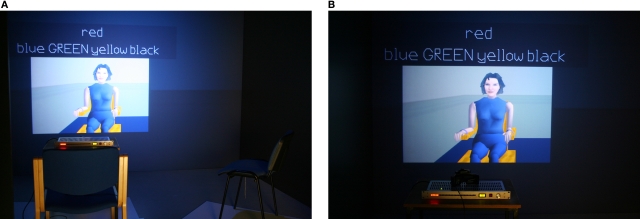
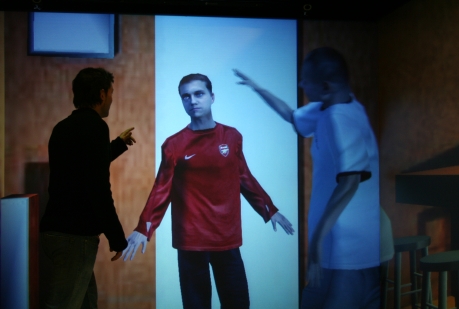
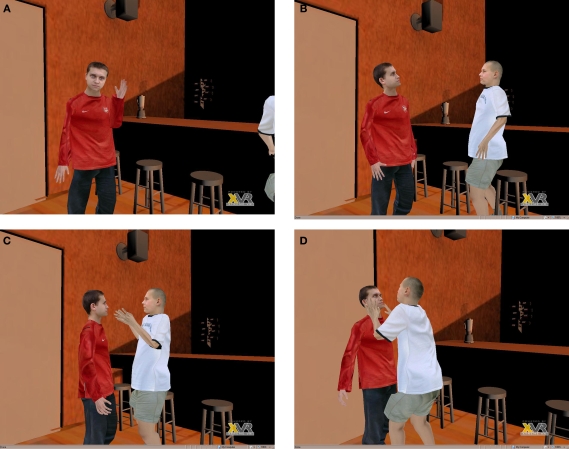
This paper reviews experimental methods for the study of the responses of people to violence in digital media, and in particular considers the issues of internal validity and ecological validity or generalisability of results to events in the real world. Experimental methods typically involve a significant level of abstraction from reality, with participants required to carry out tasks that are far removed from violence in real life, and hence their ecological validity is questionable. On the other hand studies based on field data, while having ecological validity, cannot control multiple confounding variables that may have an impact on observed results, so that their internal validity is questionable. It is argued that immersive virtual reality may provide a unification of these two approaches. Since people tend to respond realistically to situations and events that occur in virtual reality, and since virtual reality simulations can be completely controlled for experimental purposes, studies of responses to violence within virtual reality are likely to have both ecological and internal validity. This depends on a property that we call 'plausibility' - including the fidelity of the depicted situation with prior knowledge and expectations. We illustrate this with data from a previously published experiment, a virtual reprise of Stanley Milgram's 1960s obedience experiment, and also with pilot data from a new study being developed that looks at bystander responses to violent incidents.
本文回顾了研究人们对数字媒体中暴力行为反应的实验方法,尤其考虑了内部效度以及结果对现实世界事件的生态效度或可推广性问题。实验方法通常涉及对现实的高度抽象,要求参与者执行与现实生活中的暴力行为相去甚远的任务,因此其生态效度值得怀疑。另一方面,基于实地数据的研究虽然具有生态效度,但无法控制可能影响观察结果的多个混杂变量,因此其内部效度也值得怀疑。有人认为沉浸式虚拟现实可能会将这两种方法统一起来。由于人们往往会对虚拟现实中发生的情况和事件做出真实反应,而且虚拟现实模拟可以出于实验目的进行完全控制,因此对虚拟现实中的暴力行为反应进行的研究可能同时具有生态效度和内部效度。这取决于我们称之为“似真性”的一种特性——包括所描绘情境与先验知识和预期的逼真程度。我们用之前发表的一项实验数据、斯坦利·米尔格拉姆20世纪60年代服从实验的虚拟重演,以及一项正在开展的关于旁观者对暴力事件反应的新研究的试点数据来说明这一点。