Department of Chemistry, The Johns Hopkins University, Baltimore, Maryland 21218, USA.
Inorg Chem. 2010 Apr 19;49(8):3629-45. doi: 10.1021/ic9020993.
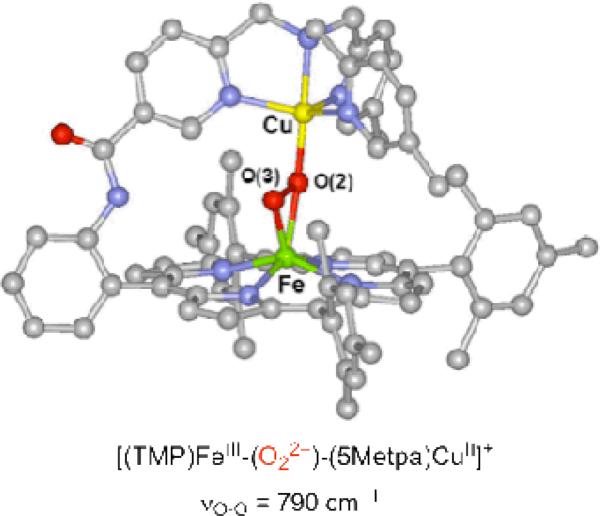
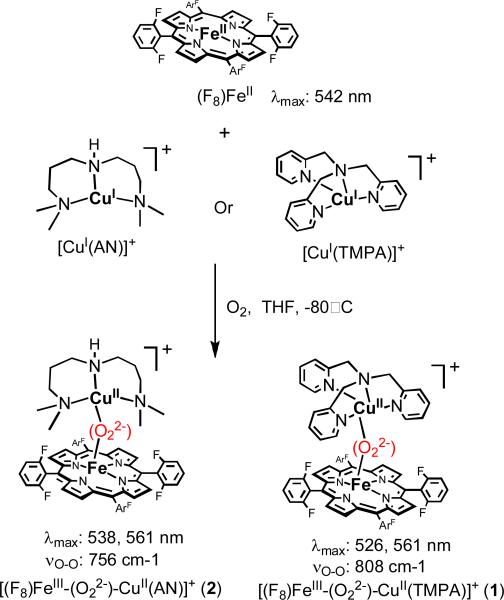
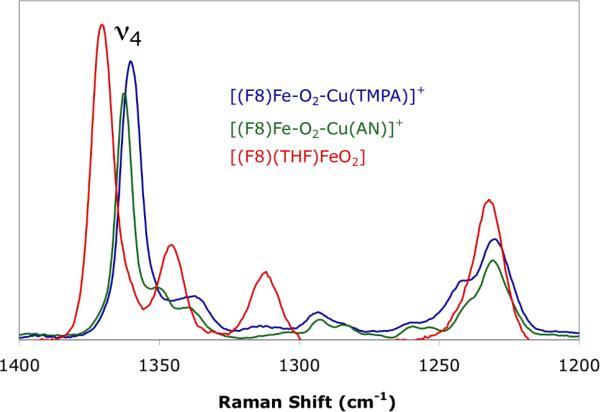
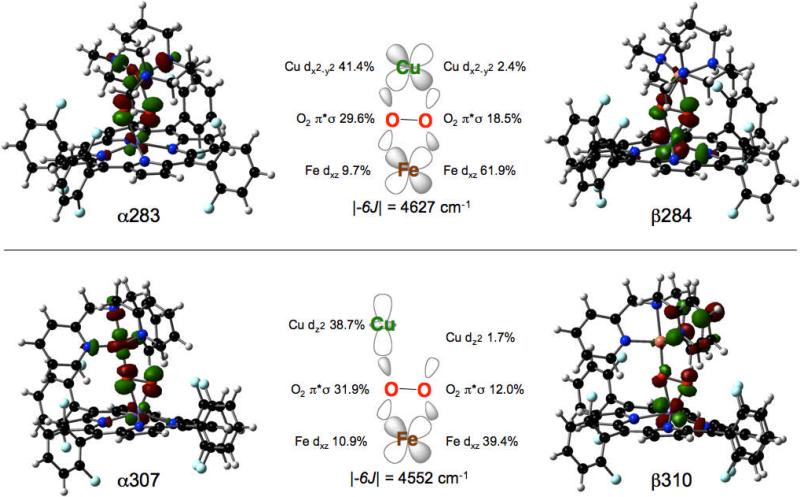
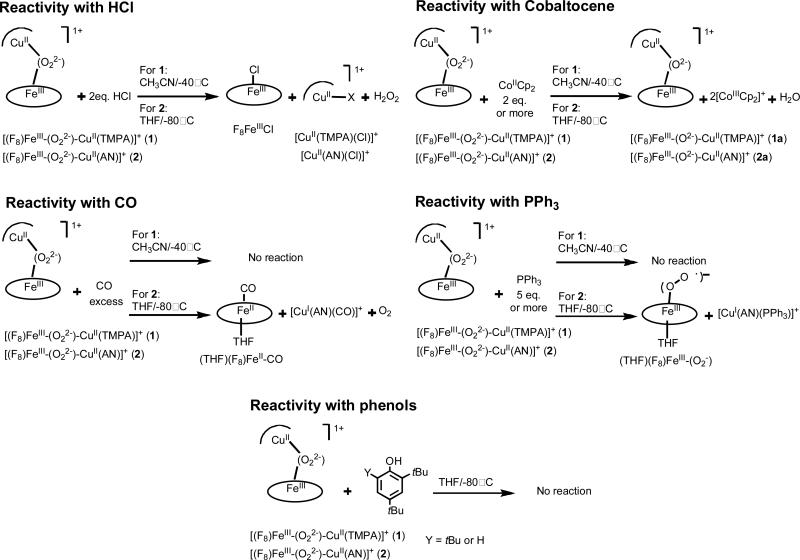
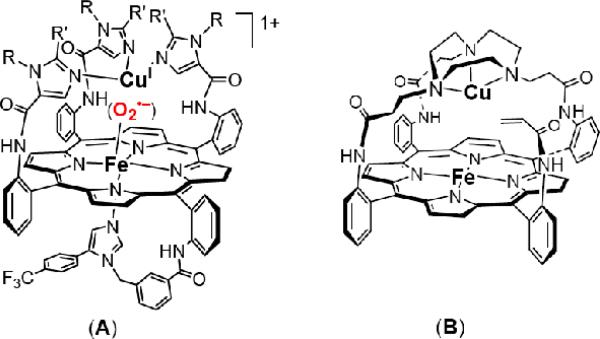
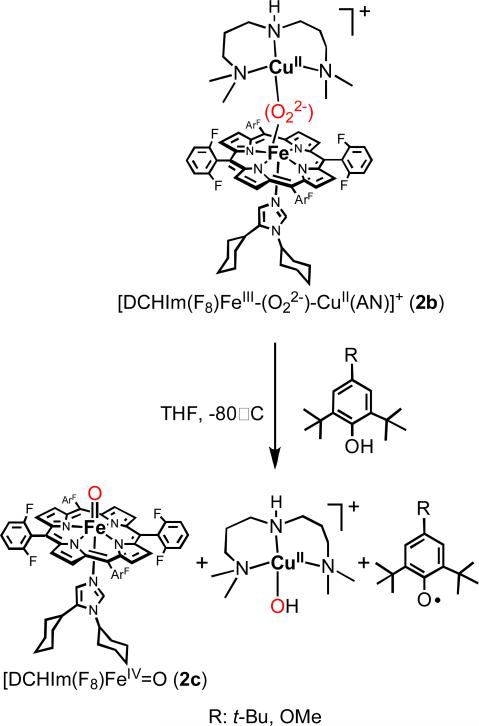
The nature of the ligand is an important aspect of controlling the structure and reactivity in coordination chemistry. In connection with our study of heme-copper-oxygen reactivity relevant to cytochrome c oxidase dioxygen-reduction chemistry, we compare the molecular and electronic structures of two high-spin heme-peroxo-copper Fe(III)O(2)(2-)Cu(II) complexes containing N(4) tetradentate (1) or N(3) tridentate (2) copper ligands. Combining previously reported and new resonance Raman and EXAFS data coupled to density functional theory calculations, we report a geometric structure and more complete electronic description of the high-spin heme-peroxo-copper complexes 1 and 2, which establish mu-(O(2)(2-)) side-on to the Fe(III) and end-on to Cu(II) (mu-eta(2):eta(1)) binding for the complex 1 but side-on/side-on (mu-eta(2):eta(2)) mu-peroxo coordination for the complex 2. We also compare and summarize the differences and similarities of these two complexes in their reactivity toward CO, PPh(3), acid, and phenols. The comparison of a new X-ray structure of mu-oxo complex 2a with the previously reported 1a X-ray structure, two thermal decomposition products respectively of 2 and 1, reveals a considerable difference in the Fe-O-Cu angle between the two mu-oxo complexes ( angleFe-O-Cu = 178.2 degrees in 1a and angleFe-O-Cu = 149.5 degrees in 2a). The reaction of 2 with 1 equiv of an exogenous nitrogen-donor axial base leads to the formation of a distinctive low-temperature-stable, low-spin heme-dioxygen-copper complex (2b), but under the same conditions, the addition of an axial base to 1 leads to the dissociation of the heme-peroxo-copper assembly and the release of O(2). 2b reacts with phenols performing H-atom (e(-) + H(+)) abstraction resulting in O-O bond cleavage and the formation of high-valent ferryl [Fe(IV)=O] complex (2c). The nature of 2c was confirmed by a comparison of its spectroscopic features and reactivity with those of an independently prepared ferryl complex. The phenoxyl radical generated by the H-atom abstraction was either (1) directly detected by electron paramagnetic resonance spectroscopy using phenols that produce stable radicals or (2) indirectly detected by the coupling product of two phenoxyl radicals.
配体的性质是控制配位化学结构和反应性的一个重要方面。在我们研究与细胞色素 c 氧化酶双氧还原化学相关的血红素-铜-氧反应性时,我们比较了两种高自旋血红素过氧-铜 Fe(III)O(2)(2-)Cu(II)配合物的分子和电子结构,它们分别含有 N(4)四齿 (1) 或 N(3)三齿 (2) 铜配体。结合以前报道的和新的共振拉曼和 EXAFS 数据以及密度泛函理论计算,我们报告了高自旋血红素过氧-铜配合物 1 和 2 的几何结构和更完整的电子描述,这些结构确定了复合物 1 中过氧 (O(2)(2-)) 侧接于 Fe(III),端接于 Cu(II)(mu-eta(2):eta(1)),而复合物 2 中过氧则为侧接/侧接(mu-eta(2):eta(2))mu-过氧配位。我们还比较和总结了这两个配合物在与 CO、PPh(3)、酸和酚反应方面的异同。与之前报道的 1a X 射线结构相比,mu-氧复合物 2a 的新 X 射线结构以及 2 和 1 的两个热分解产物的比较表明,两个 mu-氧复合物的 Fe-O-Cu 角有很大差异(复合物 1a 中 angleFe-O-Cu = 178.2 度,复合物 2a 中 angleFe-O-Cu = 149.5 度)。2 与 1 当量的外源氮供体轴向配体反应生成独特的低温稳定的低自旋血红素-二氧-铜配合物(2b),但在相同条件下,向 1 中添加轴向配体导致血红素-过氧-铜组装体的解离和 O(2)的释放。2b 与酚反应,进行 H 原子(e(-) + H(+)) 攫取,导致 O-O 键断裂,并形成高价铁氧 [Fe(IV)=O] 配合物(2c)。2c 的性质通过与独立制备的铁氧配合物的光谱特征和反应性进行比较来确认。通过使用产生稳定自由基的酚的电子顺磁共振光谱直接检测到由 H 原子攫取产生的酚氧基自由基,或者(2)通过两个酚氧基自由基的偶联产物间接检测到。