Department of Cell and Developmental Biology, University of Michigan Medical School, Ann Arbor, Michigan 48109, USA.
Nat Cell Biol. 2010 Jul;12(7):703-10. doi: 10.1038/ncb2073. Epub 2010 Jun 6.
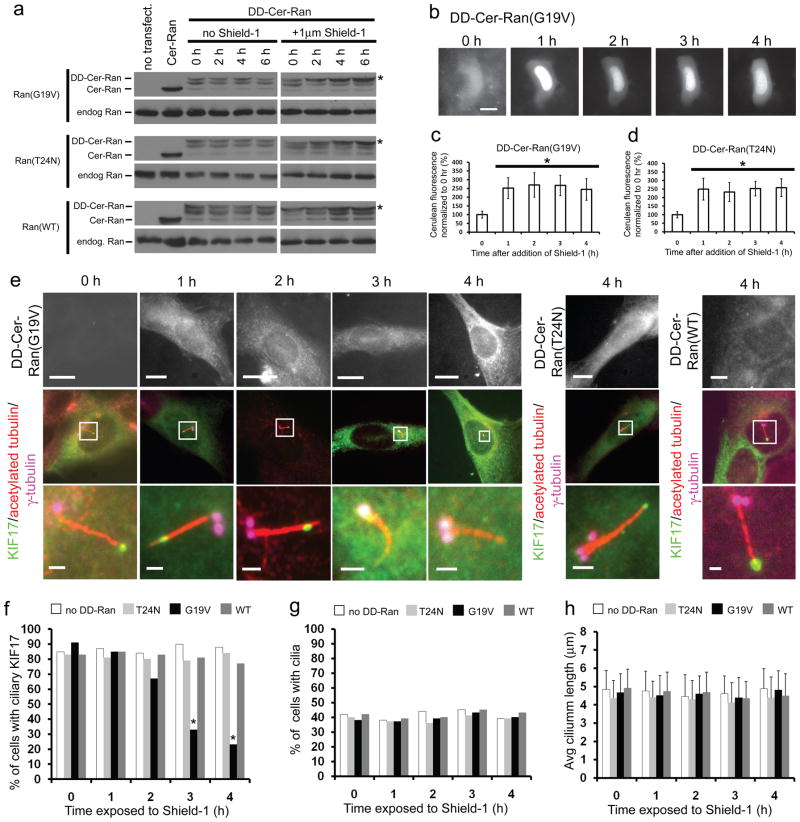
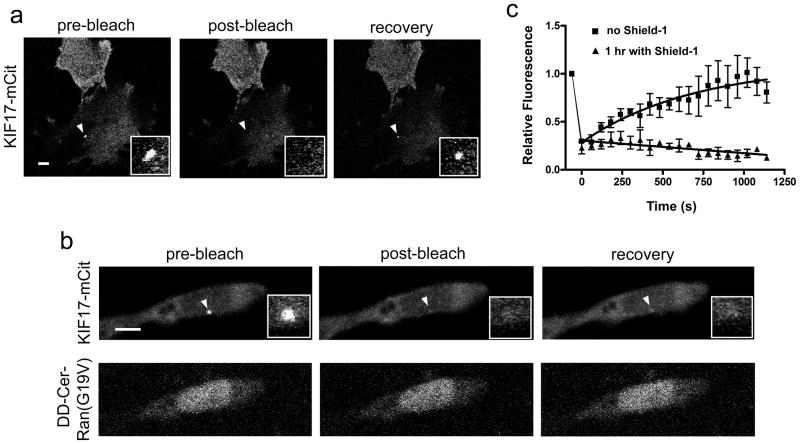
The biogenesis, maintenance and function of primary cilia are controlled through intraflagellar transport (IFT) driven by two kinesin-2 family members, the heterotrimeric KIF3A/KIF3B/KAP complex and the homodimeric KIF17 motor. How these motors and their cargoes gain access to the ciliary compartment is poorly understood. Here, we identify a ciliary localization signal (CLS) in the KIF17 tail domain that is necessary and sufficient for ciliary targeting. Similarities between the CLS and classic nuclear localization signals (NLSs) suggest that similar mechanisms regulate nuclear and ciliary import. We hypothesize that ciliary targeting of KIF17 is regulated by a ciliary-cytoplasmic gradient of the small GTPase Ran, with high levels of GTP-bound Ran (RanGTP) in the cilium. Consistent with this, cytoplasmic expression of GTP-locked Ran(G19V) disrupts the gradient and abolishes ciliary entry of KIF17. Furthermore, KIF17 interacts with the nuclear import protein importin-beta2 in a manner dependent on the CLS and inhibited by RanGTP. We propose that Ran has a global role in regulating cellular compartmentalization by controlling the shuttling of cytoplasmic proteins into nuclear and ciliary compartments.
原发性纤毛的生物发生、维持和功能受到由两种驱动蛋白-2 家族成员(异源三聚体 KIF3A/KIF3B/KAP 复合物和同源二聚体 KIF17 马达)驱动的鞭毛内运输(IFT)的控制。这些马达及其货物如何进入纤毛隔室尚不清楚。在这里,我们在 KIF17 尾部结构域中鉴定出一个纤毛定位信号(CLS),该信号对于纤毛靶向是必需和充分的。CLS 与经典核定位信号(NLS)之间的相似性表明,类似的机制调节核和纤毛的输入。我们假设 KIF17 的纤毛靶向受小 GTPase Ran 的纤毛细胞质梯度调节,Ran 的高浓度 GTP 结合形式(RanGTP)存在于纤毛中。与这一假设一致的是,细胞质中表达的 GTP 锁定的 Ran(G19V)破坏了梯度并阻止了 KIF17 的纤毛进入。此外,KIF17 以依赖于 CLS 并受 RanGTP 抑制的方式与核输入蛋白 importin-β2 相互作用。我们提出,Ran 通过控制细胞质蛋白进入核和纤毛隔室的穿梭,在调节细胞区室化方面具有全局作用。