Division of Bioinformatics, State Key Laboratory of Plant Physiology and Biochemistry, College of Biological Sciences, China Agricultural University, Beijing 100193, China.
Bioinformatics. 2010 Jun 15;26(12):i168-74. doi: 10.1093/bioinformatics/btq189.
Circadian rhythms are prevalent in most organisms. Identification of circadian-regulated genes is a crucial step in discovering underlying pathways and processes that are clock-controlled. Such genes are largely detected by searching periodic patterns in microarray data. However, temporal gene expression profiles usually have a short time-series with low sampling frequency and high levels of noise. This makes circadian rhythmic analysis of temporal microarray data very challenging.
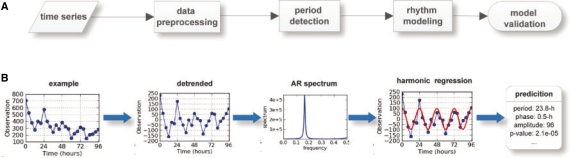
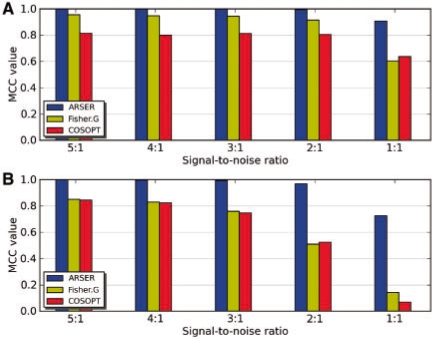
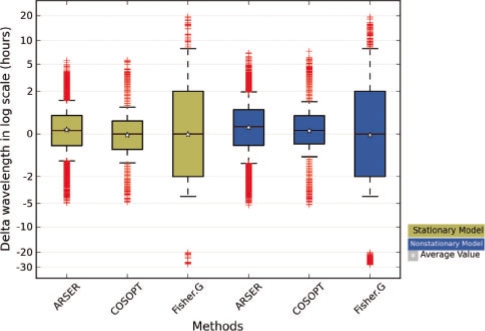
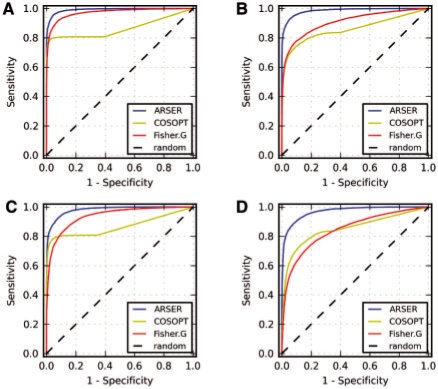
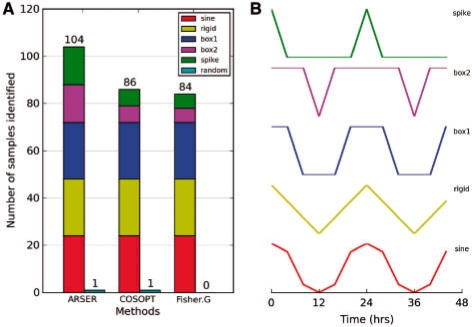
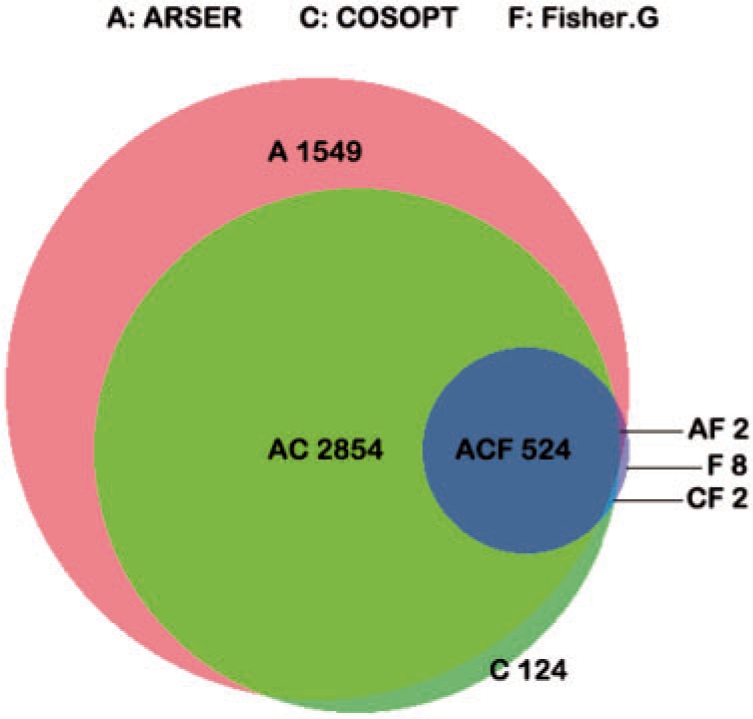
We propose an algorithm named ARSER, which combines time domain and frequency domain analysis for extracting and characterizing rhythmic expression profiles from temporal microarray data. ARSER employs autoregressive spectral estimation to predict an expression profile's periodicity from the frequency spectrum and then models the rhythmic patterns by using a harmonic regression model to fit the time-series. ARSER describes the rhythmic patterns by four parameters: period, phase, amplitude and mean level, and measures the multiple testing significance by false discovery rate q-value. When tested on well defined periodic and non-periodic short time-series data, ARSER was superior to two existing and widely-used methods, COSOPT and Fisher's G-test, during identification of sinusoidal and non-sinusoidal periodic patterns in short, noisy and non-stationary time-series. Finally, analysis of Arabidopsis microarray data using ARSER led to identification of a novel set of previously undetected non-sinusoidal periodic transcripts, which may lead to new insights into molecular mechanisms of circadian rhythms.
ARSER is implemented by Python and R. All source codes are available from http://bioinformatics.cau.edu.cn/ARSER.
昼夜节律在大多数生物中都很普遍。鉴定昼夜节律调节基因是发现受时钟控制的潜在途径和过程的关键步骤。这些基因主要通过在微阵列数据中搜索周期性模式来检测。然而,时间基因表达谱通常具有短时间序列、低采样频率和高水平噪声。这使得对时间微阵列数据的昼夜节律分析极具挑战性。
我们提出了一种名为 ARSER 的算法,该算法结合了时域和频域分析,用于从时间微阵列数据中提取和描述节律表达谱。ARSER 采用自回归谱估计从频谱中预测表达谱的周期性,然后使用谐波回归模型对节律模式进行建模以拟合时间序列。ARSER 通过四个参数来描述节律模式:周期、相位、幅度和平均水平,并通过错误发现率 q 值来衡量多重检验的显著性。在对定义明确的周期性和非周期性短时间序列数据进行测试时,ARSER 在识别短、噪声和非平稳时间序列中的正弦和非正弦周期性模式方面优于两种现有的广泛使用的方法,即 COSOPT 和 Fisher 的 G 检验。最后,使用 ARSER 对拟南芥微阵列数据进行分析,鉴定出了一组以前未检测到的新的非正弦周期性转录本,这可能为昼夜节律的分子机制提供新的见解。
ARSER 是用 Python 和 R 实现的。所有源代码都可以从 http://bioinformatics.cau.edu.cn/ARSER 获得。