Division of Global Health IHCAR, Department of Public Health Sciences, Karolinska Institutet, 171 77 Stockholm, Sweden.
Malar J. 2010 Jun 18;9:173. doi: 10.1186/1475-2875-9-173.
Insecticide-treated nets (ITN) and long-lasting insecticidal treated nets (LLIN) are important means of malaria prevention. Although there is consensus regarding their importance, there is uncertainty as to which delivery strategies are optimal for dispensing these life saving interventions. A targeted mass distribution of free LLINs to children under five and pregnant women was implemented in Zanzibar between August 2005 and January 2006. The outcomes of this distribution among children under five were evaluated, four to nine months after implementation.
Two cross-sectional surveys were conducted in May 2006 in two districts of Zanzibar: Micheweni (MI) on Pemba Island and North A (NA) on Unguja Island. Household interviews were conducted with 509 caretakers of under-five children, who were surveyed for socio-economic status, the net distribution process, perceptions and use of bed nets. Each step in the distribution process was assessed in all children one to five years of age for unconditional and conditional proportion of success. System effectiveness (the accumulated proportion of success) and equity effectiveness were calculated, and predictors for LLIN use were identified.
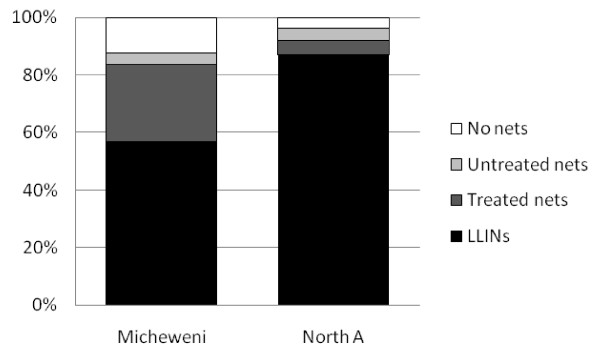
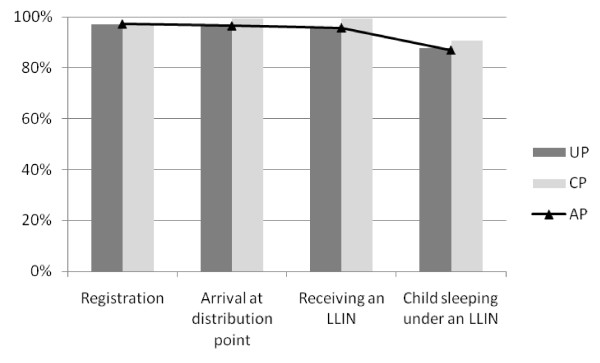
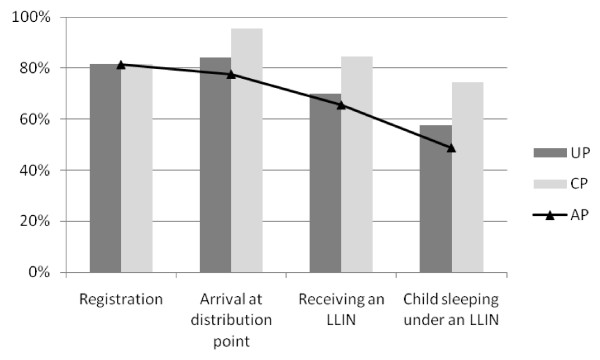
The overall proportion of children under five sleeping under any type of treated net was 83.7% (318/380) in MI and 91.8% (357/389) in NA. The LLIN usage was 56.8% (216/380) in MI and 86.9% (338/389) in NA. Overall system effectiveness was 49% in MI and 87% in NA, and equity was found in the distribution scale-up in NA. In both districts, the predicting factor of a child sleeping under an LLIN was caretakers thinking that LLINs are better than conventional nets (OR = 2.8, p = 0.005 in MI and 2.5, p = 0.041 in NA), in addition to receiving an LLIN (OR = 4.9, p < 0.001 in MI and in OR = 30.1, p = 0.001 in NA).
Targeted free mass distribution of LLINs can result in high and equitable bed net coverage among children under five. However, in order to sustain high effective coverage, there is need for complimentary distribution strategies between mass distribution campaigns. Considering the community's preferences prior to a mass distribution and addressing the communities concerns through information, education and communication, may improve the LLIN usage.
经杀虫剂处理的蚊帐(ITN)和长效驱虫蚊帐(LLIN)是预防疟疾的重要手段。尽管人们普遍认为它们很重要,但对于分发这些救生干预措施的最佳策略仍存在不确定性。2005 年 8 月至 2006 年 1 月,桑给巴尔在奔巴岛的米钦维和乌干达岛的北 A 区为五岁以下儿童和孕妇实施了有针对性的免费 LLIN 大规模分发。对实施后四个至九个月的五岁以下儿童的分发结果进行了评估。
2006 年 5 月在桑给巴尔的两个区进行了两项横断面调查:奔巴岛的米钦维和乌干达岛的北 A。对 509 名五岁以下儿童的照顾者进行了家庭访谈,调查了社会经济地位、蚊帐分发过程、对蚊帐的看法和使用情况。对所有一至五岁的儿童进行了分配过程的每一步评估,以获得无条件和有条件的成功率。计算了系统效率(累计成功率)和公平效率,并确定了 LLIN 使用的预测因素。
米钦维和北 A 地区五岁以下儿童中,有 83.7%(318/380)的儿童在任何类型的处理过的蚊帐中睡觉,91.8%(357/389)的儿童在北 A 地区。米钦维和北 A 地区的 LLIN 使用率分别为 56.8%(216/380)和 86.9%(338/389)。米钦维和北 A 的总体系统效率分别为 49%和 87%,并且在北 A 的分配扩展中发现了公平性。在这两个地区,儿童在 LLIN 下睡觉的预测因素是照顾者认为 LLIN 比传统蚊帐更好(OR=2.8,p=0.005 在 MI 和 OR=2.5,p=0.041 在 NA),以及收到 LLIN(OR=4.9,p<0.001 在 MI 和 OR=30.1,p=0.001 在 NA)。
有针对性的免费大规模 LLIN 分发可以在五岁以下儿童中实现高且公平的蚊帐覆盖率。然而,为了维持高的有效覆盖率,需要在大规模分发运动之间采用补充分发策略。在大规模分发之前考虑社区的偏好,并通过信息、教育和宣传来解决社区的关切,可能会提高 LLIN 的使用率。