National Institute for Nutrition and Food Safety, Chinese Center for Disease Control and Prevention, Beijing, China.
Diabetes. 2010 Oct;59(10):2400-6. doi: 10.2337/db10-0385. Epub 2010 Jul 9.
Early developmental adaptations in response to undernutrition may play an essential role in susceptibility to type 2 diabetes, particularly for those experiencing a "mismatched rich nutritional environment" in later life. We examined the associations of exposure to the Chinese famine (1959-1961) during fetal life and childhood with the risk of hyperglycemia and type 2 diabetes in adulthood.
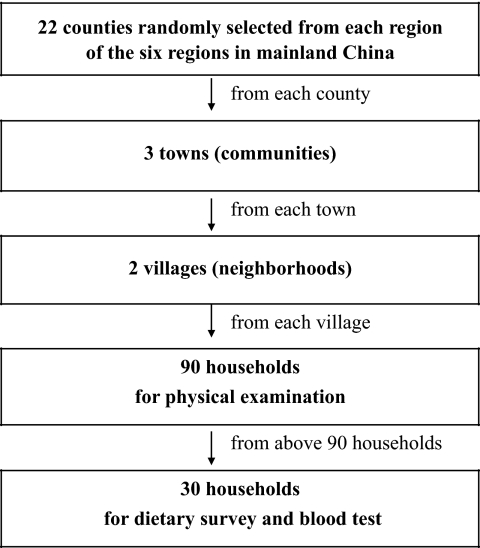
We used the data for 7,874 rural adults born between 1954 and 1964 in selected communities from the cross-sectional 2002 China National Nutrition and Health Survey. Hyperglycemia was defined as fasting plasma glucose ≥6.1 mmol/l and/or 2-h plasma glucose ≥7.8 mmol/l and/or a previous clinical diagnosis of type 2 diabetes.
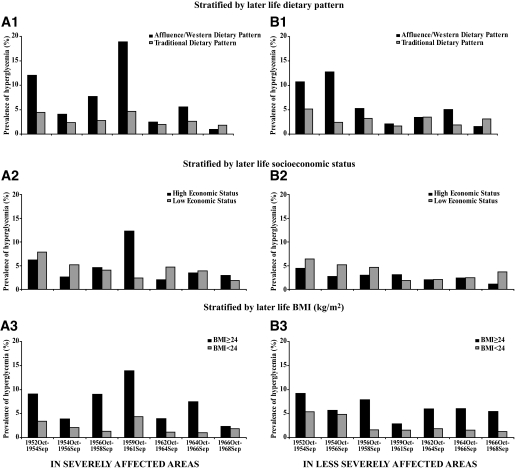
Prevalences of hyperglycemia among adults in nonexposed, fetal exposed, early-childhood, mid-childhood, and late-childhood exposed cohorts were 2.4%, 5.7%, 3.9%, 3.4%, and 5.9%, respectively. In severely affected famine areas, fetal-exposed subjects had an increased risk of hyperglycemia compared with nonexposed subjects (odds ratio = 3.92; 95% CI: 1.64-9.39; P = 0.002); this difference was not observed in less severely affected famine areas (odds ratio = 0.57; 95% CI: 0.25-1.31; P = 0.185). The odds ratios were significantly different between groups from the severe and less severe famine areas (P for interaction = 0.001). In severely affected famine areas, fetal-exposed subjects who followed an affluent/Western dietary pattern (odds ratios = 7.63; 95% CI: 2.41-24.1; P = 0.0005) or who had a higher economic status in later life experienced a substantially elevated risk of hyperglycemia (odds ratios = 6.20; 95% CI: 2.08-18.5; P = 0.001).
Fetal exposure to the severe Chinese famine increases the risk of hyperglycemia in adulthood. This association appears to be exacerbated by a nutritionally rich environment in later life.
胎儿期和儿童期对营养不良的早期发育适应,可能在 2 型糖尿病易感性中发挥重要作用,尤其是对那些在以后生活中经历“营养环境不匹配”的人。我们研究了胎儿期和儿童期暴露于中国饥荒(1959-1961 年)与成年人发生高血糖和 2 型糖尿病风险之间的关系。
我们使用了来自 2002 年中国全国营养与健康调查的特定社区中,1954 年至 1964 年出生的 7874 名农村成年人的数据。高血糖定义为空腹血糖≥6.1mmol/l 和/或 2 小时后血糖≥7.8mmol/l 和/或以前临床诊断为 2 型糖尿病。
在未暴露、胎儿暴露、幼儿期、儿童中期和儿童晚期暴露队列中,成年人的高血糖患病率分别为 2.4%、5.7%、3.9%、3.4%和 5.9%。在受饥荒严重影响的地区,与未暴露组相比,胎儿暴露组的高血糖风险增加(比值比=3.92;95%可信区间:1.64-9.39;P=0.002);而在受饥荒影响较小的地区,这种差异并不明显(比值比=0.57;95%可信区间:0.25-1.31;P=0.185)。严重和轻度受饥荒影响的地区之间的组间差异有统计学意义(交互作用 P 值=0.001)。在受饥荒严重影响的地区,胎儿暴露且遵循富裕/西方饮食模式(比值比=7.63;95%可信区间:2.41-24.1;P=0.0005)或在以后的生活中经济地位较高的胎儿暴露者,高血糖的风险显著升高(比值比=6.20;95%可信区间:2.08-18.5;P=0.001)。
胎儿期暴露于中国严重饥荒会增加成年后患高血糖的风险。这种关联似乎因以后生活中丰富的营养环境而加剧。