Centre for Infectious Disease Control, National Institute for Public Health and the Environment, Bilthoven, The Netherlands.
PLoS One. 2010 Jul 7;5(7):e11442. doi: 10.1371/journal.pone.0011442.
Despite impressive advances in our understanding of the biology of novel influenza A(H1N1) virus, little is as yet known about its transmission efficiency in close contact places such as households, schools, and workplaces. These are widely believed to be key in supporting propagating spread, and it is therefore of importance to assess the transmission levels of the virus in such settings.
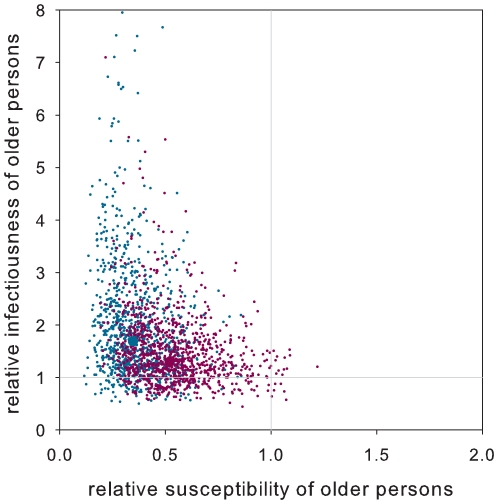
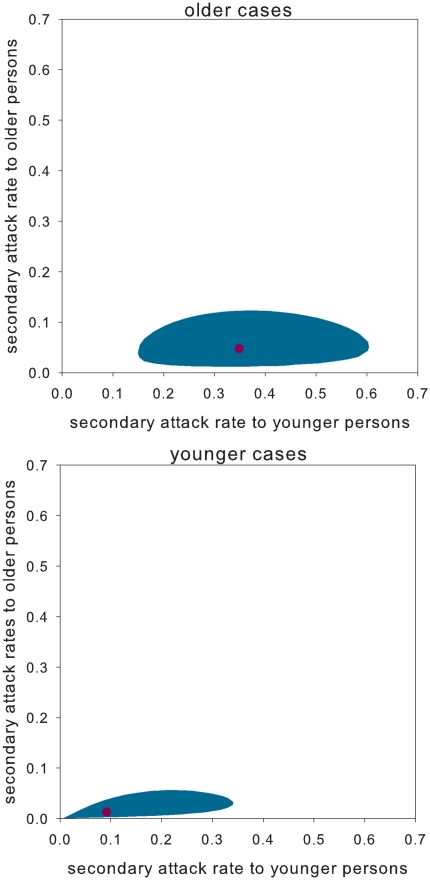
METHODOLOGY/PRINCIPAL FINDINGS: We estimate the transmissibility of novel influenza A(H1N1) in 47 households in the Netherlands using stochastic epidemic models. All households contained a laboratory confirmed index case, and antiviral drugs (oseltamivir) were given to both the index case and other households members within 24 hours after detection of the index case. Among the 109 household contacts there were 9 secondary infections in 7 households. The overall estimated secondary attack rate is low (0.075, 95%CI: 0.037-0.13). There is statistical evidence indicating that older persons are less susceptible to infection than younger persons (relative susceptibility of older persons: 0.11, 95%CI: 0.024-0.43. Notably, the secondary attack rate from an older to a younger person is 0.35 (95%CI: 0.14-0.61) when using an age classification of <or=12 versus >12 years, and 0.28 (95%CI: 0.12-0.50) when using an age classification of <or=18 versus >18 years.
CONCLUSIONS/SIGNIFICANCE: Our results indicate that the overall household transmission levels of novel influenza A(H1N1) in antiviral-treated households were low in the early stage of the epidemic. The relatively high rate of adult-to-child transmission indicates that control measures focused on this transmission route will be most effective in minimizing the total number of infections.
尽管我们对新型甲型 H1N1 流感病毒的生物学特性有了令人瞩目的了解,但对于其在家庭、学校和工作场所等密切接触场所的传播效率仍知之甚少。这些场所被广泛认为是支持病毒传播的关键,因此评估病毒在这些环境中的传播水平非常重要。
方法/主要发现:我们使用随机传染病模型来估计新型甲型 H1N1 在荷兰 47 个家庭中的传播能力。所有家庭都包含一个实验室确诊的索引病例,并且在发现索引病例后 24 小时内,向索引病例和其他家庭成员给予了抗病毒药物(奥司他韦)。在 109 名家庭接触者中,有 7 个家庭的 9 名接触者发生了继发感染。总体估计的继发感染率较低(0.075,95%置信区间:0.037-0.13)。有统计证据表明,老年人比年轻人不易感染(老年人的相对易感性:0.11,95%置信区间:0.024-0.43)。值得注意的是,当使用<or=12 岁与>12 岁的年龄分类时,从老年人到年轻人的继发感染率为 0.35(95%置信区间:0.14-0.61),当使用<or=18 岁与>18 岁的年龄分类时,继发感染率为 0.28(95%置信区间:0.12-0.50)。
结论/意义:我们的研究结果表明,在抗病毒治疗家庭中,新型甲型 H1N1 在家庭中的传播水平在疫情早期较低。成人向儿童传播的相对较高率表明,以这种传播途径为重点的控制措施将是减少总感染人数的最有效措施。