Centro de Biología Molecular Severo Ochoa, Consejo Superior de Investigaciones Científicas, Universidad Autónoma de Madrid, C/Nicolás Cabrera 1, Lab-107, Cantoblanco, 28049 Madrid, Spain.
Nucleic Acids Res. 2010 Dec;38(22):8001-14. doi: 10.1093/nar/gkq698. Epub 2010 Aug 10.
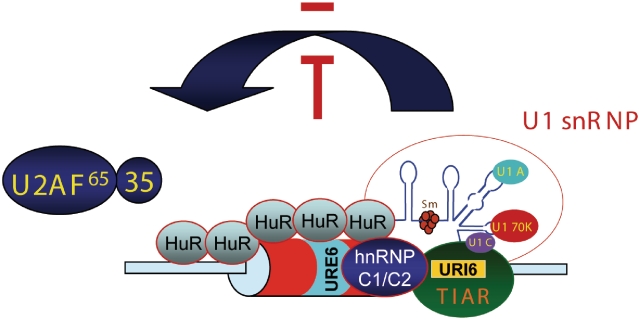
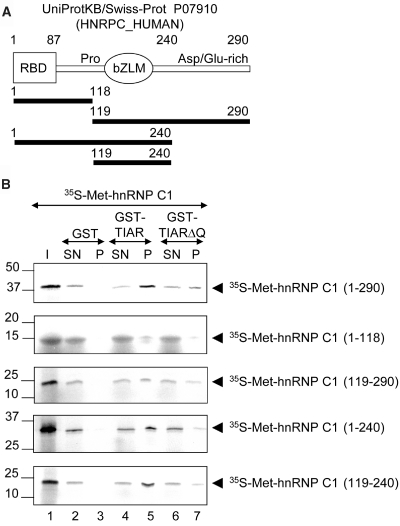
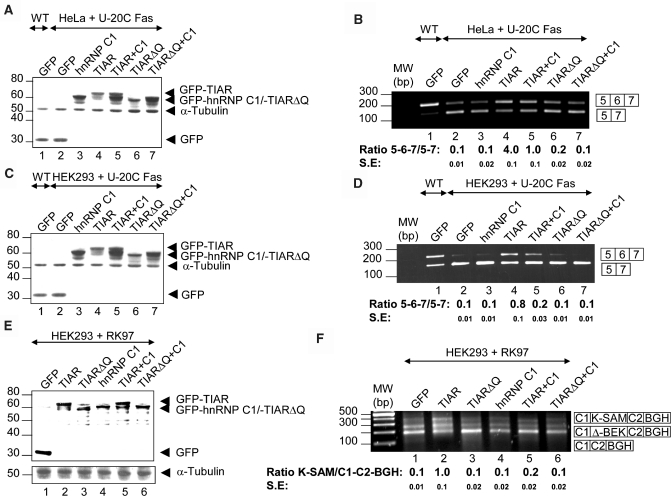
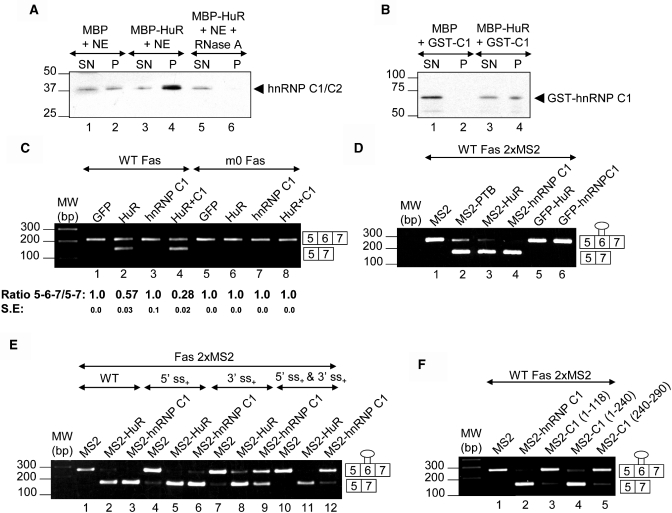
T-cell intracellular antigen (TIA)-proteins are known regulators of alternative pre-mRNA splicing. In this study, pull-down experiments and mass spectrometry indicate that TIAR/TIAL1 and hnRNP C1/C2 are associated in HeLa nuclear extracts. Co-immunoprecipitation and GST-pull-down assays confirmed this interaction. Interestingly, binding requires the glutamine-rich (Q-rich) C-terminal domain of TIAR and the leucine-rich plus acidic residues-rich C-terminal domains of hnRNP C1/C2. This interaction also occurs in an RNA-dependent manner. Recombinant GFP-TIAR and RFP-hnRNP C1 proteins display partial nuclear co-localization when overexpressed in HeLa cells, and this requires the Q-rich domain of TIAR. hnRNP C1 overexpression in the presence of rate-limiting amounts of TIAR in HeLa and HEK293 cells affects alternative splicing of Fas and FGFR2 minigenes, promoting Fas exon 6 and FGFR2 exon K-SAM skipping, respectively. The repressor activity of hnRNP C1 on Fas exon 6 splicing is mediated by Hu antigen R (HuR). Experiments involving tethering approaches showed that the repressor capacity of hnRNP C1 is associated with an exonic splicing silencer in Fas exon 6. This effect was reversed by splice-site strengthening and is linked to its basic leucine zipper-like motif. These results suggest that hnRNP C1/C2 acts as a bridge between HuR and TIAR to modulate alternative Fas splicing.
T 细胞内抗原(TIA)-蛋白是已知的可变剪接的前体 mRNA 调控因子。在这项研究中,下拉实验和质谱分析表明 TIAR/TIAL1 和 hnRNP C1/C2 存在于 HeLa 核提取物中。免疫共沉淀和 GST 下拉实验证实了这种相互作用。有趣的是,这种结合需要 TIAR 的富含谷氨酰胺(Q 富含)C 末端结构域和 hnRNP C1/C2 的富含亮氨酸和酸性残基的 C 末端结构域。这种相互作用也以 RNA 依赖性的方式发生。当在 HeLa 细胞中过表达时,重组 GFP-TIAR 和 RFP-hnRNP C1 蛋白显示出部分核共定位,这需要 TIAR 的 Q 富含结构域。hnRNP C1 在 HeLa 和 HEK293 细胞中过表达,同时存在有限量的 TIAR 时,会影响 Fas 和 FGFR2 小基因的可变剪接,分别促进 Fas 外显子 6 和 FGFR2 外显子 K-SAM 的跳过。hnRNP C1 对 Fas 外显子 6 剪接的抑制活性是由 Hu 抗原 R(HuR)介导的。涉及系留方法的实验表明,hnRNP C1 的抑制能力与 Fas 外显子 6 中的内含子剪接沉默子有关。这种效应被剪接位点增强所逆转,并且与它的碱性亮氨酸拉链样基序有关。这些结果表明,hnRNP C1/C2 作为 HuR 和 TIAR 之间的桥梁,调节 Fas 可变剪接。