Channing Laboratory, Department of Medicine, Brigham and Women's Hospital, and Harvard Medical School, Boston, Massachusetts, USA.
Mov Disord. 2010 Nov 15;25(15):2654-7. doi: 10.1002/mds.23256.
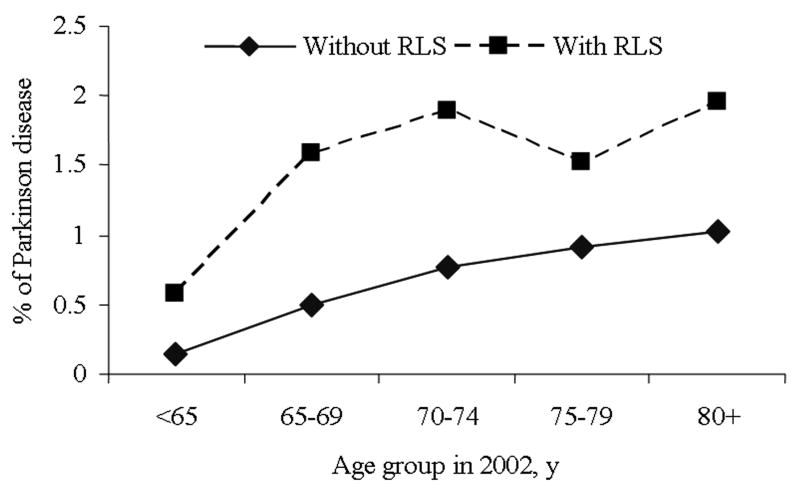
We examined whether men with restless legs syndrome (RLS) have a higher prevalence of Parkinson's disease (PD) among 23,119 US participants of the Health Professional Follow-up Study who were free of diabetes and arthritis. RLS was assessed using a set of standardized questions recommended by the International RLS Study Group. PD cases were identified by self-reported questionnaires and confirmed by review of medical records. Compared to men without RLS, multivariate-adjusted odds ratios for PD were 1.1 (95% confidence interval: 0.4, 3.0) for men with RLS symptoms 5-14 times per month and 3.09 (95% confidence interval: 1.5, 6.2; P trend = 0.003) for those with symptoms 15 times or more per month, after adjusting for age, smoking, use of antidepressant, and other covariates. In conclusion, men with RLS are more likely to have concurrent PD. Prospective studies are warranted to clarify the temporal relationship between RLS and PD.
我们在一项针对 23119 名美国健康专业随访研究参与者的研究中调查了是否患有不安腿综合征(RLS)的男性患帕金森病(PD)的比例更高,这些参与者无糖尿病和关节炎。RLS 通过一组国际 RLS 研究组推荐的标准化问题进行评估。PD 病例通过自我报告的问卷确定,并通过审查病历进行确认。与无 RLS 的男性相比,每月 RLS 症状出现 5-14 次的男性 PD 的多变量调整比值比为 1.1(95%置信区间:0.4,3.0),每月 RLS 症状出现 15 次或更多的男性 PD 的比值比为 3.09(95%置信区间:1.5,6.2;P 趋势=0.003),这些因素在调整年龄、吸烟、使用抗抑郁药和其他混杂因素后进行了调整。总之,患有 RLS 的男性更有可能同时患有 PD。需要前瞻性研究来阐明 RLS 和 PD 之间的时间关系。