Department of Physiology, Faculty of Medicine, Khon Kaen University, Khon Kaen 40002, Thailand.
J Biomed Sci. 2010 Aug 24;17 Suppl 1(Suppl 1):S22. doi: 10.1186/1423-0127-17-S1-S22.
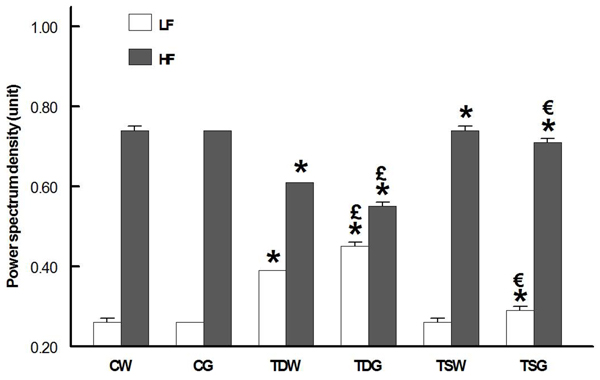
Perinatal taurine depletion and high sugar diets blunted baroreflex function and heightens sympathetic nerve activity in adult rats. Cardiac ischemia/reperfusion also produces these disorders and taurine treatment appears to improve these effects. This study tests the hypothesis that perinatal taurine exposure predisposes recovery from reperfusion injury in rats on either a basal or high sugar diet. Female Sprague-Dawley rats were fed normal rat chow with 3% beta-alanine (taurine depletion, TD), 3% taurine (taurine supplementation, TS) or water alone (control, C) from conception to weaning. Male offspring were fed normal rat chow and water containing 5% glucose (G) or water alone (W) throughout the experiment. At 7-8 weeks of age, all rats were anesthetized and their trachea clamped until cardiac arrest occurred and mean arterial pressure fell below 60 mm Hg. The clamp was immediately released and cardiopulmonary resuscitation was performed with cardiac function returning within 4 min. Twenty-four hours later, arterial pressure, heart rate, and baroreflex function were measured in conscious and one day later in anesthetized conditions. Basic blood chemistry and circulating markers of cardiac injury were also measured. Baroreflex sensitivity was depressed moderately in CG and TDW, and severely in TDG. TSW displayed increased baroreflex and high sugar intake returned it to CW. Sympathetic nerve activity increased and parasympathetic decreased in TDW but not TSW and these effects were exacerbated sharply in TDG and slightly in TSG. Arterial pressure and heart rate increased in all groups but to a lesser degree in TDG. Plasma aspartate aminotransferase increased in all groups except TSW, but the increase was nearly 3X greater in TDG vs. any other group. Creatine kinase-MB increased in all groups except TSG and was far greater in TD than other groups. Troponin-T and brain natriuretic peptide were greatly increased in TDG compared to all other groups. Thus, perinatal taurine depletion increases injury from cardiac ischemia/reperfusion, and in adult rats on a high sugar diet, these effects are greatly exacerbated.
围产期牛磺酸耗竭和高糖饮食削弱了成年大鼠的血压反射功能,并增加了交感神经活性。心肌缺血/再灌注也会产生这些紊乱,而牛磺酸治疗似乎可以改善这些影响。本研究测试了以下假设:围产期牛磺酸暴露会使无论是在基础饮食还是高糖饮食条件下,大鼠从再灌注损伤中恢复的能力下降。雌性 Sprague-Dawley 大鼠从受孕到断奶期间,喂食含有 3%β-丙氨酸(牛磺酸耗竭,TD)、3%牛磺酸(牛磺酸补充,TS)或仅水(对照,C)的普通大鼠饲料。雄性后代在整个实验过程中喂食普通大鼠饲料和含有 5%葡萄糖(G)或仅水(W)的水。在 7-8 周龄时,所有大鼠均接受麻醉,并在气管夹闭直至发生心搏骤停和平均动脉压降至 60mmHg 以下。立即松开夹子,并进行心肺复苏,在 4 分钟内恢复心功能。24 小时后,在清醒状态下测量动脉压、心率和血压反射功能,一天后在麻醉状态下测量。还测量了基本血液化学和循环心脏损伤标志物。CG 和 TDW 中的血压反射敏感性中度降低,TDG 中严重降低。TSW 显示出血压反射增加,而高糖摄入使其恢复到 CW。TDW 中的交感神经活性增加,副交感神经活性降低,但 TSW 中没有,并且这些作用在 TDG 中急剧加剧,在 TSG 中略有加剧。所有组的动脉压和心率均增加,但 TDG 中的增加程度较小。除 TSW 外,所有组的血浆天冬氨酸转氨酶均增加,但 TDG 中的增加幅度几乎是其他组的 3 倍。除 TSG 外,所有组的肌酸激酶-MB 均增加,且 TD 组的增加幅度明显大于其他组。与其他组相比,TDG 中的肌钙蛋白-T 和脑钠肽大大增加。因此,围产期牛磺酸耗竭会增加心肌缺血/再灌注引起的损伤,而在成年高糖饮食大鼠中,这些作用会大大加剧。