Center for Aerobiological Sciences, United States Army Medical Research Institute of Infectious Diseases, Fort Detrick, Maryland, USA.
PLoS One. 2010 Sep 20;5(9):e12880. doi: 10.1371/journal.pone.0012880.
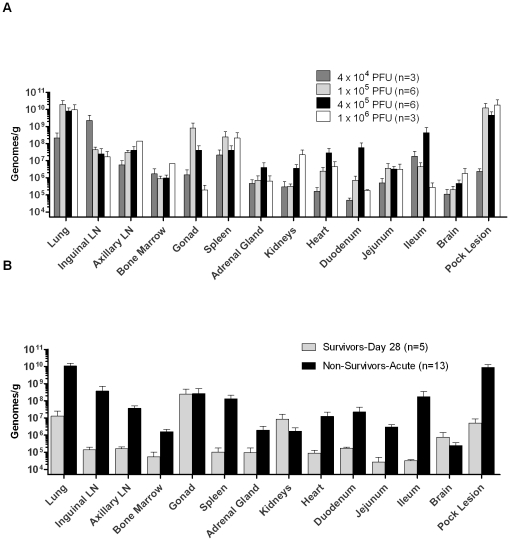
Monkeypox virus (MPXV) infection in humans results in clinical symptoms very similar to ordinary smallpox. Aerosol is a route of secondary transmission for monkeypox, and a primary route of smallpox transmission in humans. Therefore, an animal model for aerosol exposure to MPXV is needed to test medical countermeasures. To characterize the pathogenesis in cynomolgus macaques (Macaca fascicularis), groups of macaques were exposed to four different doses of aerosolized MPXV. Blood was collected the day before, and every other day after exposure and assessed for complete blood count (CBC), clinical chemistry analysis, and quantitative PCR. Macaques showed mild anorexia, depression, and fever on day 6 post-exposure. Lymphadenopathy, which differentiates monkeypox from smallpox, was observed in exposed macaques around day 6 post-exposure. CBC and clinical chemistries showed abnormalities similar to human monkeypox cases. Whole blood and throat swab viral loads peaked around day 10, and in survivors, gradually decreased until day 28 post-exposure. Survival was not dose dependent. As such, doses of 4 × 10(4) PFU, 1 × 10(5) PFU, or 1 × 10(6) PFU resulted in lethality for 70% of the animals, whereas a dose of 4 × 10(5) PFU resulted in 85% lethality. Overall, cynomolgus macaques exposed to aerosolized MPXV develop a clinical disease that resembles that of human monkeypox. These findings provide a strong foundation for the use of aerosolized MPXV exposure of cynomolgus macaques as an animal model to test medical countermeasures against orthopoxviruses.
猴痘病毒(MPXV)感染人类会导致与普通天花非常相似的临床症状。飞沫是猴痘的二次传播途径,也是人类天花的主要传播途径。因此,需要建立一种用于气溶胶暴露 MPXV 的动物模型来测试医学应对措施。为了描述食蟹猴(Macaca fascicularis)中的发病机制,将一组食蟹猴暴露于四种不同剂量的气溶胶化 MPXV 中。暴露前一天和暴露后每隔一天采集血液,进行全血细胞计数(CBC)、临床化学分析和定量 PCR 检测。暴露后第 6 天,猴子出现轻度食欲不振、抑郁和发热。暴露后第 6 天左右,可观察到暴露猴子出现与猴痘相区别的淋巴结病。CBC 和临床化学显示出与人类猴痘病例相似的异常。全血和咽喉拭子病毒载量在暴露后第 10 天左右达到峰值,在幸存者中,逐渐减少,直到暴露后第 28 天。存活率与剂量无关。因此,4×10(4)PFU、1×10(5)PFU 或 1×10(6)PFU 的剂量导致 70%的动物死亡,而 4×10(5)PFU 的剂量导致 85%的动物死亡。总体而言,暴露于气溶胶化 MPXV 的食蟹猴会发展出类似于人类猴痘的临床疾病。这些发现为使用气溶胶化 MPXV 暴露食蟹猴作为一种动物模型来测试针对正痘病毒的医学应对措施提供了坚实的基础。