Medical Emergency Department, Ibn Sina University Hospital, 10000, Rabat, Morocco.
J Occup Med Toxicol. 2010 Sep 28;5:27. doi: 10.1186/1745-6673-5-27.
Anyone working in the hospital may become a victim of violence. The effects of violence can range in intensity and include the following: minor physical injuries, serious physical injuries, temporary or permanent physical disability, psychological trauma, and death. The aim of this study was to determine the frequency of exposure, characteristics, and psychological impact of violence toward hospital-based emergency physicians in Morocco.
This was a survey including emergency physicians who ensured emergency service during the last fortnight. The variables studied were those related to the victim (age and gender), and those related to aggression: assaulter gender, number, time, reason (delay of consultation and/or care, acute drunkenness, neuropsychiatric disease), and type (verbal abuse, verbal threat and/or physical assault). After the questionnaire was completed, State-Trait Anxiety Inventory (STAI) of Spielberg was applied to all participants.
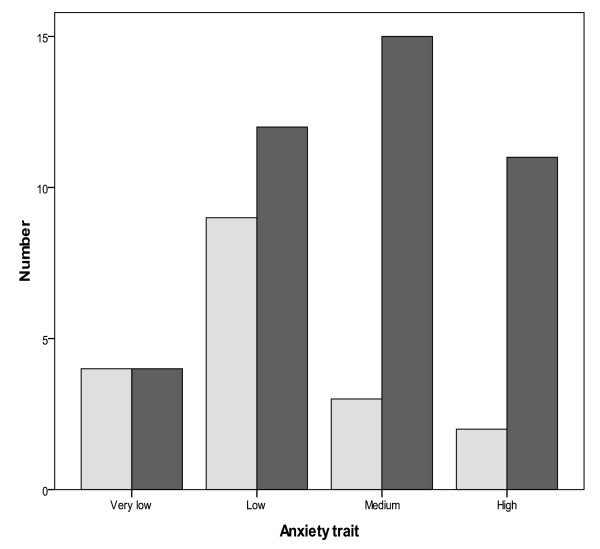
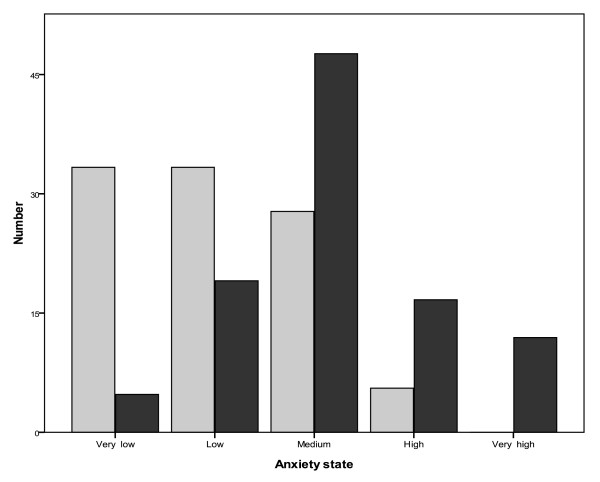
A total of 60 physicians have achieved permanence in emergency department during the 15 days preceding the questionnaire response. The mean age was 24 ± 1 year and 57% were male. A total of 42 (70%) had been exposed to violence. The violence occurred at night n = 16 (27%), afternoon n = 13 (22%), evening n = 7 (12%) and morning n = 6 (10%). Reasons for violence were: the delay of consultation or care in n = 31 (52%) cases, acute drunkenness in n = 10 (17%) cases and neuropsychiatric disease in n = 3 (5%) cases. Twenty eight (47%) participants stated that they experienced verbal abuse, n = 18 (30%) verbal threat and n = 5 (8.3%) physical assault. Exposure to some form of violence was related to a higher median [interquartile range, IQR] state anxiety point (SAP); (51 [46-59] vs 39 [34-46]; P < 0,001), and trait anxiety point (TAP) (48 [41-55] vs 40,5 [38-53]; P = 0,01).
This study revealed a high prevalence (70%) of violence toward doctors in Morocco emergency departments. The exposure of physicians to some form of violence is greater among doctors with anxiety trait and was related to significant degree of anxiety state.
在医院工作的任何人都可能成为暴力的受害者。暴力的影响程度不一,包括以下几种:轻微的身体伤害、严重的身体伤害、暂时或永久的身体残疾、心理创伤和死亡。本研究的目的是确定摩洛哥医院急诊医生遭受暴力的频率、特征和心理影响。
这是一项调查,包括过去两周内负责急诊服务的急诊医生。研究的变量包括与受害者相关的变量(年龄和性别)和与攻击相关的变量:攻击者的性别、人数、时间、原因(咨询和/或护理延迟、急性醉酒、神经精神疾病)和类型(言语虐待、言语威胁和/或身体攻击)。完成问卷后,对所有参与者进行 Spielberg 的状态-特质焦虑量表(STAI)测试。
共有 60 名医生在问卷答复前的 15 天内在急诊部常驻。平均年龄为 24 ± 1 岁,其中 57%为男性。共有 42 人(70%)遭受过暴力。暴力发生在夜间 n = 16(27%),下午 n = 13(22%),晚上 n = 7(12%),早上 n = 6(10%)。暴力的原因是:咨询或护理延迟 n = 31 例(52%),急性醉酒 n = 10 例(17%),神经精神疾病 n = 3 例(5%)。28 名(47%)参与者表示他们遭受过言语虐待,n = 18 人(30%)遭受过言语威胁,n = 5 人(8.3%)遭受过身体攻击。遭受某种形式的暴力与更高的中位(四分位距,IQR)状态焦虑点(SAP)有关;(51 [46-59] 比 39 [34-46];P < 0.001),特质焦虑点(TAP)(48 [41-55] 比 40.5 [38-53];P = 0.01)。
本研究显示,摩洛哥急诊医生遭受暴力的比例很高(70%)。医生在某种形式的暴力中的暴露程度在具有焦虑特质的医生中更大,并且与显著程度的状态焦虑有关。