Center for Research to Practice, 12 Shelton McMurphey Blvd,, Eugene, OR 97401, USA.
Implement Sci. 2010 Oct 6;5:72. doi: 10.1186/1748-5908-5-72.
Despite the burgeoning number of well-validated interventions that have been shown in randomized trials to produce superior outcomes compared to usual services, it is estimated that only 10% of public systems deliver evidence-based mental health services. In California, for example, more than 15,000 children are placed in group homes or residential centers with some evidence of iatrogenic effects. The present study evaluates the willingness among county leaders of child public service systems to adopt a new evidence-based model, Multidimensional Treatment Foster Care, (MTFC), as a way to decrease the prevalence of out-of-home placements. Specifically, the study examines how county-level socio-demographic factors and child public service system leaders' perceptions of their county's organizational climate influence their decision of whether or not to consider adopting MTFC.
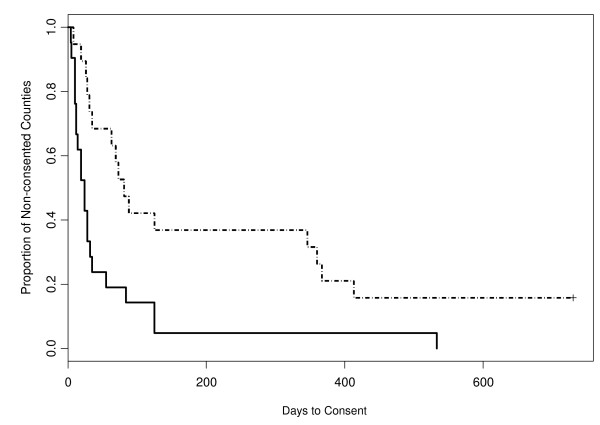
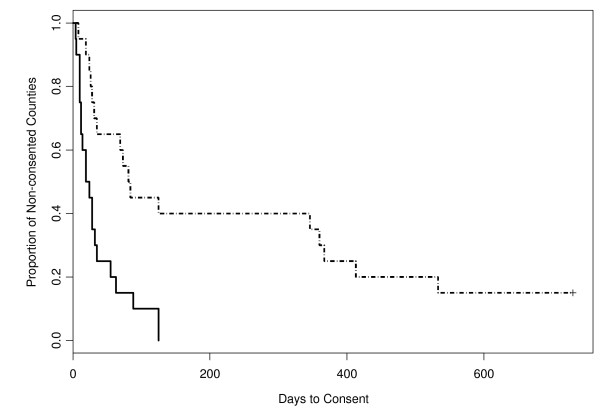
Two levels were examined in this study: Stable and historical factors from 40 California counties gathered from public records including population size, number of entries into out-of-home care, financing of mental health services, and percent minority population; and system leaders' perceptions of their county's organizational climate and readiness for change measured via a web-based survey. The number of days-to-consent was the primary outcome variable defined as the duration of time between being notified of the opportunity to implement MTFC and the actual signing of a consent form indicating interest in considering implementation. Survival analysis methods were used to assess the predictors of this time-to-event measure. The present study is part of a larger randomized trial comparing two methods of implementation where counties are randomized to one of three time cohorts and two implementation conditions.
The number of entries into care was the primary predictor of days-to-consent. This variable was significantly correlated to county size. System leader's perceptions of positive climate and organizational readiness for change also contributed to but did not mediate or moderate the days-to-consent.
System leaders' decision to consider implementing a new evidence-based model was influenced most by their objective need for the program and next by their perception of the county's organizational climate and motivation to change. These findings highlight the importance of understanding the fit between the needs of the systems or agencies and the potential for addressing those needs with the proposed new program.
尽管有大量经过充分验证的干预措施在随机试验中被证明比常规服务能产生更好的结果,但据估计,只有 10%的公共系统提供基于证据的心理健康服务。例如,在加利福尼亚州,有超过 15000 名儿童被安置在集体之家或住宿中心,这些儿童存在一些医源性影响的证据。本研究评估了儿童公共服务系统的县级领导采用新的循证模式——多维治疗寄养护理(MTFC)的意愿,作为减少非家庭安置的一种方式。具体来说,本研究考察了县级社会人口因素和儿童公共服务系统领导者对其所在县组织氛围的看法如何影响他们是否考虑采用 MTFC 的决策。
本研究考察了两个层次:从加利福尼亚州的 40 个县收集的公共记录中的稳定和历史因素,包括人口规模、进入非家庭护理的人数、心理健康服务的融资情况以及少数民族人口的百分比;以及通过基于网络的调查衡量的系统领导者对其所在县组织氛围和变革准备的看法。同意天数是主要的结果变量,定义为从通知有机会实施 MTFC 到签署表示有兴趣考虑实施的同意书之间的时间间隔。生存分析方法用于评估此时间事件测量的预测因子。本研究是一项更大的随机试验的一部分,该试验比较了两种实施方法,其中各县被随机分配到三个时间队列和两种实施条件之一。
进入护理的人数是同意天数的主要预测因素。该变量与县的规模显著相关。系统领导者对积极的气候和组织变革准备的看法也有助于但不能调解或调节同意天数。
系统领导者考虑实施新的循证模式的决定最受他们对该计划的客观需求的影响,其次是他们对县组织氛围的看法和变革的动力。这些发现强调了理解系统或机构的需求与拟议的新计划解决这些需求的能力之间的契合度的重要性。