Department of Chemistry, Islamic Azad University-Tonekabon Branch, Iran.
Int J Nanomedicine. 2010 Oct 21;5:839-52. doi: 10.2147/IJN.S11883.
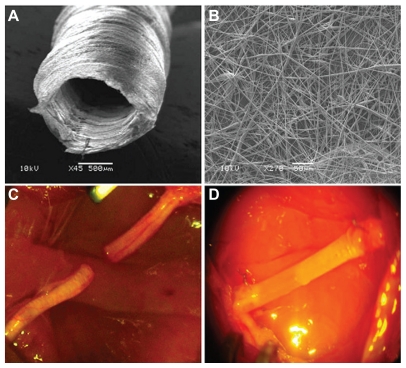
Peripheral nerve injuries can lead to lifetime loss of function and permanent disfigurement. Different methods, such as conventional allograft procedures and use of biologic tubes present problems when used for damaged peripheral nerve reconstruction. Designed scaffolds comprised of natural and synthetic materials are now widely used in the reconstruction of damaged tissues. Utilization of absorbable and nonabsorbable synthetic and natural polymers with unique characteristics can be an appropriate solution to repair damaged nerve tissues. Polymeric nanofibrous scaffolds with properties similar to neural structures can be more effective in the reconstruction process. Better cell adhesion and migration, more guiding of axons, and structural features, such as porosity, provide a clearer role for nanofibers in the restoration of neural tissues. In this paper, basic concepts of peripheral nerve injury, types of artificial and natural guides, and methods to improve the performance of tubes, such as orientation, nanotechnology applications for nerve reconstruction, fibers and nanofibers, electrospinning methods, and their application in peripheral nerve reconstruction are reviewed.
周围神经损伤可导致终身丧失功能和永久性残疾。传统同种异体移植程序和使用生物管等不同方法在用于受损周围神经重建时存在问题。由天然和合成材料设计的支架现在广泛用于受损组织的重建。利用具有独特特性的可吸收和不可吸收的合成和天然聚合物可能是修复受损神经组织的合适解决方案。具有类似于神经结构特性的聚合物纳米纤维支架在重建过程中可能更有效。更好的细胞黏附和迁移、更多的轴突引导以及多孔性等结构特征,为纳米纤维在神经组织修复中的作用提供了更清晰的认识。本文综述了周围神经损伤的基本概念、人工和天然引导物的类型,以及提高导管性能的方法,如定向、纳米技术在神经重建中的应用、纤维和纳米纤维、静电纺丝方法及其在周围神经重建中的应用。