Rothschild Ryan Mark
Department of Physiology, University of Pretoria Pretoria, South Africa.
Front Neuroeng. 2010 Oct 15;3:112. doi: 10.3389/fneng.2010.00112. eCollection 2010.
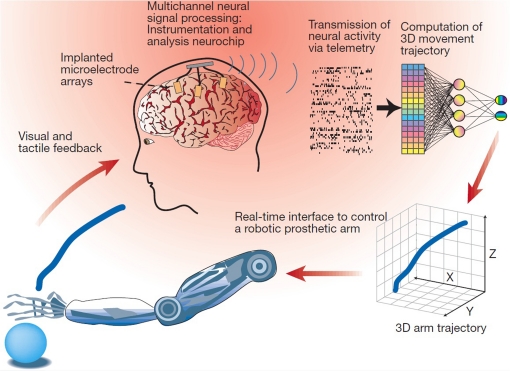
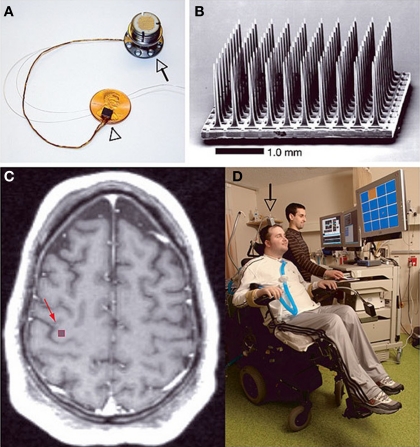
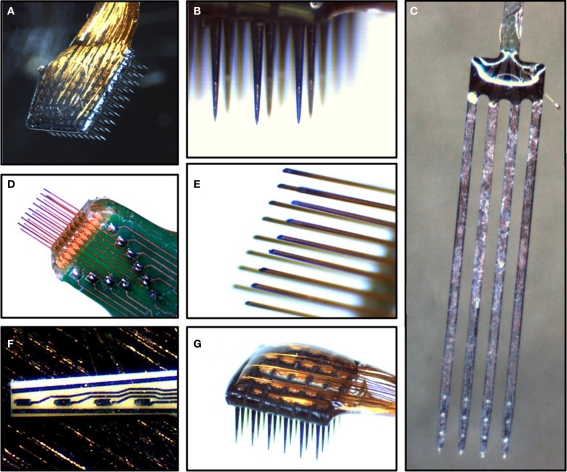
The main focus of this review is to provide a holistic amalgamated overview of the most recent human in vivo techniques for implementing brain-computer interfaces (BCIs), bidirectional interfaces, and neuroprosthetics. Neuroengineering is providing new methods for tackling current difficulties; however neuroprosthetics have been studied for decades. Recent progresses are permitting the design of better systems with higher accuracies, repeatability, and system robustness. Bidirectional interfaces integrate recording and the relaying of information from and to the brain for the development of BCIs. The concepts of non-invasive and invasive recording of brain activity are introduced. This includes classical and innovative techniques like electroencephalography and near-infrared spectroscopy. Then the problem of gliosis and solutions for (semi-) permanent implant biocompatibility such as innovative implant coatings, materials, and shapes are discussed. Implant power and the transmission of their data through implanted pulse generators and wireless telemetry are taken into account. How sensation can be relayed back to the brain to increase integration of the neuroengineered systems with the body by methods such as micro-stimulation and transcranial magnetic stimulation are then addressed. The neuroprosthetic section discusses some of the various types and how they operate. Visual prosthetics are discussed and the three types, dependant on implant location, are examined. Auditory prosthetics, being cochlear or cortical, are then addressed. Replacement hand and limb prosthetics are then considered. These are followed by sections concentrating on the control of wheelchairs, computers and robotics directly from brain activity as recorded by non-invasive and invasive techniques.
本综述的主要重点是对用于实现脑机接口(BCI)、双向接口和神经假体的最新人体体内技术进行全面综合概述。神经工程学正在提供解决当前难题的新方法;然而,神经假体已经研究了几十年。最近的进展使得能够设计出具有更高准确性、可重复性和系统鲁棒性的更好系统。双向接口集成了大脑信息的记录与从大脑传出以及传入大脑的信息中继,以用于脑机接口的开发。介绍了大脑活动的非侵入性和侵入性记录概念。这包括脑电图和近红外光谱等经典和创新技术。然后讨论了胶质增生问题以及(半)永久性植入物生物相容性的解决方案,如创新的植入物涂层、材料和形状。考虑了植入物的电源以及它们通过植入式脉冲发生器和无线遥测传输数据的情况。接着探讨了如何通过微刺激和经颅磁刺激等方法将感觉反馈回大脑,以增强神经工程系统与身体的整合。神经假体部分讨论了一些不同类型及其工作方式。讨论了视觉假体,并研究了取决于植入位置的三种类型。接着讨论了听觉假体,包括耳蜗假体和皮质假体。然后考虑了替代手和肢体假体。随后的章节重点关注如何直接根据通过非侵入性和侵入性技术记录的大脑活动来控制轮椅、计算机和机器人。