Department of Public Health, Erasmus Medical Center, Rotterdam, The Netherlands.
Eur J Epidemiol. 2011 Jan;26(1):23-8. doi: 10.1007/s10654-010-9522-9. Epub 2010 Nov 18.
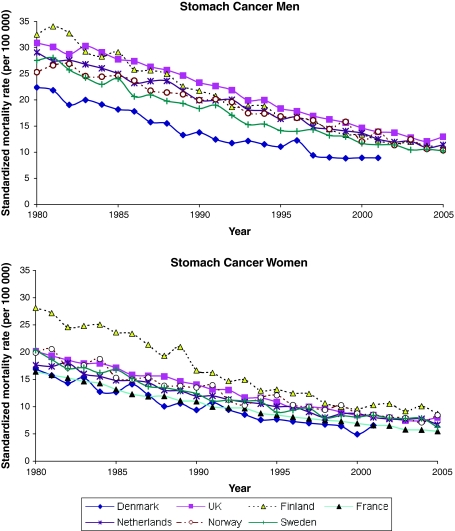
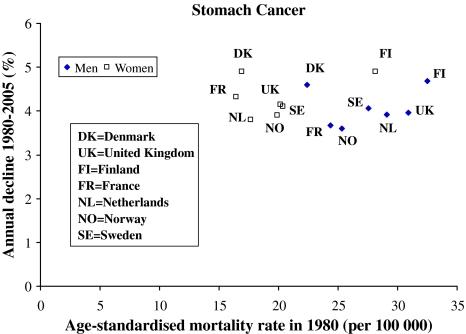
Mortality from stomach cancer has fallen steadily during the past decades. The aim of this paper is to assess the implication of a possible continuation of the decline in stomach cancer mortality until the year 2030. Annual rates of decline in stomach cancer mortality from 1980 to 2005 were determined for the Netherlands, United Kingdom, France, and four Nordic countries on the basis of regression analysis. Mortality rates were extrapolated until 2030, assuming the same rate of decline as in the past, using three possible scenarios. The absolute numbers of deaths were projected taking into account data on the ageing of national populations. Stomach cancer mortality rates declined between 1980 and 2005 at about the same rate (3.6-4.9% per year) for both men and women in all countries. The rate of decline did not level off in recent years, and it was not smaller in countries with lower overall mortality rates in 1980. If this decline were to continue into the future, stomach cancer mortality rates would decline with about 66% between 2005 and 2030 in most populations, while the absolute number of stomach cancer deaths would diminish by about 50%. Thus, in view of the strong, stable and consistent mortality declines in recent decades, and despite population ageing, stomach cancer is likely to become far less important as a cause of death in Europe in the future.
在过去几十年中,胃癌死亡率稳步下降。本文旨在评估胃癌死亡率可能持续下降到 2030 年的影响。基于回归分析,确定了荷兰、英国、法国和北欧四国从 1980 年到 2005 年胃癌死亡率的年下降率。假设过去的下降速度相同,使用三种可能的情景,将死亡率外推到 2030 年。考虑到各国人口老龄化的数据,预测了死亡人数的绝对值。在所有国家,男性和女性的胃癌死亡率在 1980 年至 2005 年间以相同的速度(每年 3.6-4.9%)下降。近年来,下降速度并没有趋于平稳,而且在 1980 年总体死亡率较低的国家,下降速度也没有更小。如果这种下降持续到未来,在大多数人群中,2005 年至 2030 年期间,胃癌死亡率将下降约 66%,而胃癌死亡人数将减少约 50%。因此,鉴于近几十年来死亡率的强劲、稳定和持续下降,尽管人口老龄化,胃癌在未来可能在欧洲成为一个不那么重要的死因。