Biological Rhythms Research Laboratory, Department of Behavioral Sciences, Rush University Medical Center, Chicago, IL, USA.
J Biol Rhythms. 2010 Dec;25(6):460-8. doi: 10.1177/0748730410385544.
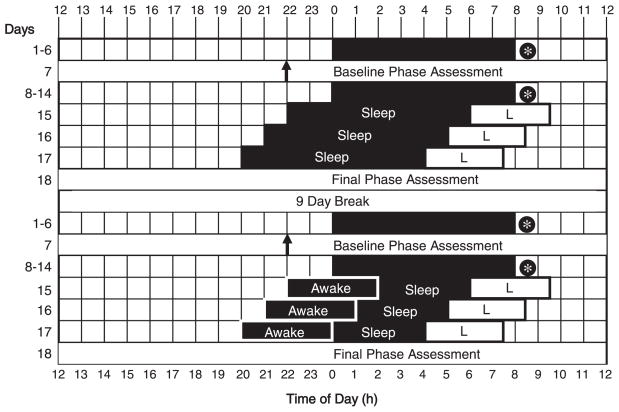
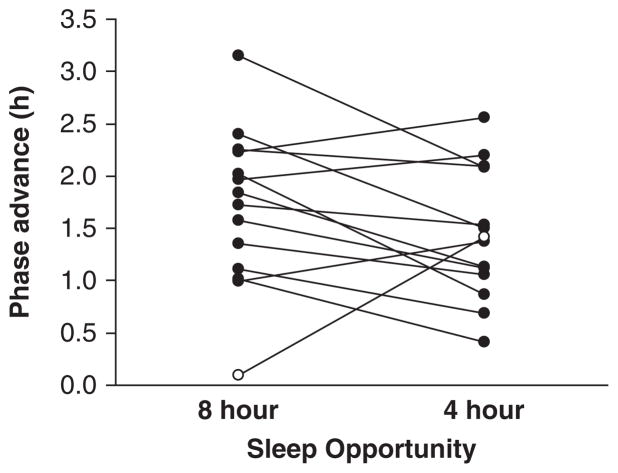
Partial sleep deprivation is increasingly common in modern society. This study examined for the first time if partial sleep deprivation alters circadian phase shifts to bright light in humans. Thirteen young healthy subjects participated in a repeated-measures counterbalanced design with 2 conditions. Each condition had baseline sleep, a dim-light circadian phase assessment, a 3-day phase-advancing protocol with morning bright light, then another phase assessment. In one condition (no sleep deprivation), subjects had an 8-h sleep opportunity per night during the advancing protocol. In the other condition (partial sleep deprivation), subjects were kept awake for 4 h in near darkness (<0.25 lux), immediately followed by a 4-h sleep opportunity per night during the advancing protocol. The morning bright light stimulus was four 30-min pulses of bright light (~5000 lux), separated by 30-min intervals of room light. The light always began at the same circadian phase, 8 h after the baseline dim-light melatonin onset (DLMO). The average phase advance without sleep deprivation was 1.8 ± 0.6 (SD) h, which reduced to 1.4 ± 0.6 h with partial sleep deprivation (p < 0.05). Ten of the 13 subjects showed reductions in phase advances with partial sleep deprivation, ranging from 0.2 to 1.2 h. These results indicate that short-term partial sleep deprivation can moderately reduce circadian phase shifts to bright light in humans. This may have significant implications for the sleep-deprived general population and for the bright light treatment of circadian rhythm sleep disorders such as delayed sleep phase disorder.
部分睡眠剥夺在现代社会中越来越常见。本研究首次考察了部分睡眠剥夺是否会改变人类对明亮光线的昼夜节律相位转移。13 名年轻健康的受试者参与了一项重复测量的平衡设计,有 2 种条件。每种条件都有基线睡眠、暗光昼夜节律相位评估、为期 3 天的促前进相位方案和另一个相位评估。在一种条件(无睡眠剥夺)下,受试者在推进方案中有 8 小时的睡眠机会。在另一种条件(部分睡眠剥夺)下,受试者在近黑暗(<0.25 勒克斯)中保持清醒 4 小时,随后在推进方案中每晚有 4 小时的睡眠机会。早晨的强光刺激是四个 30 分钟的强光脉冲(~5000 勒克斯),间隔 30 分钟的室内光。灯光总是在基线暗光褪黑素开始后 8 小时的相同昼夜节律相位开始。无睡眠剥夺时的平均相位提前量为 1.8 ± 0.6(SD)小时,部分睡眠剥夺时减少到 1.4 ± 0.6 小时(p < 0.05)。13 名受试者中有 10 名出现部分睡眠剥夺时相位提前量减少,范围为 0.2 至 1.2 小时。这些结果表明,短期部分睡眠剥夺可适度减少人类对明亮光线的昼夜节律相位转移。这可能对睡眠剥夺的普通人群以及对延迟睡眠相位障碍等昼夜节律睡眠障碍的明亮光治疗有重要意义。