International Research Institute for Climate and Society, The Earth Institute at Columbia University, LDEO Campus, Palisades, NY 10964-8000, USA.
Malar J. 2011 Jan 17;10:12. doi: 10.1186/1475-2875-10-12.
Whether or not observed increases in malaria incidence in the Kenyan Highlands during the last thirty years are associated with co-varying changes in local temperature, possibly connected to global changes in climate, has been debated for over a decade. Studies, using differing data sets and methodologies, produced conflicting results regarding the occurrence of temperature trends and their likelihood of being responsible, at least in part, for the increases in malaria incidence in the highlands of western Kenya. A time series of quality controlled daily temperature and rainfall data from Kericho, in the Kenyan Highlands, may help resolve the controversy. If significant temperature trends over the last three decades have occurred then climate should be included (along with other factors such as land use change and drug resistance) as a potential driver of the observed increases in malaria in the region.
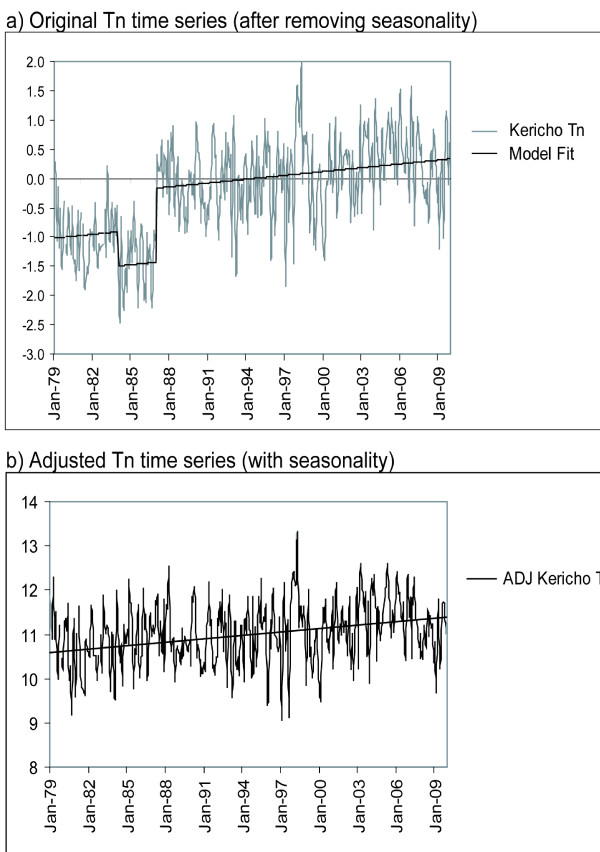
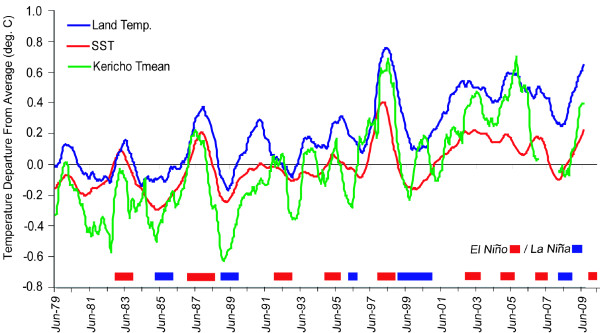
Over 30 years (1 January 1979 to 31 December 2009) of quality controlled daily observations ( > 97% complete) of maximum, minimum and mean temperature were used in the analysis of trends at Kericho meteorological station, sited in a tea growing area of Kenya's western highlands. Inhomogeneities in all the time series were identified and corrected. Linear trends were identified via a least-squares regression analysis with statistical significance assessed using a two-tailed t-test. These 'gold standard' meteorological observations were compared with spatially interpolated temperature datasets that have been developed for regional or global applications. The relationship of local climate processes with larger climate variations, including tropical sea surface temperatures (SST), and El Niño-Southern Oscillation (ENSO) was also assessed.
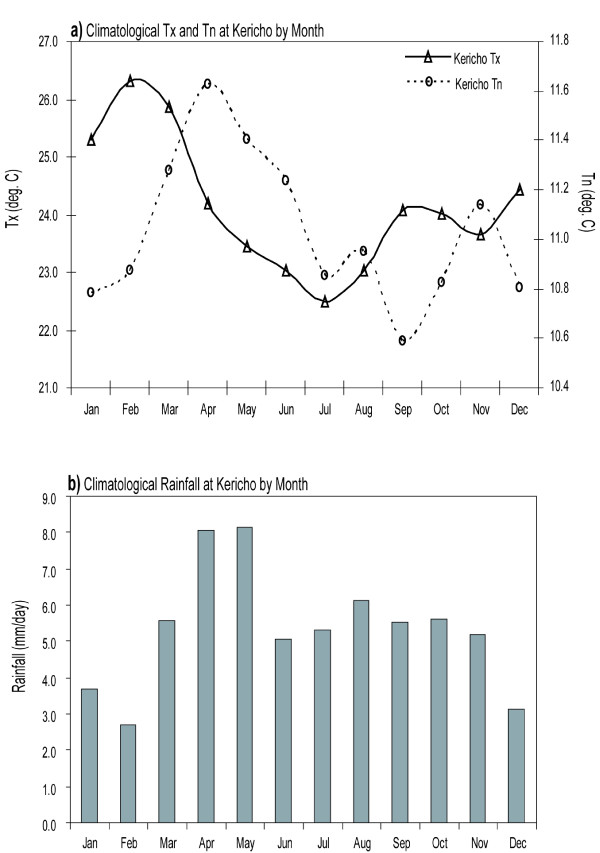
An upward trend of ≈0.2°C/decade was observed in all three temperature variables (P < 0.01). Mean temperature variations in Kericho were associated with large-scale climate variations including tropical SST (r = 0.50; p < 0.01). Local rainfall was found to have inverse effects on minimum and maximum temperature. Three versions of a spatially interpolated temperature data set showed markedly different trends when compared with each other and with the Kericho station observations.
This study presents evidence of a warming trend in observed maximum, minimum and mean temperatures at Kericho during the period 1979 to 2009 using gold standard meteorological observations. Although local factors may be contributing to these trends, the findings are consistent with variability and trends that have occurred in correlated global climate processes. Climate should therefore not be dismissed as a potential driver of observed increases in malaria seen in the region during recent decades, however its relative importance compared to other factors needs further elaboration. Climate services, pertinent to the achievement of development targets such as the Millennium Development Goals and the analysis of infectious disease in the context of climate variability and change are being developed and should increase the availability of relevant quality controlled climate data for improving development decisions. The malaria community should seize this opportunity to make their needs heard.
在过去的三十年中,肯尼亚高地的疟疾发病率是否与当地温度的变化有关,这种变化可能与全球气候变化有关,这一问题已经争论了十多年。使用不同数据集和方法的研究对温度趋势的发生及其是否有可能至少部分导致肯尼亚高地疟疾发病率的上升产生了相互矛盾的结果。来自肯尼亚高地克里乔的经过质量控制的每日温度和降雨数据时间序列可能有助于解决这一争议。如果过去三十年来发生了显著的温度趋势,那么气候(以及土地利用变化和抗药性等其他因素)就应该被视为该地区疟疾发病率上升的潜在驱动因素。
在对位于肯尼亚高地西部一个茶叶种植区的克里乔气象站的分析中,使用了 30 多年(1979 年 1 月 1 日至 2009 年 12 月 31 日)的高质量每日观测数据(>97%完整),包括最高、最低和平均温度。确定了所有时间序列中的非均一性并进行了校正。通过最小二乘回归分析确定线性趋势,并使用双侧 t 检验评估统计显著性。将这些“黄金标准”气象观测结果与为区域或全球应用开发的空间插值温度数据集进行了比较。还评估了当地气候过程与包括热带海表温度(SST)和厄尔尼诺-南方涛动(ENSO)在内的较大气候变化之间的关系。
在所有三个温度变量中都观察到了约 0.2°C/decade 的上升趋势(P < 0.01)。克里乔的平均温度变化与包括热带 SST(r = 0.50;p < 0.01)在内的大尺度气候变化有关。当地降雨量与最低和最高温度呈反比关系。与克里乔站观测结果相比,三个版本的空间插值温度数据集之间的趋势差异明显。
本研究使用黄金标准气象观测结果,提供了 1979 年至 2009 年期间克里乔观测到的最高、最低和平均温度上升趋势的证据。尽管当地因素可能导致了这些趋势,但这些发现与相关全球气候过程中发生的变化和趋势一致。因此,不应将气候排除在该地区最近几十年观察到的疟疾发病率上升的潜在驱动因素之外,但是与其他因素相比,其相对重要性需要进一步阐述。与发展目标(如千年发展目标)相关的气候服务以及在气候变异性和变化背景下分析传染病的服务正在开发中,这将增加相关高质量控制气候数据的可用性,以改善发展决策。疟疾界应该抓住这个机会,让他们的需求得到关注。