Graduate School of Environmental Sciences and Global Center of Excellence Program on Integrated Field Environmental Science, Hokkaido University, Sapporo, Japan.
Parasitology. 2012 Jan;139(1):14-25. doi: 10.1017/S0031182011001685.
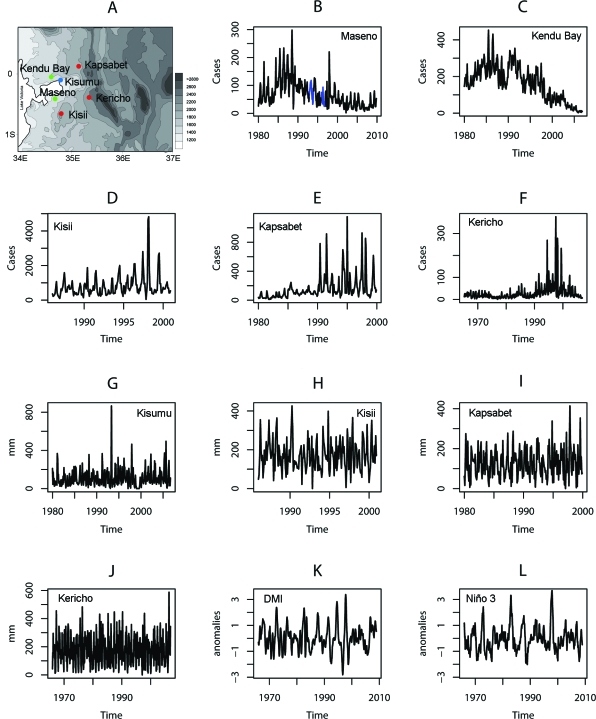
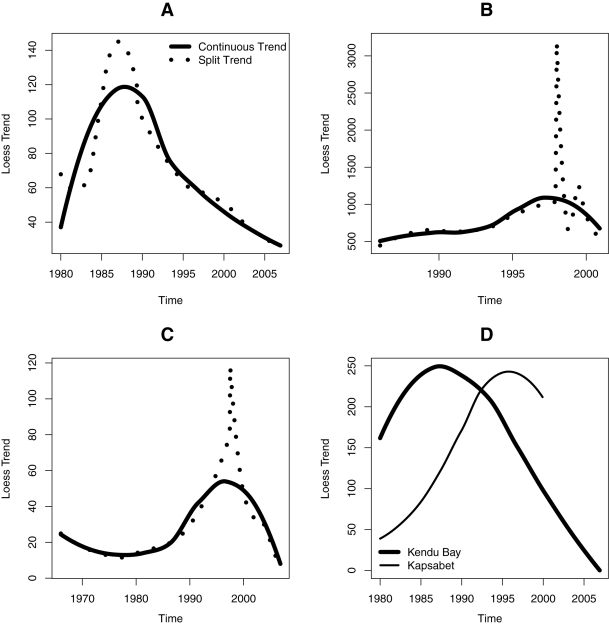
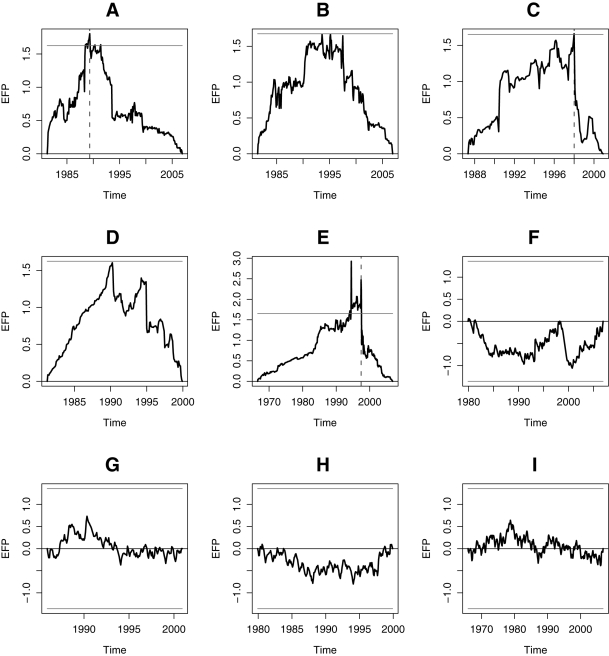
Large malaria epidemics in the East African highlands during the mid and late 1990s kindled a stream of research on the role that global warming might have on malaria transmission. Most of the inferences using temporal information have been derived from a malaria incidence time series from Kericho. Here, we report a detailed analysis of 5 monthly time series, between 15 and 41 years long, from West Kenya encompassing an altitudinal gradient along Lake Victoria basin. We found decreasing, but heterogeneous, malaria trends since the late 1980s at low altitudes (<1600 m), and the early 2000s at high altitudes (>1600 m). Regime shifts were present in 3 of the series and were synchronous in the 2 time series from high altitudes. At low altitude, regime shifts were associated with a shift from increasing to decreasing malaria transmission, as well as a decrease in variability. At higher altitudes, regime shifts reflected an increase in malaria transmission variability. The heterogeneity in malaria trends probably reflects the multitude of factors that can drive malaria transmission and highlights the need for both spatially and temporally fine-grained data to make sound inferences about the impacts of climate change and control/elimination interventions on malaria transmission.
20 世纪 90 年代中期和后期,东非高原发生大规模疟疾疫情,引发了一系列关于全球变暖可能对疟疾传播产生影响的研究。大多数利用时间信息进行的推断都来自于肯尼亚克里乔的疟疾发病率时间序列。在这里,我们报告了对来自肯尼亚西部的 5 个长达 15 至 41 年的逐月时间序列的详细分析,这些时间序列涵盖了维多利亚湖盆地的海拔梯度。我们发现,自 20 世纪 80 年代末以来,低海拔(<1600 米)地区的疟疾趋势一直在下降,但存在异质性,而高海拔(>1600 米)地区的趋势则出现在 21 世纪初。在 3 个系列中存在着状态转变,并且在两个高海拔地区的时间序列中是同步的。在低海拔地区,状态转变与从增加到减少的疟疾传播以及变异性的降低有关。在较高的海拔地区,状态转变反映了疟疾传播变异性的增加。疟疾趋势的异质性可能反映了驱动疟疾传播的多种因素,这突出表明需要具有空间和时间精细粒度的数据,以便对气候变化的影响以及控制/消除干预措施对疟疾传播的影响做出合理推断。