• 文献检索
  • 文档翻译
  • 深度研究
  • 学术资讯
  • Suppr Zotero 插件Zotero 插件
  • 邀请有礼
  • 套餐&价格
  • 历史记录
应用&插件
Suppr Zotero 插件Zotero 插件浏览器插件Mac 客户端Windows 客户端微信小程序
定价
高级版会员购买积分包购买API积分包
服务
文献检索文档翻译深度研究API 文档MCP 服务
关于我们
关于 Suppr公司介绍联系我们用户协议隐私条款
关注我们

Suppr 超能文献

核心技术专利:CN118964589B侵权必究
粤ICP备2023148730 号-1Suppr @ 2026

文献检索

告别复杂PubMed语法,用中文像聊天一样搜索,搜遍4000万医学文献。AI智能推荐,让科研检索更轻松。

立即免费搜索

文件翻译

保留排版,准确专业,支持PDF/Word/PPT等文件格式,支持 12+语言互译。

免费翻译文档

深度研究

AI帮你快速写综述,25分钟生成高质量综述,智能提取关键信息,辅助科研写作。

立即免费体验

从再现到高度流行:巴西登革热疫情的自然史。

From re-emergence to hyperendemicity: the natural history of the dengue epidemic in Brazil.

机构信息

Department of Epidemiology, Johns Hopkins Bloomberg School of Public Health, Baltimore, Maryland, United States of America.

出版信息

PLoS Negl Trop Dis. 2011 Jan 4;5(1):e935. doi: 10.1371/journal.pntd.0000935.

DOI:10.1371/journal.pntd.0000935
PMID:21245922
原文链接:https://pmc.ncbi.nlm.nih.gov/articles/PMC3014978/
Abstract

BACKGROUND

dengue virus (DENV) was reintroduced into Brazil in 1986 and by 1995 it had spread throughout the country. In 2007 the number of dengue hemorrhagic fever (DHF) cases more than doubled and a shift in the age distribution was reported. While previously the majority of DHF cases occurred among adults, in 2007 53% of cases occurred in children under 15 years old. The reasons for this shift have not been determined.

METHODS AND FINDINGS

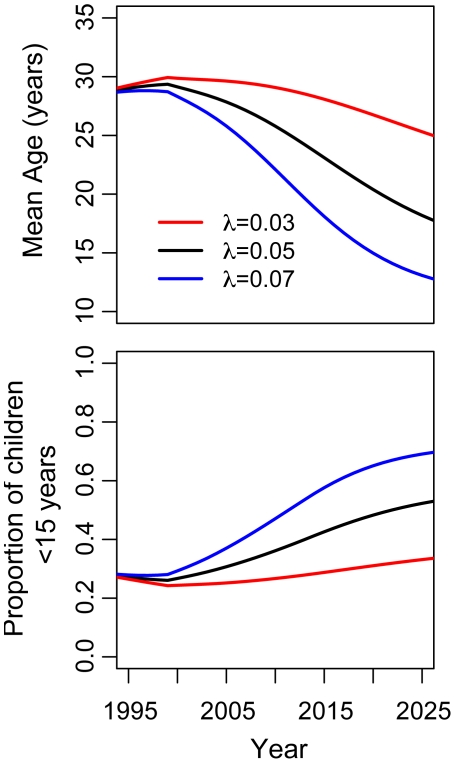
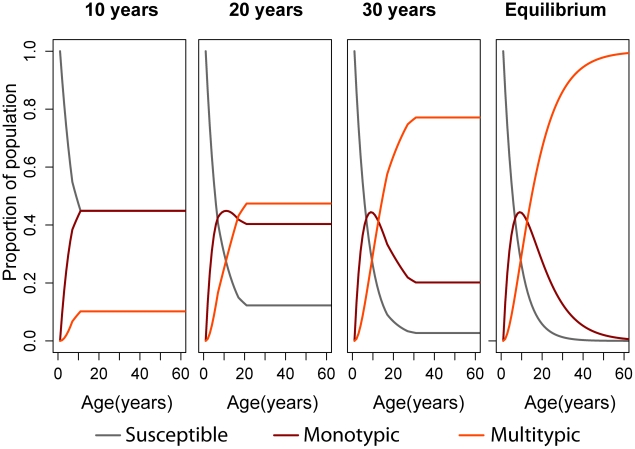
age stratified cross-sectional seroepidemiologic survey conducted in Recife, Brazil in 2006. Serostatus was determined by ELISA based detection of Dengue IgG. We estimated time-constant and time-varying forces of infection of DENV between 1986 and 2006. We used discrete-time simulation to estimate the accumulation of monotypic and multitypic immunity over time in a population previously completely susceptible to DENV. We projected the age distribution of population immunity to dengue assuming similar hazards of infection in future years. The overall prevalence of DENV IgG was 0.80 (n = 1427). The time-constant force of infection for the period was estimated to be 0.052 (95% CI 0.041, 0.063), corresponding to 5.2% of susceptible individuals becoming infected each year by each serotype. Simulations show that as time since re-emergence of dengue goes by, multitypic immunity accumulates in adults while an increasing proportion of susceptible individuals and those with monotypic immunity are among young age groups. The median age of those monotypically immune can be expected to shift from 24 years, 10 years after introduction, to 13 years, 50 years after introduction. Of those monotypically immune, the proportion under 15 years old shifts from 27% to 58%. These results are consistent with the dengue notification records from the same region since 1995.

INTERPRETATION

assuming that persons who have been monotypically exposed are at highest risk for severe dengue, the shift towards younger patient ages observed in Brazil can be partially explained by the accumulation of multitypic immunity against DENV-1, 2, and 3 in older age groups, 22 years after the re-introduction of these viruses. Serotype specific seroepidemiologic studies are necessary to accurately estimate the serotype specific forces of infection.

摘要

背景

登革热病毒(DENV)于 1986 年重新引入巴西,到 1995 年已传播到全国各地。2007 年,登革出血热(DHF)病例数增加了一倍多,年龄分布也发生了变化。以前,大多数 DHF 病例发生在成年人中,但 2007 年,53%的病例发生在 15 岁以下的儿童中。这种转变的原因尚未确定。

方法和发现

2006 年在巴西累西腓进行了分层的横断面血清流行病学调查。通过基于 ELISA 的检测,确定了登革热 IgG 的血清状态。我们估计了 1986 年至 2006 年间 DENV 的时间不变和时变感染力。我们使用离散时间模拟来估计在以前对 DENV 完全易感的人群中,单型和多型免疫随时间的积累。我们假设未来几年感染的风险相似,从而预测人群对登革热的免疫年龄分布。总体 DENV IgG 患病率为 0.80(n=1427)。该时期的时间不变感染力估计为 0.052(95%CI 0.041, 0.063),相当于每年每个血清型有 5.2%的易感个体感染。模拟结果表明,随着登革热再次出现的时间的推移,多型免疫在成年人中积累,而越来越多的易感个体和具有单型免疫的个体出现在年轻年龄组中。预计那些具有单型免疫的人的中位数年龄将从引入后 10 年的 24 岁,变为引入后 50 年的 13 岁。在那些具有单型免疫的人中,15 岁以下的比例从 27%上升到 58%。这些结果与 1995 年以来同一地区的登革热通知记录一致。

解释

假设曾经单型暴露的人患重症登革热的风险最高,那么巴西观察到的患者年龄向年轻方向的转变可以部分解释为,在重新引入这些病毒 22 年后,DENV-1、2 和 3 在年龄较大的人群中积累了多型免疫。进行血清型特异性血清流行病学研究对于准确估计血清型特异性感染力是必要的。

https://cdn.ncbi.nlm.nih.gov/pmc/blobs/a3b3/3014978/8ada0359a84c/pntd.0000935.g005.jpg
https://cdn.ncbi.nlm.nih.gov/pmc/blobs/a3b3/3014978/026f8ebb0978/pntd.0000935.g001.jpg
https://cdn.ncbi.nlm.nih.gov/pmc/blobs/a3b3/3014978/484d6878a409/pntd.0000935.g002.jpg
https://cdn.ncbi.nlm.nih.gov/pmc/blobs/a3b3/3014978/ef090e25e8f8/pntd.0000935.g003.jpg
https://cdn.ncbi.nlm.nih.gov/pmc/blobs/a3b3/3014978/c7e7e95cca50/pntd.0000935.g004.jpg
https://cdn.ncbi.nlm.nih.gov/pmc/blobs/a3b3/3014978/8ada0359a84c/pntd.0000935.g005.jpg
https://cdn.ncbi.nlm.nih.gov/pmc/blobs/a3b3/3014978/026f8ebb0978/pntd.0000935.g001.jpg
https://cdn.ncbi.nlm.nih.gov/pmc/blobs/a3b3/3014978/484d6878a409/pntd.0000935.g002.jpg
https://cdn.ncbi.nlm.nih.gov/pmc/blobs/a3b3/3014978/ef090e25e8f8/pntd.0000935.g003.jpg
https://cdn.ncbi.nlm.nih.gov/pmc/blobs/a3b3/3014978/c7e7e95cca50/pntd.0000935.g004.jpg
https://cdn.ncbi.nlm.nih.gov/pmc/blobs/a3b3/3014978/8ada0359a84c/pntd.0000935.g005.jpg

相似文献

1
From re-emergence to hyperendemicity: the natural history of the dengue epidemic in Brazil.从再现到高度流行:巴西登革热疫情的自然史。
PLoS Negl Trop Dis. 2011 Jan 4;5(1):e935. doi: 10.1371/journal.pntd.0000935.
2
Episodes of the epidemiological factors correlated with prevailing viral infections with dengue virus and molecular characterization of serotype-specific dengue virus circulation in eastern India.与登革热病毒相关的流行病毒感染的流行病学因素以及印度东部血清型特异性登革热病毒循环的分子特征。
Infect Genet Evol. 2018 Mar;58:40-49. doi: 10.1016/j.meegid.2017.12.005. Epub 2017 Dec 13.
3
High frequency of pre-existing neutralizing antibody responses in patients with dengue during an outbreak in Central Brazil.巴西中部登革热疫情期间登革热患者中预先存在的中和抗体反应频率较高。
BMC Infect Dis. 2016 Oct 7;16(1):546. doi: 10.1186/s12879-016-1867-6.
4
Force of infection of dengue serotypes in a population-based study in the northeast of Brazil.巴西东北部基于人群的研究中登革热血清型的感染力度。
Epidemiol Infect. 2013 May;141(5):1080-8. doi: 10.1017/S0950268812001367. Epub 2012 Jul 17.
5
Incidence of Dengue Virus Infection in Adults and Children in a Prospective Longitudinal Cohort in the Philippines.菲律宾一个前瞻性纵向队列中成人和儿童登革病毒感染的发病率
PLoS Negl Trop Dis. 2016 Feb 4;10(2):e0004337. doi: 10.1371/journal.pntd.0004337. eCollection 2016 Feb.
6
Stratified sero-prevalence revealed overall high disease burden of dengue but suboptimal immunity in younger age groups in Pune, India.分层血清流行率显示,印度浦那的登革热整体疾病负担较高,但年轻人群的免疫力不足。
PLoS Negl Trop Dis. 2018 Aug 6;12(8):e0006657. doi: 10.1371/journal.pntd.0006657. eCollection 2018 Aug.
7
Impact of the emergence and re-emergence of different dengue viruses' serotypes in Rio de Janeiro, Brazil, 2010 to 2012.2010年至2012年巴西里约热内卢不同登革热病毒血清型的出现和再次出现的影响
Trans R Soc Trop Med Hyg. 2015 Apr;109(4):268-74. doi: 10.1093/trstmh/trv006. Epub 2015 Jan 28.
8
Seroprevalence and risk factors for dengue infection in socio-economically distinct areas of Recife, Brazil.巴西累西腓社会经济不同地区登革热感染的血清流行率和危险因素。
Acta Trop. 2010 Mar;113(3):234-40. doi: 10.1016/j.actatropica.2009.10.021. Epub 2009 Nov 6.
9
Dengue virus 4 (DENV-4) re-emerges after 30 years in Brazil: cocirculation of DENV-2, DENV-3, and DENV-4 in Bahia.登革热病毒4型(DENV-4)在巴西30年后再度出现:在巴伊亚州登革热病毒2型、3型和4型共同传播。
Jpn J Infect Dis. 2015;68(1):45-9. doi: 10.7883/yoken.JJID.2014.063. Epub 2014 Nov 25.
10
Comparative Analyses of Historical Trends in Confirmed Dengue Illnesses Detected at Public Hospitals in Bangkok and Northern Thailand, 2002-2018.2002-2018 年曼谷和泰国北部公立医院确诊登革热病例的历史趋势比较分析。
Am J Trop Med Hyg. 2020 Dec 14;104(3):1058-1066. doi: 10.4269/ajtmh.20-0396.

引用本文的文献

1
The impact of hot nights on dengue incidence: a nationwide case crossover study in Brazil.炎热夜晚对登革热发病率的影响:巴西一项全国性病例交叉研究
Infect Dis Poverty. 2025 Jun 16;14(1):50. doi: 10.1186/s40249-025-01326-4.
2
Large-scale epidemiological modelling: scanning for mosquito-borne diseases spatio-temporal patterns in Brazil.大规模流行病学建模:探寻巴西蚊媒疾病的时空模式
R Soc Open Sci. 2025 May 28;12(5):241261. doi: 10.1098/rsos.241261. eCollection 2025 May.
3
Detection of viral antigen and inflammatory mediators in fatal pediatric dengue: a study on lung immunopathogenesis.

本文引用的文献

1
The epidemiology of dengue in the americas over the last three decades: a worrisome reality.过去三十年美洲登革热的流行病学:令人担忧的现实。
Am J Trop Med Hyg. 2010 Jan;82(1):128-35. doi: 10.4269/ajtmh.2010.09-0346.
2
Seroprevalence and risk factors for dengue infection in socio-economically distinct areas of Recife, Brazil.巴西累西腓社会经济不同地区登革热感染的血清流行率和危险因素。
Acta Trop. 2010 Mar;113(3):234-40. doi: 10.1016/j.actatropica.2009.10.021. Epub 2009 Nov 6.
3
The impact of the demographic transition on dengue in Thailand: insights from a statistical analysis and mathematical modeling.
致命性儿童登革热中病毒抗原和炎症介质的检测:一项关于肺部免疫发病机制的研究
Front Immunol. 2025 Feb 4;16:1487284. doi: 10.3389/fimmu.2025.1487284. eCollection 2025.
4
Increasing transmission of dengue virus across ecologically diverse regions of Ecuador and associated risk factors.厄瓜多尔生态多样地区登革热病毒传播增加及相关危险因素。
PLoS Negl Trop Dis. 2024 Jan 31;18(1):e0011408. doi: 10.1371/journal.pntd.0011408. eCollection 2024 Jan.
5
Antibodies from dengue patients with prior exposure to Japanese encephalitis virus are broadly neutralizing against Zika virus.曾感染日本脑炎病毒的登革热患者的抗体对 Zika 病毒具有广泛的中和作用。
Commun Biol. 2024 Jan 24;7(1):15. doi: 10.1038/s42003-023-05661-w.
6
Shifting patterns of dengue three years after Zika virus emergence in Brazil.巴西寨卡病毒出现三年后登革热流行模式的转变。
Nat Commun. 2024 Jan 20;15(1):632. doi: 10.1038/s41467-024-44799-x.
7
Dengue virus serotype did not contribute to clinical severity or mortality in Taiwan's largest dengue outbreak in 2015.2015 年,台湾爆发了史上最大规模的登革热疫情,但登革病毒血清型并未导致临床病情加重或患者死亡。
Eur J Med Res. 2023 Nov 6;28(1):482. doi: 10.1186/s40001-023-01454-3.
8
Seroprevalence of Dengue, Chikungunya and Zika at the epicenter of the congenital microcephaly epidemic in Northeast Brazil: A population-based survey.巴西东北部先天性小头畸形流行中心登革热、基孔肯雅热和寨卡病毒血清流行率:一项基于人群的调查。
PLoS Negl Trop Dis. 2023 Jul 3;17(7):e0011270. doi: 10.1371/journal.pntd.0011270. eCollection 2023 Jul.
9
Reconstructing long-term dengue virus immunity in French Polynesia.重建法属波利尼西亚的长期登革热病毒免疫。
PLoS Negl Trop Dis. 2022 Oct 3;16(10):e0010367. doi: 10.1371/journal.pntd.0010367. eCollection 2022 Oct.
10
Estimating dengue transmission intensity from serological data: A comparative analysis using mixture and catalytic models.基于血清学数据估算登革热传播强度:混合模型和催化模型的比较分析。
PLoS Negl Trop Dis. 2022 Jul 11;16(7):e0010592. doi: 10.1371/journal.pntd.0010592. eCollection 2022 Jul.
人口转变对泰国登革热的影响:来自统计分析和数学建模的见解
PLoS Med. 2009 Sep;6(9):e1000139. doi: 10.1371/journal.pmed.1000139. Epub 2009 Sep 1.
4
Dengue: twenty-five years since reemergence in Brazil.登革热:在巴西再度出现至今已25年。
Cad Saude Publica. 2009;25 Suppl 1:S7-18. doi: 10.1590/s0102-311x2009001300002.
5
Dynamics of the 2006/2007 dengue outbreak in Brazil.2006/2007年巴西登革热疫情动态
Mem Inst Oswaldo Cruz. 2008 Sep;103(6):535-9. doi: 10.1590/s0074-02762008000600004.
6
Recent shift in age pattern of dengue hemorrhagic fever, Brazil.巴西登革出血热年龄模式的近期变化
Emerg Infect Dis. 2008 Oct;14(10):1663. doi: 10.3201/eid1410.071164.
7
Global spread and persistence of dengue.登革热的全球传播与持续存在。
Annu Rev Microbiol. 2008;62:71-92. doi: 10.1146/annurev.micro.62.081307.163005.
8
Reconstructing historical changes in the force of infection of dengue fever in Singapore: implications for surveillance and control.重构新加坡登革热感染强度的历史变化:对监测与控制的启示
Bull World Health Organ. 2008 Mar;86(3):187-96. doi: 10.2471/blt.07.040170.
9
Dengue and dengue hemorrhagic fever in the State of Pernambuco, 1995-2006.1995 - 2006年伯南布哥州的登革热和登革出血热
Rev Soc Bras Med Trop. 2007 Nov-Dec;40(6):605-11. doi: 10.1590/s0037-86822007000600001.
10
Dengue viruses in Brazil, 1986-2006.1986 - 2006年巴西的登革热病毒
Rev Panam Salud Publica. 2007 Nov;22(5):358-63. doi: 10.1590/s1020-49892007001000009.