Department of Paediatrics, University of Gothenburg, Gothenburg, Sweden Paediatric Outpatient Clinic, Central Infant Welfare Unit, Mölndal, Sweden.
Pediatr Allergy Immunol. 2011 Jun;22(4):398-404. doi: 10.1111/j.1399-3038.2011.01153.x. Epub 2011 Mar 8.
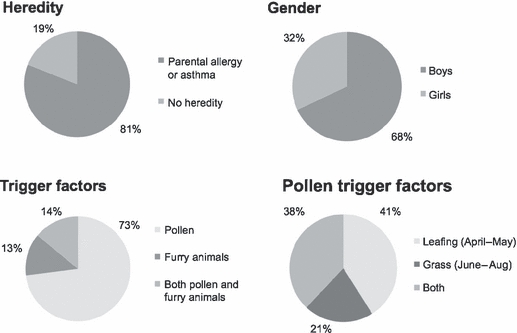
Allergic heredity plays a major role in the development of allergic rhinitis. In addition the introduction of food may influence the risk of subsequent allergic disease. The aim of this study was to analyse early risk factors and protective factors for allergic rhinitis at preschool age. Data were obtained from a prospective, longitudinal study of a cohort of children born in the region of western Sweden in 2003 and 8,176 families (50% of the birth cohort) were randomly selected. The parents answered questionnaires at 6 and 12 months and at 4½ yr of age. The response rate at 4½ yr was 4,496, i.e. 83% of the 5,398 questionnaires distributed at 4½ yr. At 4½ yr of age, 5.5% reported symptoms of allergic rhinitis during the last year. In the multivariate analysis, independent risk factors for allergic rhinitis were: allergic sensitisation to food allergens at 4½ yr (OR 10.21; 95% confidence interval 4.22-24.73), recurrent wheeze at 4½ yr (3.33; 1.56-7.10), doctor-diagnosed eczema at 4½ yr (2.72; 1.62-4.55), parental rhinitis (2.21; 1.39-3.53), eczema first year (1.97; 1.19-3.26) and male gender (1.82; 1.13-2.94). The risk was reduced with fish introduction before 9 months (0.49; 0.29-0.82). In conclusion, we found that previous and present allergic disease, heredity and male gender increased the risk of allergic rhinitis at 4½ yr of age. The introduction of fish before the age of 9 months reduced the risk.
过敏遗传在过敏性鼻炎的发展中起着重要作用。此外,食物的引入可能会影响随后发生过敏疾病的风险。本研究的目的是分析学龄前儿童过敏性鼻炎的早期危险因素和保护因素。数据来自于 2003 年在瑞典西部一个地区出生的队列的前瞻性、纵向研究,随机选择了 8176 个家庭(出生队列的 50%)。父母在 6 个月和 12 个月以及 4 岁半时回答了问卷。4 岁半时的回复率为 4496 人,即 5398 份 4 岁半时分发的问卷中有 83%。在 4 岁半时,有 5.5%的人报告在过去一年中有过敏性鼻炎症状。在多变量分析中,过敏性鼻炎的独立危险因素包括:4 岁半时对食物过敏原过敏(OR 10.21;95%置信区间 4.22-24.73)、4 岁半时反复喘息(3.33;1.56-7.10)、4 岁半时医生诊断的特应性皮炎(2.72;1.62-4.55)、父母的鼻炎(2.21;1.39-3.53)、婴儿期湿疹(1.97;1.19-3.26)和男性性别(1.82;1.13-2.94)。9 个月前引入鱼类可降低风险(0.49;0.29-0.82)。总之,我们发现以前和现在的过敏疾病、遗传和男性性别增加了 4 岁半时患过敏性鼻炎的风险。9 个月前引入鱼类可降低风险。