Department of Radiology and Radiological Sciences, Vanderbilt University, Nashville, Tennessee 37232-2310, USA.
Magn Reson Med. 2011 Sep;66(3):831-8. doi: 10.1002/mrm.22862. Epub 2011 Mar 22.
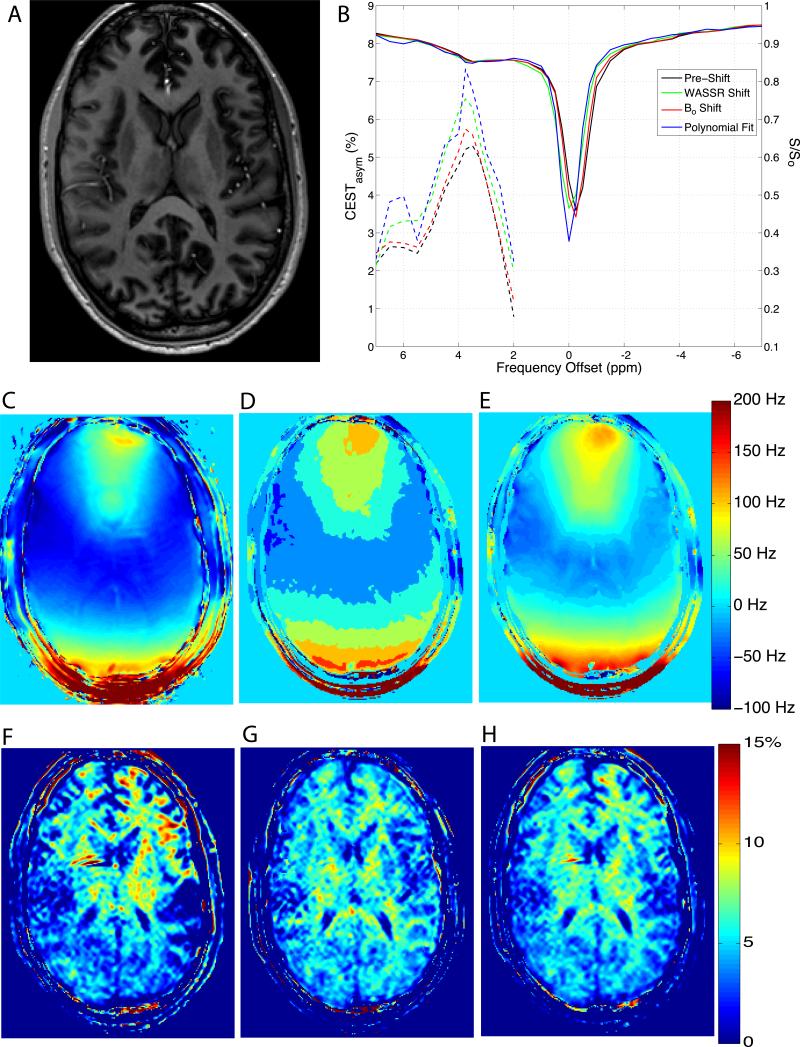
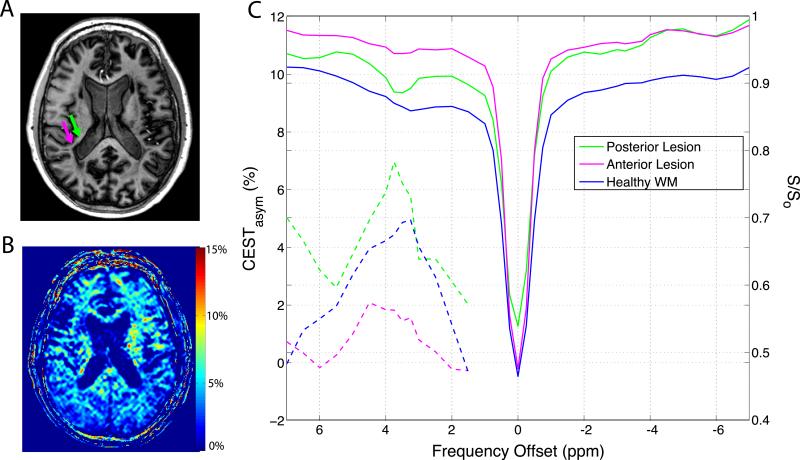
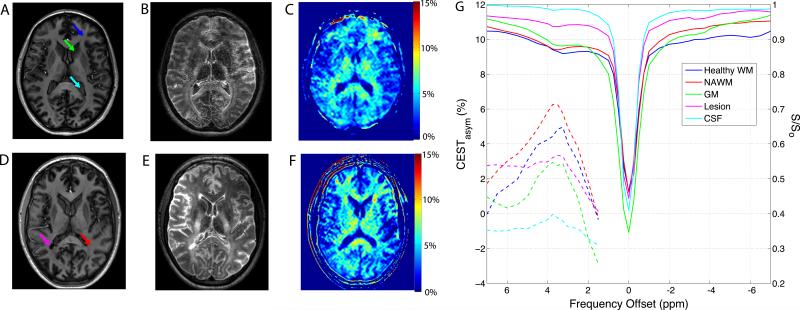
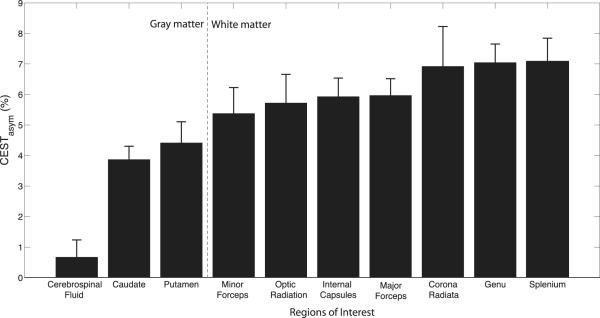
Chemical exchange saturation transfer (CEST) MRI is a molecular imaging method that has previously been successful at reporting variations in tissue protein and glycogen contents and pH. We have implemented amide proton transfer (APT), a specific form of chemical exchange saturation transfer imaging, at high field (7 T) and used it to study healthy human subjects and patients with multiple sclerosis. The effects of static field inhomogeneities were mitigated using a water saturation shift referencing method to center each z-spectrum on a voxel-by-voxel basis. Contrary to results obtained at lower fields, APT imaging at 7 T revealed significant contrast between white and gray matters, with a higher APT signal apparent within the white matter. Preliminary studies of multiple sclerosis showed that the APT asymmetry varied with the type of lesion examined. An increase in APT asymmetry relative to healthy tissue was found in some lesions. These results indicate the potential utility of APT at high field as a noninvasive biomarker of white matter pathology, providing complementary information to other MRI methods in current clinical use.
化学交换饱和传递(CEST)MRI 是一种分子影像学方法,先前已成功用于报告组织中蛋白质和糖原含量及 pH 值的变化。我们在高场(7T)下实现了酰胺质子转移(APT),一种特定形式的化学交换饱和传递成像,并用其研究了健康的人类受试者和多发性硬化症患者。通过使用水饱和移位参照方法来减轻静态磁场不均匀性的影响,以在每个体素的基础上使每个 z 谱居中。与较低场获得的结果相反,7T 的 APT 成像显示出白质和灰质之间的显著对比,白质内的 APT 信号明显更高。对多发性硬化症的初步研究表明,APT 不对称性随所检查的病变类型而变化。在一些病变中,相对于健康组织,APT 不对称性增加。这些结果表明,高场 APT 作为白质病理学的非侵入性生物标志物具有潜在的效用,为当前临床使用的其他 MRI 方法提供了补充信息。