Department of Psychology and Neuroscience, University of Massachusetts-Amherst, 135 Hicks Way, Amherst, MA 01003, USA.
J Sleep Res. 2012 Feb;21(1):30-9. doi: 10.1111/j.1365-2869.2011.00921.x. Epub 2011 Apr 27.
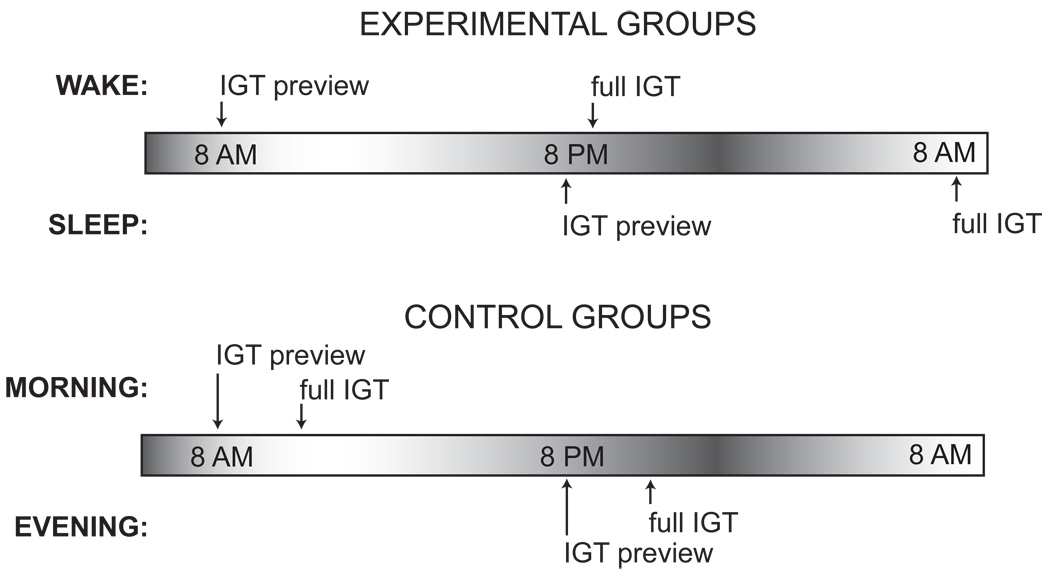
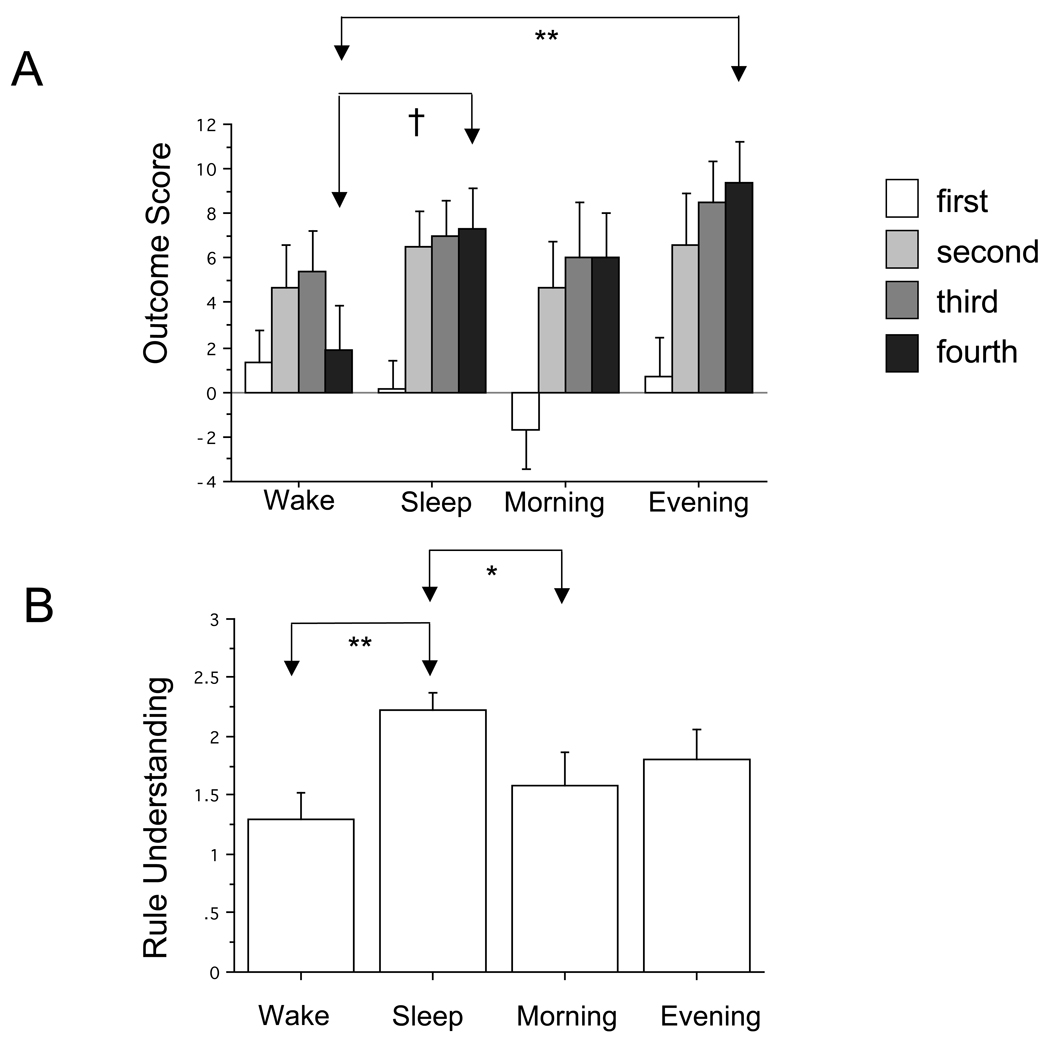
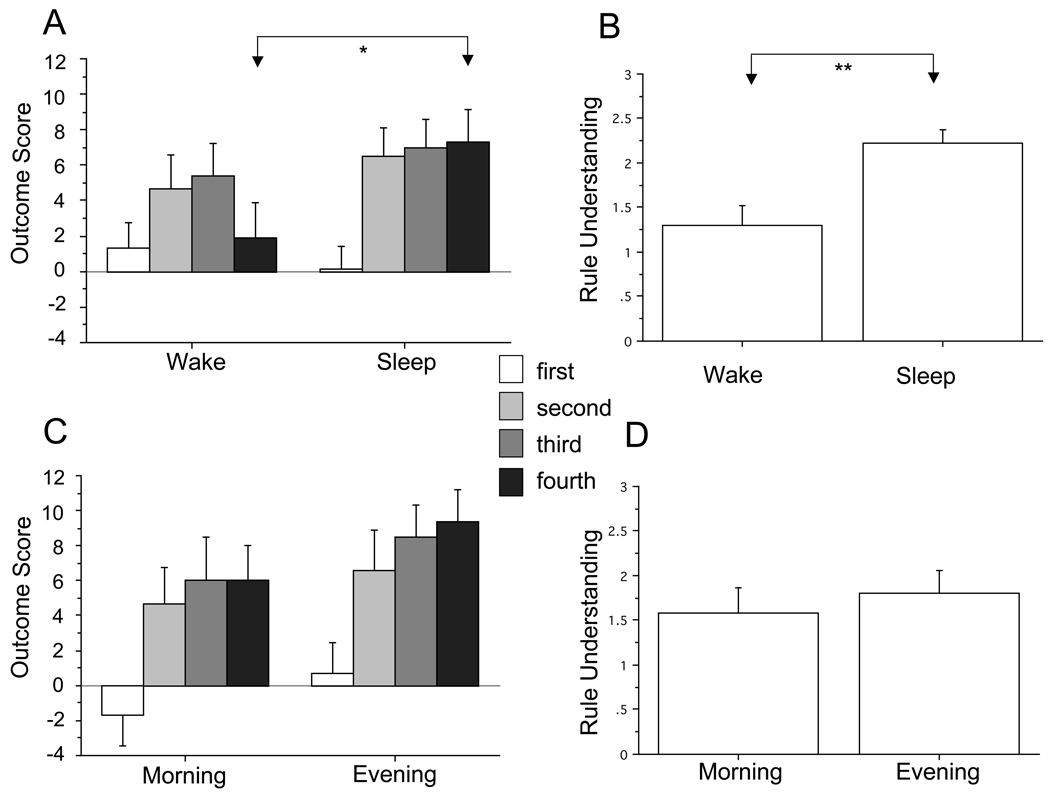
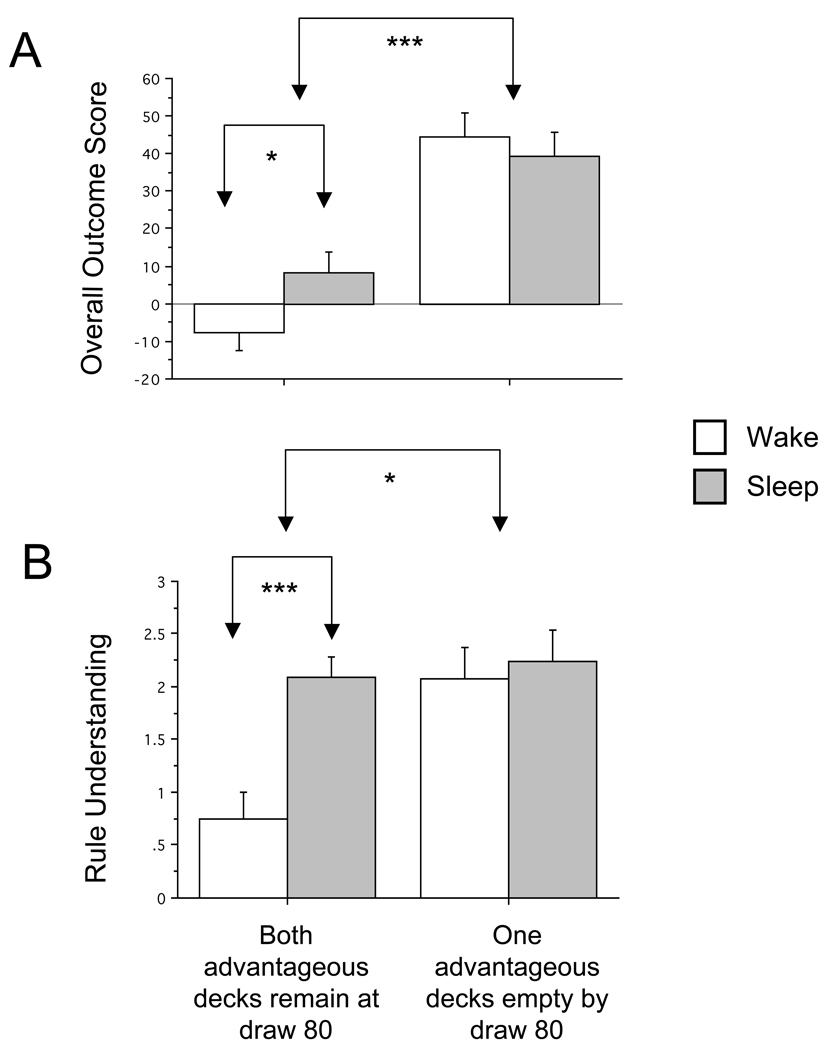
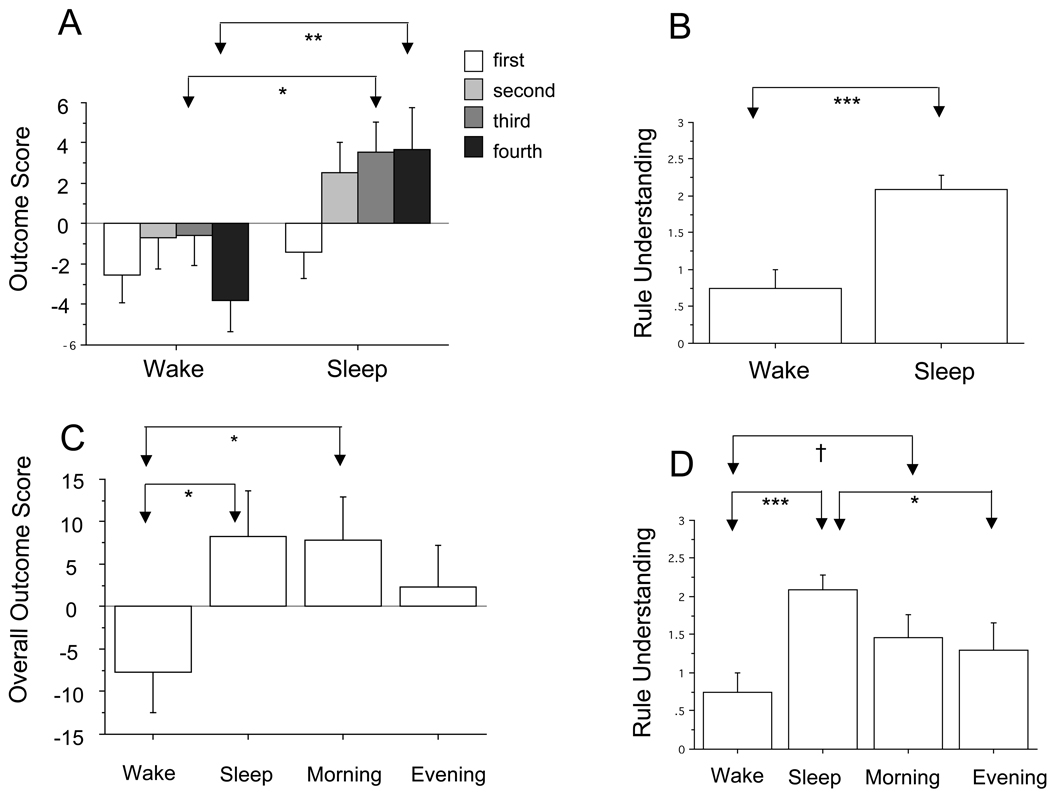
A question of great interest in current sleep research is whether and how sleep might facilitate complex cognitive skills such as decision-making. The Iowa Gambling Task (IGT) was used to investigate effects of sleep on affect-guided decision-making. After a brief standardized preview of the IGT that was insufficient to learn its underlying rule, participants underwent a 12-h delay containing either a normal night's sleep (Sleep group; N = 28) or continuous daytime wake (Wake group; N = 26). Following the delay, both groups performed the full IGT. To control for circadian effects, two additional groups performed both the preview and the full task either in the morning (N = 17) or the evening (N = 21). In the IGT, four decks of cards were presented. Draws from two 'advantageous decks' yielded low play-money rewards, occasional low losses and, over multiple draws, a net gain. Draws from 'disadvantageous' decks yielded high rewards, occasional high losses and, over multiple draws, a net loss. Participants were instructed to win and avoid losing as much as possible, and better performance was defined as more advantageous draws. Relative to the wake group, the sleep group showed both superior behavioral outcome (more advantageous draws) and superior rule understanding (blindly judged from statements written at task completion). Neither measure differentiated the two control groups. These results illustrate a role of sleep in optimizing decision-making, a benefit that may be brought about by changes in underlying emotional or cognitive processes.
当前睡眠研究中的一个重要问题是,睡眠是否以及如何促进复杂认知技能,如决策。本研究采用 Iowa 赌博任务(IGT)来探究睡眠对情绪引导决策的影响。在对 IGT 进行短暂的标准化预测试后,参与者被安排 12 小时的延迟,包括正常的夜间睡眠(睡眠组,N=28)或持续的白天觉醒(觉醒组,N=26)。延迟后,两组均进行完整的 IGT 测试。为了控制昼夜节律的影响,另外两组在上午(N=17)或晚上(N=21)进行了完整的预测试和测试。在 IGT 中,呈现了四组牌。从两个“有利牌组”中抽取会产生低的游戏货币奖励,偶尔会有低损失,并且在多次抽取后会有净收益。从“不利牌组”中抽取会产生高奖励,偶尔会有高损失,并且在多次抽取后会有净损失。参与者被指示尽可能多地赢,避免输,更好的表现被定义为更多的有利抽取。与觉醒组相比,睡眠组表现出更好的行为结果(更多的有利抽取)和更好的规则理解(盲目地从任务完成时的陈述中判断)。这两个措施都没有区分两组对照组。这些结果表明,睡眠在优化决策方面起着作用,这种好处可能是由于潜在的情感或认知过程的变化带来的。