Department of Psychology, Cornell University, Ithaca, New York 14853, USA.
Hippocampus. 2012 Apr;22(4):906-13. doi: 10.1002/hipo.20953. Epub 2011 May 3.
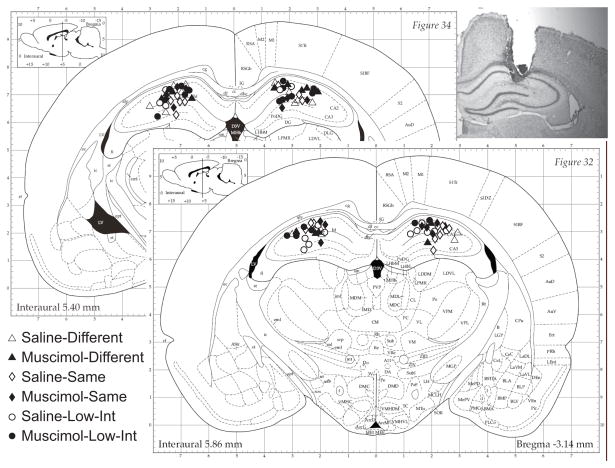
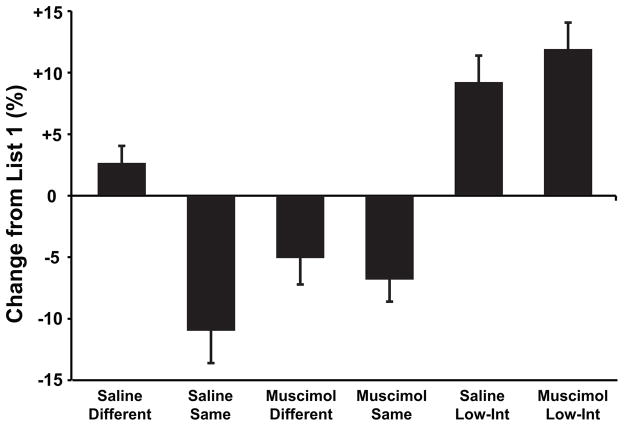
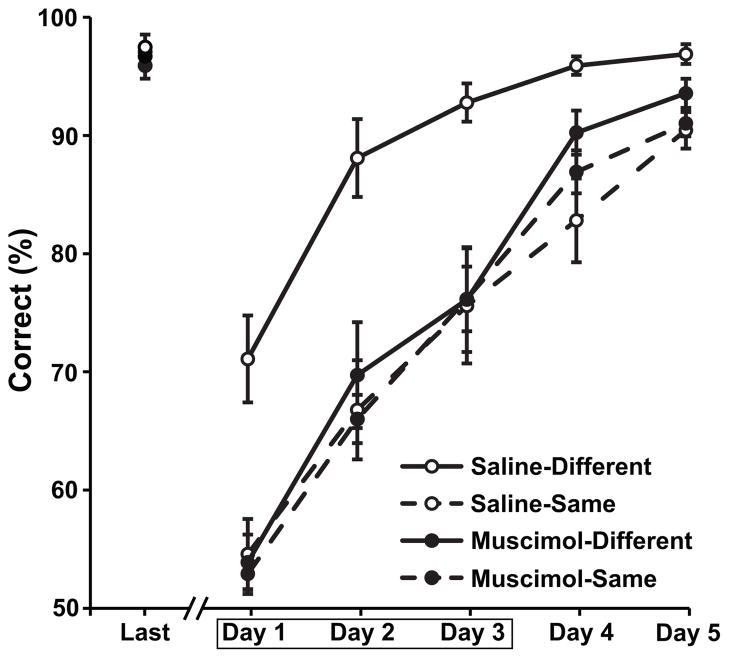
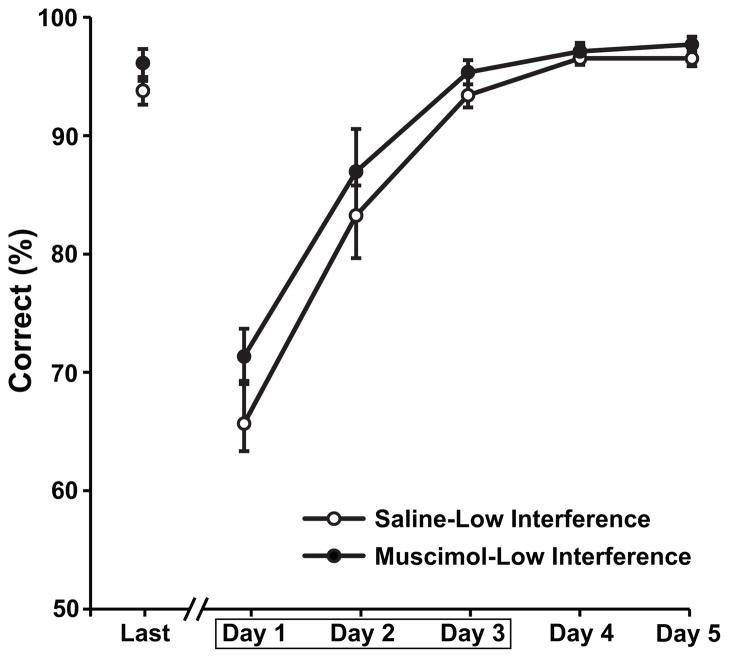
Interference is a critical problem for memory systems and a primary cause of retrieval failure. One strategy for minimizing interference is to associate the items to be remembered with the context in which they were learned. For example, human subjects who learn two lists of words in separate contexts experience less interference and better recall than subjects who learn both lists in the same context. The hippocampus has long been known to be involved in processing contextual information and recent studies have shown that hippocampal neurons exhibit context-unique firing patterns that could serve as a neural representation of the context. These observations suggest that hippocampal context processing may play a critical role in overcoming interference. To test this hypothesis, we adapted the context based list learning procedure for use with rats. Control rats and rats given temporary lesions of the hippocampus were trained on two lists of eight odor pairs, either in the same context or in different contexts. To induce interference, some of the odors appeared on both lists with their predictive value reversed. As with human subjects, rats that learned the two lists in different contexts performed significantly better than rats that learned the lists in the same context. However, hippocampal lesions completely abolished this contextual learning advantage. We also trained rats on a low interference version of the task by using lists that did not contain any common items. Interestingly, rats with hippocampal lesions were entirely unimpaired when the learning situation did not involve high levels of interference. These findings are consistent with the idea that the hippocampus encodes contexts and further suggest that hippocampal context coding is beneficial because it provides a means of overcoming interference.
干扰是记忆系统的一个关键问题,也是检索失败的主要原因。最小化干扰的一种策略是将要记住的项目与它们被学习的上下文相关联。例如,在不同的上下文中学习两列表词的人类受试者比在相同的上下文中学习两列表词的受试者经历的干扰更小,回忆效果更好。海马体长期以来一直被认为参与处理上下文信息,最近的研究表明,海马体神经元表现出独特的上下文放电模式,可作为上下文的神经表示。这些观察结果表明,海马体的上下文处理可能在克服干扰方面发挥关键作用。为了验证这一假设,我们改编了基于上下文的列表学习程序,用于大鼠。对照组大鼠和海马体临时损伤大鼠分别在相同或不同的上下文中接受两列表(8 对气味)的训练。为了引起干扰,一些气味在两列表中都出现了,但预测值是相反的。与人类受试者一样,在不同的上下文中学习两列表的大鼠的表现明显优于在相同的上下文中学习两列表的大鼠。然而,海马体损伤完全消除了这种上下文学习优势。我们还通过使用不包含任何共同项目的列表来训练大鼠进行低干扰版本的任务。有趣的是,当学习情境不涉及高水平干扰时,海马体损伤的大鼠完全不受影响。这些发现与海马体编码上下文的观点一致,并进一步表明海马体的上下文编码是有益的,因为它提供了一种克服干扰的方法。