Lewis-Sigler Institute for Integrative Genomics, Princeton University, Princeton, New Jersey 08544, USA.
Genetics. 2011 Jul;188(3):647-61. doi: 10.1534/genetics.111.128942. Epub 2011 May 5.
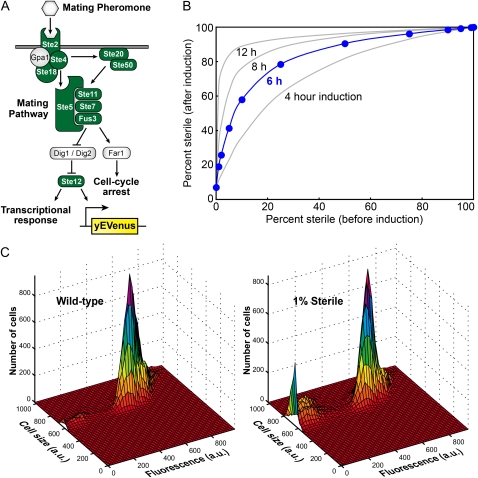
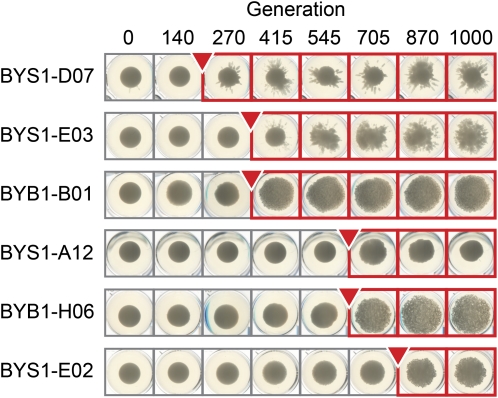
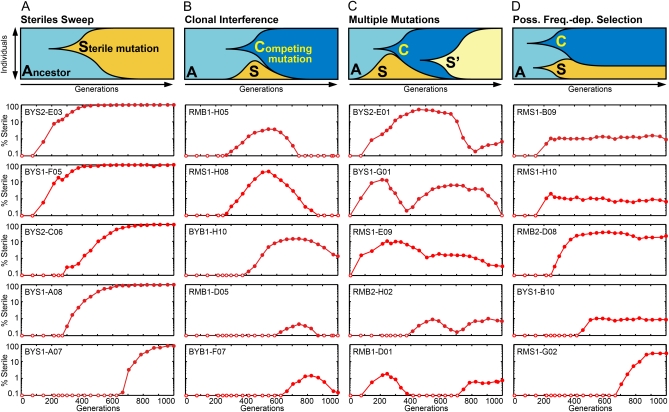
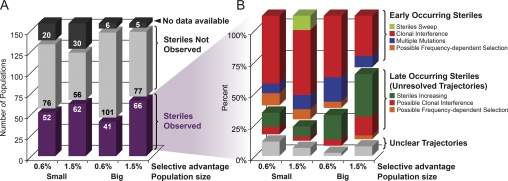
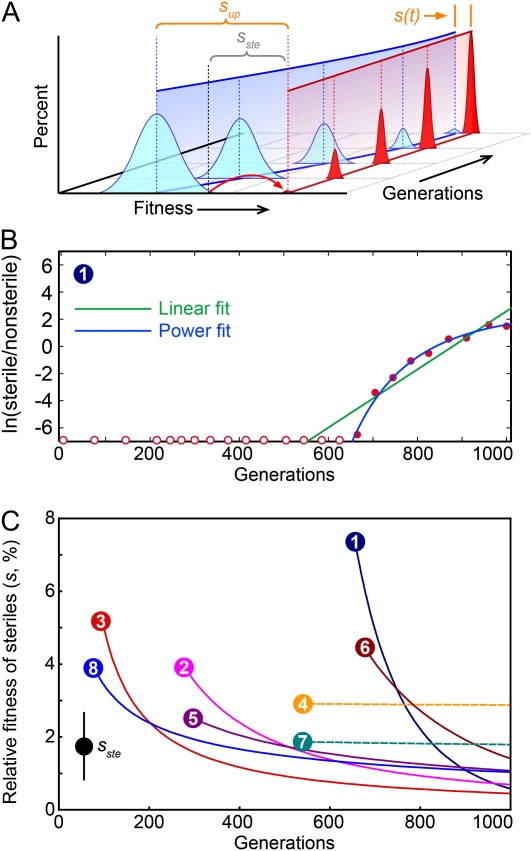
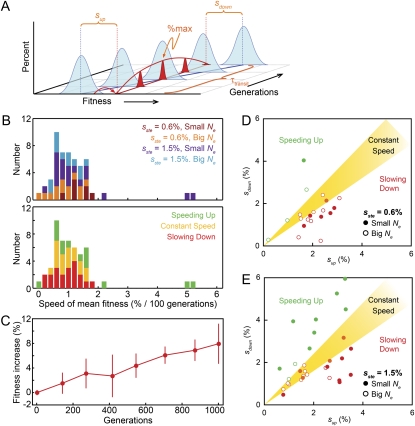
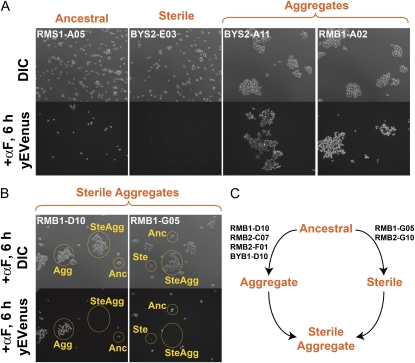
The fate of a newly arising beneficial mutation depends on many factors, such as the population size and the availability and fitness effects of other mutations that accumulate in the population. It has proved difficult to understand how these factors influence the trajectories of particular mutations, since experiments have primarily focused on characterizing successful clones emerging from a small number of evolving populations. Here, we present the results of a massively parallel experiment designed to measure the full spectrum of possible fates of new beneficial mutations in hundreds of experimental yeast populations, whether these mutations are ultimately successful or not. Using strains in which a particular class of beneficial mutation is detectable by fluorescence, we followed the trajectories of these beneficial mutations across 592 independent populations for 1000 generations. We find that the fitness advantage provided by individual mutations plays a surprisingly small role. Rather, underlying "background" genetic variation is quickly generated in our initially clonal populations and plays a crucial role in determining the fate of each individual beneficial mutation in the evolving population.
新出现的有利突变的命运取决于许多因素,例如种群大小以及在种群中积累的其他有利突变的可用性和适合度效应。由于实验主要集中在描述从小规模进化种群中出现的成功克隆,因此很难理解这些因素如何影响特定突变的轨迹。在这里,我们介绍了一项大规模平行实验的结果,该实验旨在测量数百个实验酵母种群中有利新突变的所有可能命运,无论这些突变最终是否成功。使用可以通过荧光检测特定类有益突变的菌株,我们在 592 个独立种群中追踪这些有益突变的轨迹,历时 1000 代。我们发现,单个突变提供的适应性优势作用很小。相反,在我们最初的克隆种群中迅速产生了潜在的“背景”遗传变异,并在决定进化种群中每个有益突变的命运方面起着关键作用。