MIN Faculty, Health Sciences and Education, University Hamburg, Martin-Luther-King Platz 6, D-20146 Hamburg, Germany.
BMJ. 2011 Jun 2;342:d3193. doi: 10.1136/bmj.d3193.
To compare the effect of evidence based information on risk with that of standard information on informed choice in screening for colorectal cancer.
Randomised controlled trial with 6 months' follow-up.
German statutory health insurance scheme.
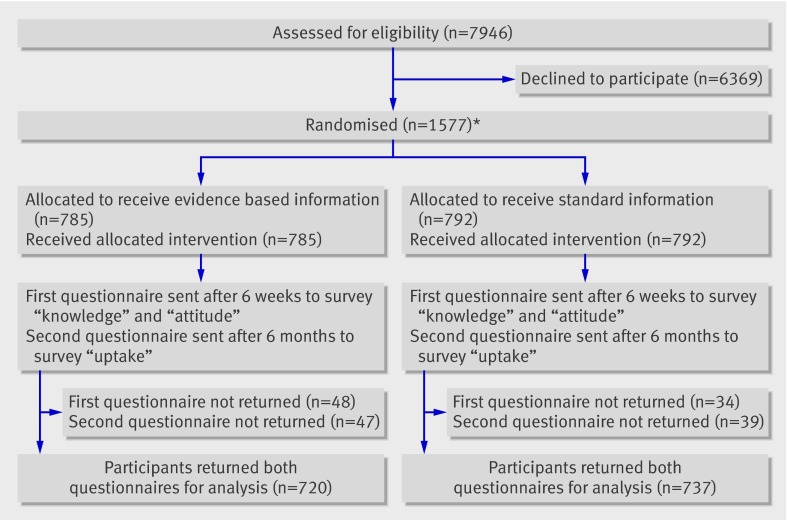
1577 insured people who were members of the target group for colorectal cancer screening (age 50-75, no history of colorectal cancer).
Brochure with evidence based risk information on colorectal cancer screening and two optional interactive internet modules on risk and diagnostic tests; official information leaflet of the German colorectal cancer screening programme (control).
The primary end point was "informed choice," comprising "knowledge," "attitude," and "combination of actual and planned uptake." Secondary outcomes were "knowledge" and "combination of actual and planned uptake." Knowledge and attitude were assessed after 6 weeks and combination of actual and planned uptake of screening after 6 months.
The response rate for return of both questionnaires was 92.4% (n = 1457). 345/785 (44.0%) participants in the intervention group made an informed choice, compared with 101/792 (12.8%) in the control group (difference 31.2%, 99% confidence interval 25.7% to 36.7%; P < 0.001). More intervention group participants had "good knowledge" (59.6% (n = 468) v 16.2% (128); difference 43.5%, 37.8% to 49.1%; P < 0.001). A "positive attitude" towards colorectal screening prevailed in both groups but was significantly lower in the intervention group (93.4% (733) v 96.5% (764); difference -3.1%, -5.9% to -0.3%; P<0.01). The intervention had no effect on the combination of actual and planned uptake (72.4% (568) v 72.9% (577); P = 0.87).
Evidence based risk information on colorectal cancer screening increased informed choices and improved knowledge, with little change in attitudes. The intervention did not affect the combination of actual and planned uptake of screening. Trial registration Current Controlled Trials ISRCTN47105521.
比较循证信息对风险的影响与标准信息对结直肠癌筛查中知情选择的影响。
6 个月随访的随机对照试验。
德国法定健康保险计划。
1577 名符合结直肠癌筛查目标人群(年龄 50-75 岁,无结直肠癌病史)的被保险人。
结直肠癌筛查的循证风险信息手册和两个可选的风险和诊断测试互动互联网模块;德国结直肠癌筛查计划的官方信息传单(对照)。
主要终点为“知情选择”,包括“知识”、“态度”和“实际和计划接受率的组合”。次要结果是“知识”和“实际和计划接受率的组合”。在 6 周后评估知识和态度,在 6 个月后评估实际和计划接受筛查的组合。
返回两份问卷的应答率为 92.4%(n=1457)。干预组有 345/785(44.0%)参与者做出了知情选择,而对照组有 101/792(12.8%)(差异 31.2%,99%置信区间 25.7%至 36.7%;P<0.001)。干预组更多的参与者有“良好的知识”(59.6%(n=468)比 16.2%(128);差异 43.5%,37.8%至 49.1%;P<0.001)。两组对结直肠筛查的“积极态度”占优势,但干预组明显较低(93.4%(733)比 96.5%(764);差异-3.1%,-5.9%至-0.3%;P<0.01)。该干预措施对实际和计划接受筛查的组合没有影响(72.4%(568)比 72.9%(577);P=0.87)。
结直肠癌筛查的循证风险信息增加了知情选择,并提高了知识,态度变化不大。该干预措施并未影响实际和计划接受筛查的组合。
当前对照试验 ISRCTN47105521。