Amirjamshidi Abbas, Ardalan Ali, Nainei Kourosh Holakouie, Sadeghi Sadegh, Pahlevani Mehrdad, Zarei Mohammad Reza
Department of Neurosurgery, Sina Hospital, Tehran University of Medical Sciences, Tehran, Iran.
Surg Neurol Int. 2011;2:49. doi: 10.4103/2152-7806.79771. Epub 2011 Apr 20.
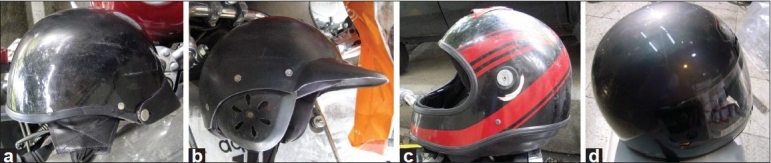
The literature does not offer the rate of protection provided by different types of helmets used, especially as it applies to developing countries. We hypothesize that standard versus nonstandard types of helmets might differ in the rate of complications of head and neck trauma occurring in victims of motorcycle accidents. Here we report the rate of occurrence, the type of injuries and differences thereof in standard and nonstandard helmet bearers, and its relevance to protection from serious injury.
The data were gathered from a data set of motorcycle accident victims admitted to the emergency department of Sina Hospital (Teheran/Iran). A cross-sectional study was designed for a 6-month period of time, June to December 2007. Variants analyzed included: demographics, types of helmets used, level of education of the victims (as in: being trained for using helmets and status of holding a valid driving license). The latter variants were evaluated for possibly influencing the outcome of the injured motorcyclists using either kind of helmets.
Among a total of 576 injured motorcyclists who had head, face, or neck injuries, 432 (75%) were using some kind of helmet. A total of 144 (25%) of the injured patients were admitted to the neurosurgical emergency service. There were 100 patients whose data sheets contained all variables which could be included in the pilot analysis of this cohort.
All 100 subjects were male patients with the age range of 32 ± 11 years. Twenty-five percent were using standard helmets at the time of accident, 43% had no cranio-facio-cervical injury except very mild skin abrasions, and 23% had facial injury, including skin lacerations needing sutures, two nasal bone fractures, and no maxillofacial damage. Among the patients using standard helmets, 44% had head injuries which needed to be taken care of (mostly nonoperatively), while 61% using nonstandard helmets had head trauma (P > 0.05). The other variables did not reach a significant value affecting the use of either standard or nonstandard helmets in prevention of craniofacial damages.
This pilot analysis (comprising the data from 100 cases of motorcycle accidents) could not demonstrate statistically significant differences in injury patterns of different types of helmets and variants influencing their respective use. However, it can lead the way for further analysis of larger and more comprehensive head trauma databases regarding factors contributing to the issue of head injury.
文献中未提及不同类型头盔所提供的防护率,尤其是在发展中国家的情况。我们推测,标准型头盔与非标准型头盔在摩托车事故受害者发生头颈部创伤的并发症发生率方面可能存在差异。在此,我们报告标准型和非标准型头盔佩戴者的损伤发生率、损伤类型及其差异,以及其与预防严重损伤的相关性。
数据收集自德黑兰伊玛目霍梅尼医院急诊科收治的摩托车事故受害者数据集。设计了一项为期6个月(2007年6月至12月)的横断面研究。分析的变量包括:人口统计学特征、使用的头盔类型、受害者的教育程度(如:是否接受过头盔使用培训以及是否持有有效驾驶执照)。对后两个变量进行评估,以确定其是否可能影响使用任何一种头盔的受伤摩托车手的结局。
在总共576名头面部或颈部受伤的摩托车事故伤者中,432人(75%)佩戴了某种头盔。共有144名(25%)受伤患者被收治入神经外科急诊。有100名患者的数据表包含了可纳入该队列初步分析的所有变量。
所有100名受试者均为男性患者,年龄范围为32±11岁。25%的患者在事故发生时佩戴标准头盔,43%的患者除非常轻微的皮肤擦伤外无颅面颈部损伤,23%的患者有面部损伤,包括需要缝合的皮肤裂伤、两处鼻骨骨折,无颌面损伤。在佩戴标准头盔的患者中,44%有需要处理的头部损伤(大多为非手术治疗),而佩戴非标准头盔的患者中有61%有头部创伤(P>0.05)。其他变量在影响标准或非标准头盔预防颅面损伤的使用方面未达到显著水平。
这项初步分析(包括100例摩托车事故的数据)未能证明不同类型头盔的损伤模式以及影响其各自使用的变量之间存在统计学上的显著差异。然而,它可为进一步分析更大、更全面的头部创伤数据库中导致头部损伤问题的因素指明方向。