Department of Emergency Medicine, Asan Medical Center, University of Ulsan College of Medicine, Songpa-gu, Seoul, Korea.
Influenza Other Respir Viruses. 2011 Nov;5(6):398-403. doi: 10.1111/j.1750-2659.2011.00244.x. Epub 2011 Mar 30.
Mixed bacterial infection is an important contributor to morbidity and mortality during influenza pandemics. We evaluated procalcitonin (PCT) and C-reactive protein (CRP) in differentiating pneumonia caused by mixed bacterial and 2009 H1N1 influenza infection from 2009 H1N1 influenza infection alone.
Data were collected retrospectively over a 7-month period during the 2009 H1N1 influenza pandemic. Patients visiting emergency department and diagnosed as community-acquired pneumonia caused by 2009 H1N1 infection were included (n = 60).
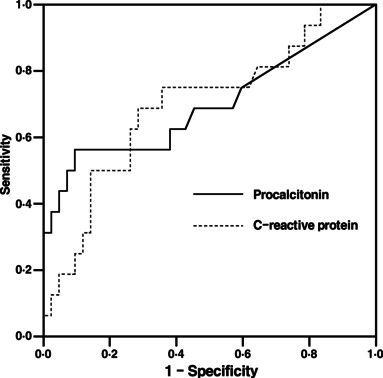
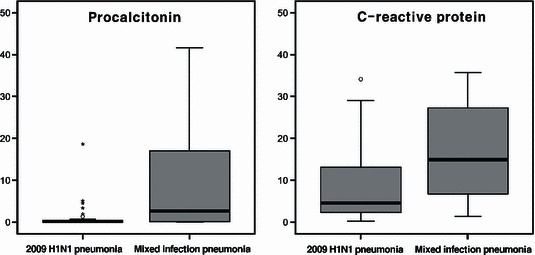
Mixed bacterial and viral infection pneumonia (n = 16) had significantly higher PCT and CRP levels than pneumonia caused by 2009 H1N1 influenza alone (n = 44, P = 0·019, 0·022 respectively). The sensitivity and specificity for detection of mixed bacterial infection pneumonia was 56% and 84% for PCT > 1·5 ng/ml, and 69% and 63% for CRP > 10 mg/dl. Using PCT and CRP in combination, the sensitivity and specificity were 50% and 93%, respectively.
Procalcitonin and CRP alone and their combination had a moderate ability to detect pneumonia of mixed bacterial infection during the 2009 H1N1 pandemic. Considering high specificity, combination of low CRP and PCT result may suggest that pneumonia is unlikely to be caused by mixed bacterial infection.
混合细菌感染是流感大流行期间发病率和死亡率的重要原因。我们评估降钙素原(PCT)和 C 反应蛋白(CRP)在区分由混合细菌和 2009 年 H1N1 流感引起的肺炎与单纯由 2009 年 H1N1 流感引起的肺炎中的作用。
数据是在 2009 年 H1N1 流感大流行期间的 7 个月内回顾性收集的。共纳入了因 2009 年 H1N1 感染而就诊于急诊科并被诊断为社区获得性肺炎的患者(n = 60)。
混合细菌和病毒感染性肺炎(n = 16)的 PCT 和 CRP 水平明显高于单纯由 2009 年 H1N1 流感引起的肺炎(n = 44,P = 0·019,0·022)。PCT > 1·5 ng/ml 检测混合细菌感染性肺炎的敏感性和特异性分别为 56%和 84%,CRP > 10 mg/dl 的敏感性和特异性分别为 69%和 63%。PCT 和 CRP 联合使用的敏感性和特异性分别为 50%和 93%。
单独使用 PCT 和 CRP 及其组合在检测 2009 年 H1N1 大流行期间的混合细菌感染性肺炎方面具有中等能力。考虑到高特异性,低 CRP 和 PCT 结果的组合可能提示肺炎不太可能由混合细菌感染引起。