Division of Cardiovascular Medicine, University of Michigan, Ann Arbor, Michigan, USA.
Environ Health Perspect. 2011 May;119(5):688-94. doi: 10.1289/ehp.1002107.
Levels of fine particulate matter [≤ 2.5 μm in aerodynamic diameter (PM(2.5))] are associated with alterations in arterial hemodynamics and vascular function. However, the characteristics of the same-day exposure-response relationships remain unclear.
We aimed to explore the effects of personal PM(2.5) exposures within the preceding 24 hr on blood pressure (BP), heart rate (HR), brachial artery diameter (BAD), endothelial function [flow-mediated dilatation (FMD)], and nitroglycerin-mediated dilatation (NMD).
Fifty-one nonsmoking subjects had up to 5 consecutive days of 24-hr personal PM(2.5) monitoring and daily cardiovascular (CV) measurements during summer and/or winter periods. The associations between integrated hour-long total personal PM(2.5) exposure (TPE) levels (continuous nephelometry among compliant subjects with low secondhand tobacco smoke exposures; n = 30) with the CV outcomes were assessed over a 24-hr period by linear mixed models.
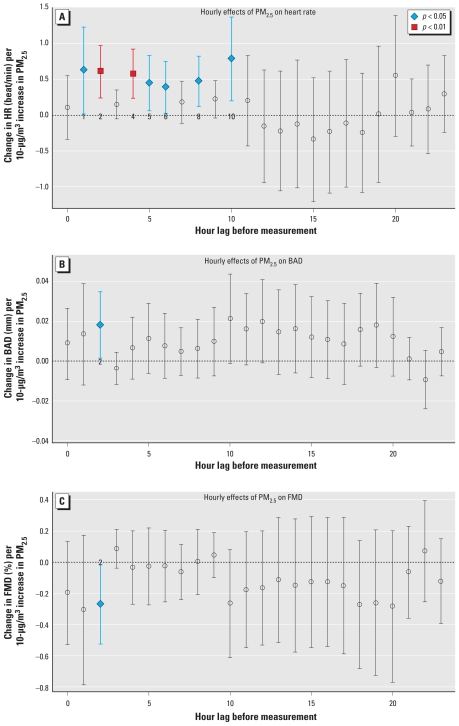
We observed the strongest associations (and smallest estimation errors) between HR and TPE recorded 1-10 hr before CV measurements. The associations were not pronounced for the other time lags (11-24 hr). The associations between TPE and FMD or BAD did not show as clear a temporal pattern. However, we found some suggestion of a negative association with FMD and a positive association with BAD related to TPE just before measurement (0-2 hr).
Brief elevations in ambient TPE levels encountered during routine daily activity were associated with small increases in HR and trends toward conduit arterial vasodilatation and endothelial dysfunction within a few hours of exposure. These responses could reflect acute PM(2.5)-induced autonomic imbalance and may factor in the associated rapid increase in CV risk among susceptible individuals.
细颗粒物水平[空气动力学直径(PM(2.5))≤2.5μm]与动脉血液动力学和血管功能的改变有关。然而,相同日暴露反应关系的特征尚不清楚。
我们旨在探索前 24 小时内个人 PM(2.5)暴露对血压(BP)、心率(HR)、肱动脉直径(BAD)、内皮功能[血流介导的扩张(FMD)]和硝酸甘油介导的扩张(NMD)的影响。
51 名不吸烟的受试者在夏季和/或冬季期间进行了多达 5 天的 24 小时个人 PM(2.5)监测和日常心血管(CV)测量。通过线性混合模型评估符合条件的低二手烟暴露者(n=30)在 24 小时内连续 1 小时总个人 PM(2.5)暴露(TPE)水平(连续光散射法)与 CV 结果之间的关联。
我们观察到 HR 与 CV 测量前 1-10 小时记录的 TPE 之间的关联最强(估计误差最小)。其他时间滞后(11-24 小时)的关联不明显。TPE 与 FMD 或 BAD 之间的关联没有明显的时间模式。然而,我们发现 TPE 与 FMD 呈负相关,与 BAD 呈正相关,与测量前 0-2 小时的 TPE 相关,这表明 FMD 和 BAD 有一定的关联。
在日常活动中短暂升高的环境 TPE 水平与 HR 略有升高以及暴露后数小时内导血管扩张和内皮功能障碍的趋势有关。这些反应可能反映了急性 PM(2.5)诱导的自主神经失衡,可能是易感个体相关 CV 风险迅速增加的因素之一。