Centre for Infectious Diseases, Division of Pathway Medicine, College of Medicine and Veterinary Medicine, The University of Edinburgh, Edinburgh, United Kingdom.
PLoS Negl Trop Dis. 2011 Jun;5(6):e1211. doi: 10.1371/journal.pntd.0001211. Epub 2011 Jun 21.
Animal and human trypanosomiasis are constraints to both animal and human health in Sub-Saharan Africa, but there is little recent evidence as to how these parasites circulate in wild hosts in natural ecosystems. The Luangwa Valley in Zambia supports high densities of tsetse flies (Glossina species) and is recognised as an historical sleeping sickness focus. The objective of this study was to characterise the nature of the reservoir community for trypanosomiasis in the absence of influence from domesticated hosts.
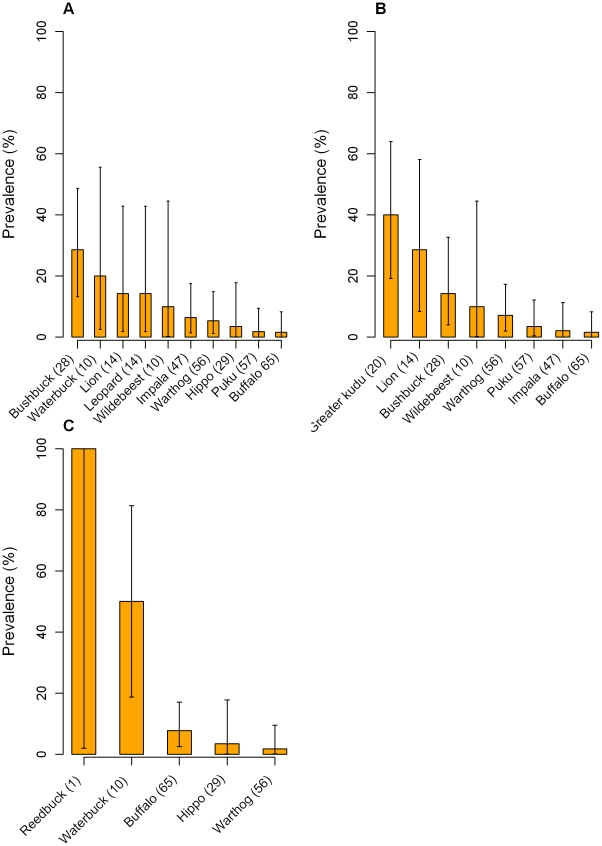
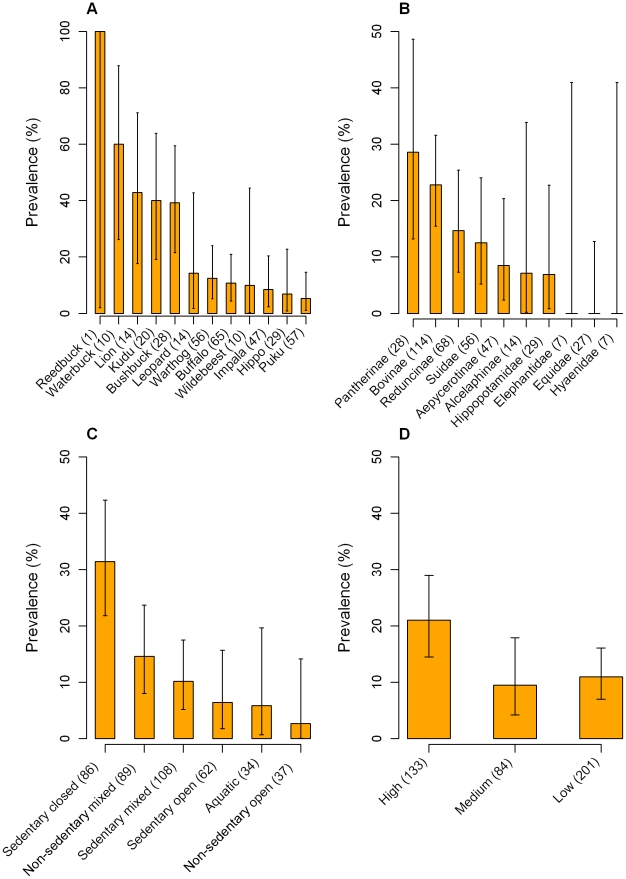
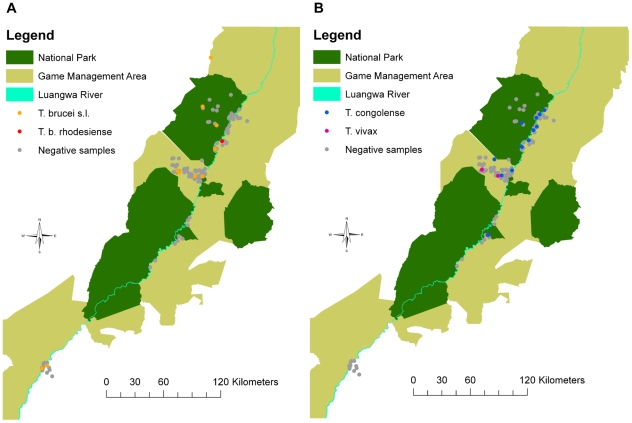
METHODOLOGY/PRINCIPAL FINDINGS: A cross-sectional survey of trypanosome prevalence in wildlife hosts was conducted in the Luangwa Valley from 2005 to 2007. Samples were collected from 418 animals and were examined for the presence of Trypanosoma brucei s.l., T. b. rhodesiense, Trypanosoma congolense and Trypanosoma vivax using molecular diagnostic techniques. The overall prevalence of infection in all species was 13.9% (95% confidence interval [CI]: 10.71-17.57%). Infection was significantly more likely to be detected in waterbuck (Kobus ellipsiprymnus) (Odds ratio [OR]=10.5, 95% CI: 2.36-46.71), lion (Panthera leo) (OR=5.3, 95% CI: 1.40-19.69), greater kudu (Tragelaphus strepsiceros) (OR=4.7, 95% CI: 1.41-15.41) and bushbuck (Tragelaphus scriptus) (OR=4.5, 95% CI: 1.51-13.56). Bushbucks are important hosts for T. brucei s.l. while the Bovidae appear the most important for T. congolense. The epidemiology of T. vivax was less clear, but parasites were detected most frequently in waterbuck. Human infective T. b. rhodesiense were identified for the first time in African buffalo (Syncerus caffer) and T. brucei s.l. in leopard (Panthera pardus). Variation in infection rates was demonstrated at species level rather than at family or sub-family level. A number of significant risk factors interact to influence infection rates in wildlife including taxonomy, habitat and blood meal preference.
Trypanosoma parasites circulate within a wide and diverse host community in this bio-diverse ecosystem. Consistent land use patterns over the last century have resulted in epidemiological stability, but this may be threatened by the recent influx of people and domesticated livestock into the mid-Luangwa Valley.
动物和人类锥虫病是撒哈拉以南非洲地区动物和人类健康的制约因素,但最近几乎没有证据表明这些寄生虫在自然生态系统中的野生动物宿主中是如何循环的。赞比亚的卢安瓜谷拥有大量采采蝇(舌蝇属物种),并被认为是历史上的昏睡病焦点。本研究的目的是在没有驯化宿主影响的情况下,描述锥虫病储存宿主群落的性质。
方法/主要发现:2005 年至 2007 年,在卢安瓜谷对野生动物宿主中的锥虫病流行情况进行了横断面调查。从 418 只动物中采集样本,并使用分子诊断技术检测是否存在布氏锥虫(布鲁斯氏锥虫)、布氏锥虫(罗得西亚种)、刚果锥虫和锥虫(锥虫)。所有物种的总体感染率为 13.9%(95%置信区间[CI]:10.71-17.57%)。在水羚(Kobus ellipsiprymnus)(优势比[OR]=10.5,95%CI:2.36-46.71)、狮子(Panthera leo)(OR=5.3,95%CI:1.40-19.69)、大角斑羚(Tragelaphus strepsiceros)(OR=4.7,95%CI:1.41-15.41)和大羚羊(Tragelaphus scriptus)(OR=4.5,95%CI:1.51-13.56)中,感染的可能性明显更大。大羚羊是布鲁斯氏锥虫的重要宿主,而牛科动物似乎是刚果锥虫的最重要宿主。锥虫的流行病学不太清楚,但在水羚中最常检测到寄生虫。人类感染的罗得西亚锥虫首次在非洲水牛(Syncerus caffer)和豹(Panthera pardus)中被发现。在物种水平上证明了感染率的变化,而不是在科或亚科水平上。一些重要的风险因素相互作用,影响野生动物的感染率,包括分类学、栖息地和血液餐偏好。
在这个生物多样性生态系统中,锥虫寄生虫在广泛而多样的宿主群落中循环。上个世纪以来一致的土地利用模式导致了流行病学的稳定,但最近涌入该地区的人和驯化牲畜可能会对其造成威胁。