Department of Biological and Medical Psychology, University of Bergen, Jonas Lies Vei 91, 5011 Bergen, Norway.
Comput Intell Neurosci. 2011;2011:129365. doi: 10.1155/2011/129365. Epub 2011 Jun 23.
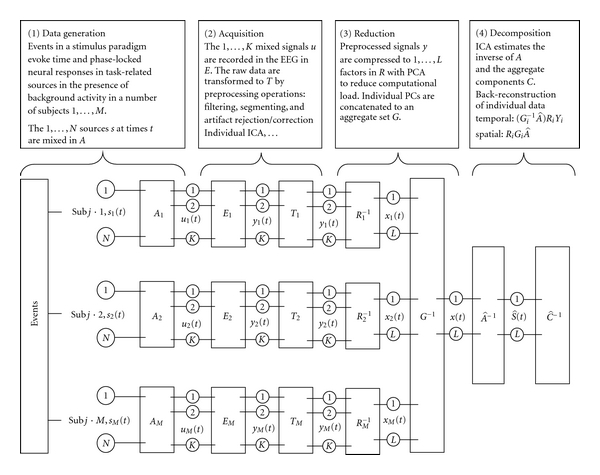
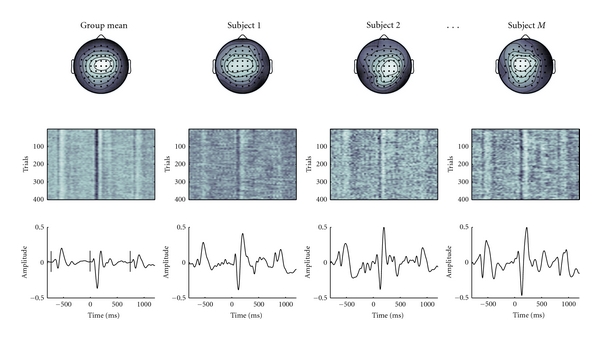
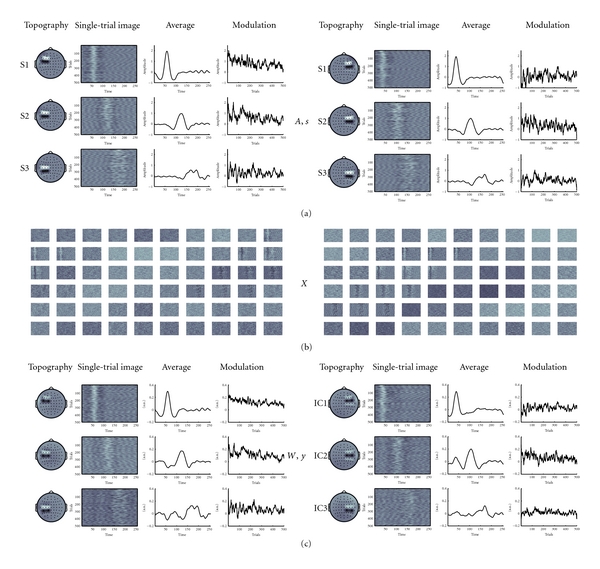
Independent component analysis (ICA) is a powerful method for source separation and has been used for decomposition of EEG, MRI, and concurrent EEG-fMRI data. ICA is not naturally suited to draw group inferences since it is a non-trivial problem to identify and order components across individuals. One solution to this problem is to create aggregate data containing observations from all subjects, estimate a single set of components and then back-reconstruct this in the individual data. Here, we describe such a group-level temporal ICA model for event related EEG. When used for EEG time series analysis, the accuracy of component detection and back-reconstruction with a group model is dependent on the degree of intra- and interindividual time and phase-locking of event related EEG processes. We illustrate this dependency in a group analysis of hybrid data consisting of three simulated event-related sources with varying degrees of latency jitter and variable topographies. Reconstruction accuracy was tested for temporal jitter 1, 2 and 3 times the FWHM of the sources for a number of algorithms. The results indicate that group ICA is adequate for decomposition of single trials with physiological jitter, and reconstructs event related sources with high accuracy.
独立成分分析(ICA)是一种强大的源分离方法,已被用于分解 EEG、MRI 和同时的 EEG-fMRI 数据。由于在个体之间识别和排序成分是一个复杂的问题,因此 ICA 并不自然适合进行群体推断。解决此问题的一种方法是创建包含所有受试者观察结果的聚合数据,估计一组单独的成分,然后在个体数据中反向重建这些成分。在这里,我们为事件相关 EEG 描述了这样一个组水平的时间 ICA 模型。当用于 EEG 时间序列分析时,使用组模型进行成分检测和反向重建的准确性取决于事件相关 EEG 过程的个体内和个体间的时间和相位锁定程度。我们在一个由三个具有不同潜伏期抖动和可变拓扑结构的模拟事件相关源组成的混合数据的组分析中说明了这种依赖性。针对多种算法,我们测试了时间抖动为源的 FWHM 的 1、2 和 3 倍的重建准确性。结果表明,组 ICA 足以分解具有生理抖动的单个试验,并以高精度重建事件相关源。