Department of Information and Communication Engineering, Graduate School of Electro-Communications, The University of Electro-Communications, Chofu-shi, Tokyo, Japan.
PLoS Comput Biol. 2011 Jul;7(7):e1002087. doi: 10.1371/journal.pcbi.1002087. Epub 2011 Jul 14.
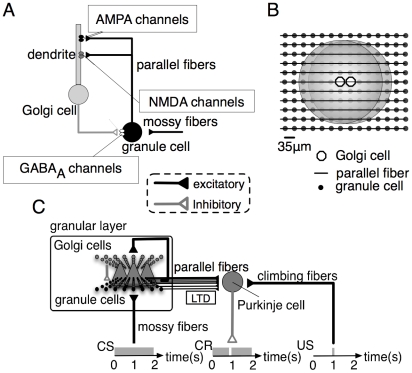
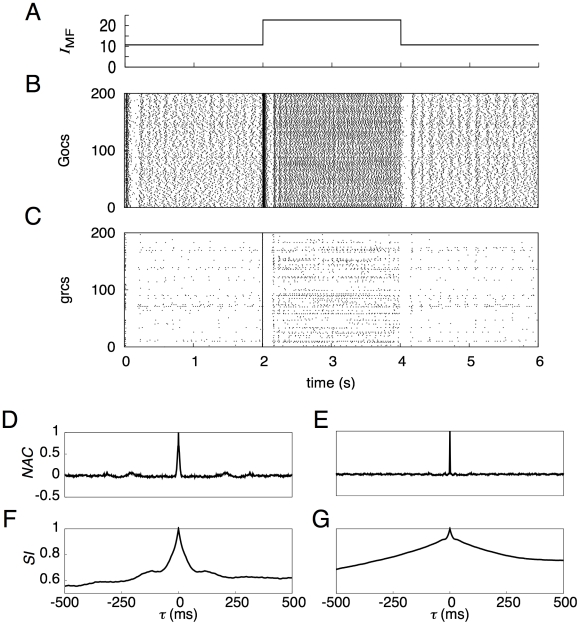
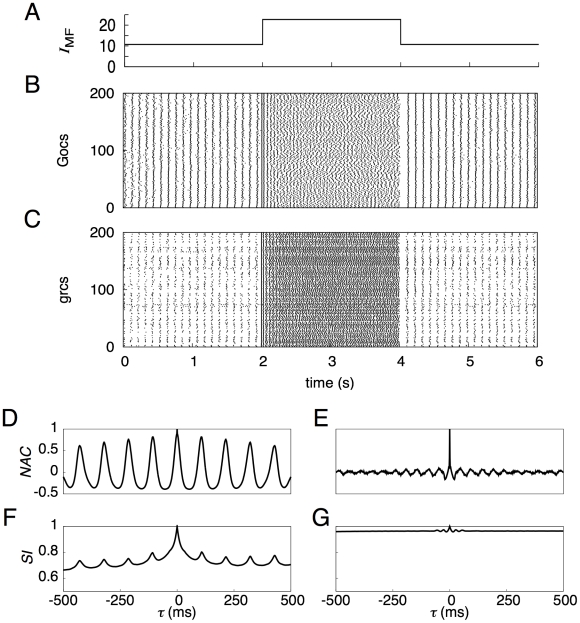
Information processing of the cerebellar granular layer composed of granule and Golgi cells is regarded as an important first step toward the cerebellar computation. Our previous theoretical studies have shown that granule cells can exhibit random alternation between burst and silent modes, which provides a basis of population representation of the passage-of-time (POT) from the onset of external input stimuli. On the other hand, another computational study has reported that granule cells can exhibit synchronized oscillation of activity, as consistent with observed oscillation in local field potential recorded from the granular layer while animals keep still. Here we have a question of whether an identical network model can explain these distinct dynamics. In the present study, we carried out computer simulations based on a spiking network model of the granular layer varying two parameters: the strength of a current injected to granule cells and the concentration of Mg²⁺ which controls the conductance of NMDA channels assumed on the Golgi cell dendrites. The simulations showed that cells in the granular layer can switch activity states between synchronized oscillation and random burst-silent alternation depending on the two parameters. For higher Mg²⁺ concentration and a weaker injected current, granule and Golgi cells elicited spikes synchronously (synchronized oscillation state). In contrast, for lower Mg²⁺ concentration and a stronger injected current, those cells showed the random burst-silent alternation (POT-representing state). It is suggested that NMDA channels on the Golgi cell dendrites play an important role for determining how the granular layer works in response to external input.
小脑颗粒层由颗粒细胞和高尔基细胞组成,其信息处理被认为是小脑计算的重要第一步。我们之前的理论研究表明,颗粒细胞可以在爆发和沉默模式之间随机交替,这为外部输入刺激开始时时间流逝(POT)的群体表示提供了基础。另一方面,另一项计算研究报告称,颗粒细胞可以表现出活动的同步振荡,这与在动物保持静止时从颗粒层记录的局部场电位中观察到的振荡一致。在这里,我们有一个问题,即相同的网络模型是否可以解释这些不同的动力学。在本研究中,我们基于颗粒层的尖峰网络模型进行了计算机模拟,该模型改变了两个参数:注入颗粒细胞的电流强度和控制假定在高尔基细胞树突上的 NMDA 通道电导的 Mg²⁺浓度。模拟表明,颗粒层中的细胞可以根据这两个参数在同步振荡和随机爆发-沉默交替之间切换活动状态。对于较高的 Mg²⁺浓度和较弱的注入电流,颗粒和高尔基细胞同步激发尖峰(同步振荡状态)。相反,对于较低的 Mg²⁺浓度和较强的注入电流,这些细胞表现出随机爆发-沉默交替(POT 表示状态)。这表明,高尔基细胞树突上的 NMDA 通道对于确定颗粒层如何对外界输入做出反应起着重要作用。