Department of Radiation Oncology, Duke University, Durham, North Carolina, 27710, USA.
J Appl Clin Med Phys. 2011 Apr 4;12(3):3495. doi: 10.1120/jacmp.v12i3.3495.
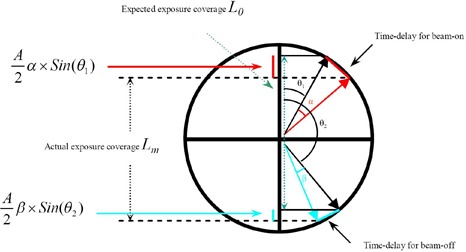
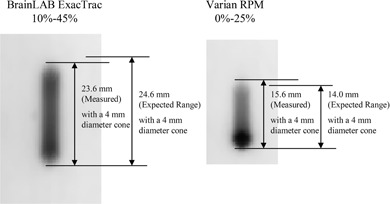
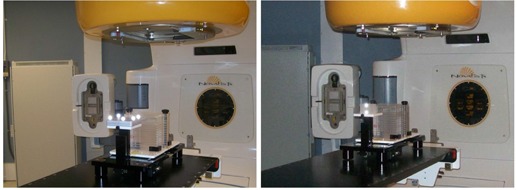
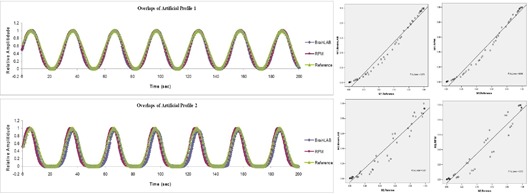
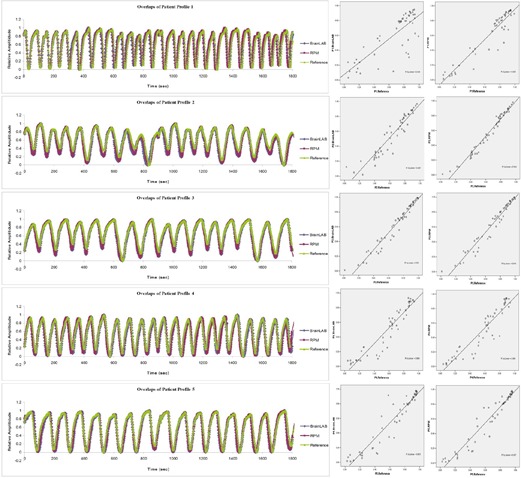
The purpose of this study was to investigate the accuracy of motion tracking and radiation delivery control of integrated gating systems on a Novalis Tx system. The study was performed on a Novalis Tx system, which is equipped with Varian Real-time Position Management (RPM) system, and BrainLAB ExacTrac gating systems. In this study, the two systems were assessed on accuracy of both motion tracking and radiation delivery control. To evaluate motion tracking, two artificial motion profiles and five patients' respiratory profiles were used. The motion trajectories acquired by the two gating systems were compared against the references. To assess radiation delivery control, time delays were measured using a single-exposure method. More specifically, radiation is delivered with a 4 mm diameter cone within the phase range of 10%-45% for the BrainLAB ExacTrac system, and within the phase range of 0%-25% for the Varian RPM system during expiration, each for three times. Radiochromic films were used to record the radiation exposures and to calculate the time delays. In the work, the discrepancies were quantified using the parameters of mean and standard deviation (SD). Pearson's product-moment correlational analysis was used to test correlation of the data, which is quantified using a parameter of r. The trajectory profiles acquired by the gating systems show good agreement with those reference profiles. A quantitative analysis shows that the average mean discrepancies between BrainLAB ExacTrac system and known references are 1.5 mm and 1.9 mm for artificial and patient profiles, with the maximum motion amplitude of 28.0 mm. As for the Varian RPM system, the corresponding average mean discrepancies are 1.1 mm and 1.7 mm for artificial and patient profiles. With the proposed single-exposure method, the time delays are found to be 0.20 ± 0.03 seconds and 0.09 ± 0.01 seconds for BrainLAB ExacTrac and Varian RPM systems, respectively. The results indicate the systems can track motion and control radiation delivery with reasonable accuracy. The proposed single-exposure method has been demonstrated to be feasible in measuring time delay efficiently.
本研究旨在探究 Novalis Tx 系统中集成门控系统的运动跟踪和放射治疗控制的准确性。该研究使用配备有瓦里安实时位置管理(RPM)系统和 BrainLAB ExacTrac 门控系统的 Novalis Tx 系统进行。在本研究中,对两个系统的运动跟踪和放射治疗控制的准确性进行了评估。为了评估运动跟踪,使用了两个人工运动轮廓和五个患者的呼吸轮廓。将门控系统获取的运动轨迹与参考轨迹进行比较。为了评估放射治疗控制,使用单次曝光法测量时间延迟。更具体地说,对于 BrainLAB ExacTrac 系统,在呼气阶段,将以 4 毫米直径的圆锥体在相位范围 10%-45%内输送放射治疗,对于瓦里安 RPM 系统,在呼气阶段,将以 0%-25%的相位范围输送放射治疗,每种情况进行三次。使用放射色胶片记录放射治疗暴露并计算时间延迟。在工作中,使用平均值和标准偏差(SD)参数量化差异。使用参数 r 量化数据的相关性,使用 Pearson 积矩相关分析测试数据的相关性。门控系统获取的轨迹轮廓与参考轮廓吻合良好。定量分析表明,BrainLAB ExacTrac 系统与已知参考值之间的平均平均差异分别为 1.5 毫米和 1.9 毫米,最大运动幅度为 28.0 毫米。对于瓦里安 RPM 系统,人工和患者的平均平均差异分别为 1.1 毫米和 1.7 毫米。使用提出的单次曝光方法,发现 BrainLAB ExacTrac 和瓦里安 RPM 系统的时间延迟分别为 0.20 ± 0.03 秒和 0.09 ± 0.01 秒。结果表明,这些系统可以以合理的精度跟踪运动并控制放射治疗的输送。所提出的单次曝光方法已被证明可以有效地测量时间延迟。