Weill Institute for Cell and Molecular Biology and Department of Molecular Biology and Genetics, Cornell University, Ithaca, NY 14853, USA.
Mol Biol Cell. 2011 Nov;22(21):4093-107. doi: 10.1091/mbc.E11-05-0440. Epub 2011 Aug 31.
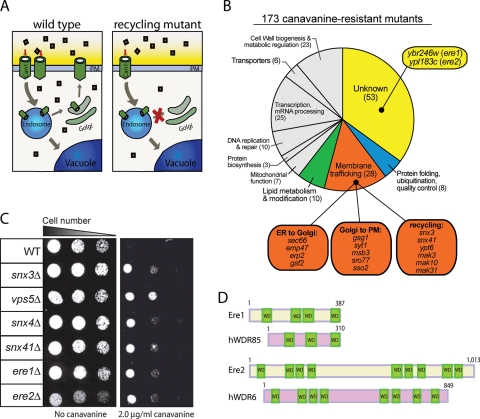
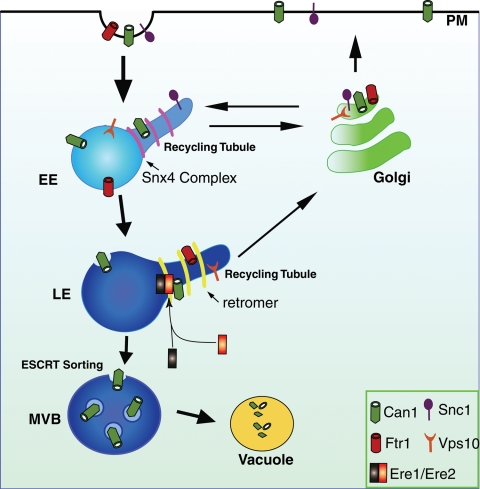
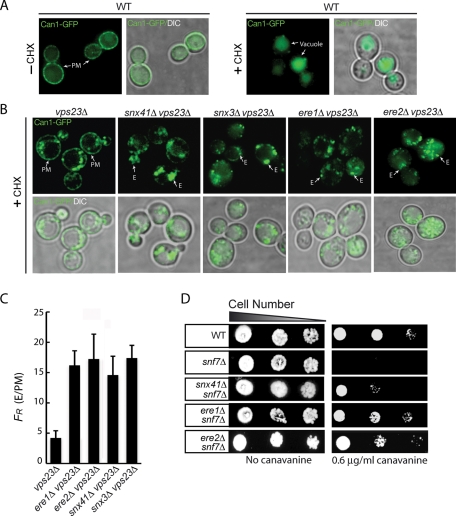
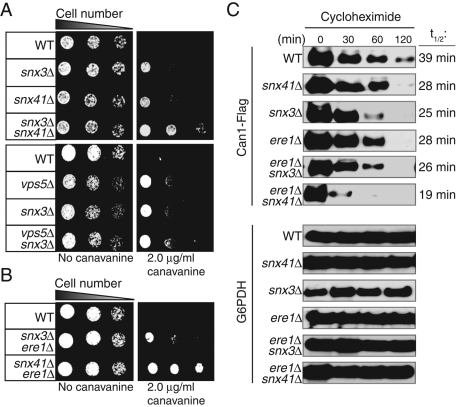
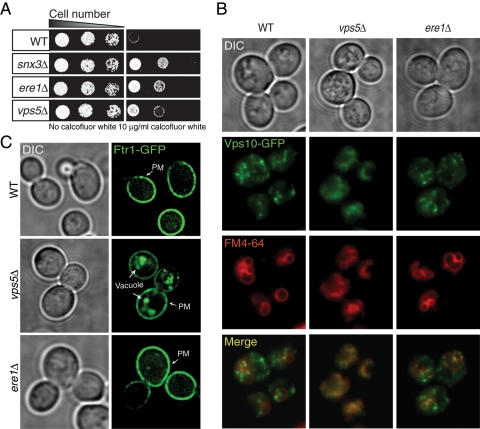
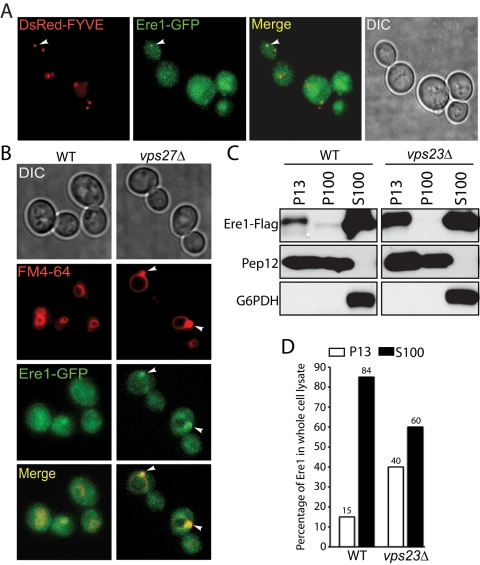
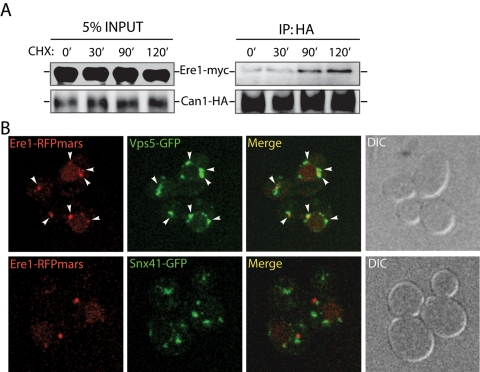
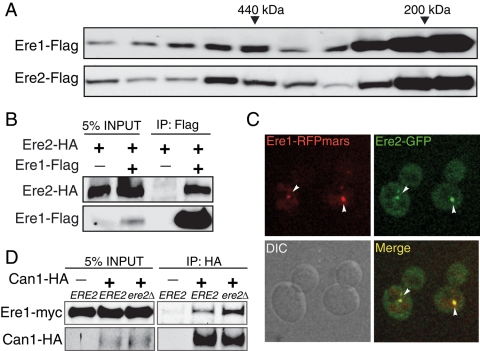
Regulated secretion, nutrient uptake, and responses to extracellular signals depend on cell-surface proteins that are internalized and recycled back to the plasma membrane. However, the underlying mechanisms that govern membrane protein recycling to the cell surface are not fully known. Using a chemical-genetic screen in yeast, we show that the arginine transporter Can1 is recycled back to the cell surface via two independent pathways mediated by the sorting nexins Snx4/41/42 and the retromer complex, respectively. In addition, we identify two novel WD40-domain endosomal recycling proteins, Ere1 and Ere2, that function in the retromer pathway. Ere1 is required for Can1 recycling via the retromer-mediated pathway, but it is not required for the transport of other retromer cargoes, such as Vps10 and Ftr1. Biochemical studies reveal that Ere1 physically interacts with internalized Can1. Ere2 is present in a complex containing Ere1 on endosomes and functions as a regulator of Ere1. Taken together, our results suggest that Snx4/41/42 and the retromer comprise two independent pathways for the recycling of internalized cell-surface proteins. Moreover, a complex containing the two novel proteins Ere1 and Ere2 mediates cargo-specific recognition by the retromer pathway.
受调控的分泌、营养物质摄取以及对外界信号的响应依赖于内化并循环回到质膜的细胞表面蛋白。然而,调控膜蛋白循环回到质膜的潜在机制尚不完全清楚。我们利用酵母中的化学遗传学筛选,发现精氨酸转运体 Can1 通过分别由分选连接蛋白 Snx4/41/42 和逆行转运体复合物介导的两条独立途径被循环回到质膜。此外,我们还鉴定了两种新型 WD40 结构域内体再循环蛋白 Ere1 和 Ere2,它们在逆行转运体途径中发挥作用。Ere1 对于通过逆行转运体介导的途径进行的 Can1 循环是必需的,但对于其他逆行转运体货物(如 Vps10 和 Ftr1)的运输不是必需的。生化研究表明 Ere1 与内化的 Can1 发生物理相互作用。Ere2 存在于包含内体上 Ere1 的复合物中,并且作为 Ere1 的调节剂发挥作用。总之,我们的结果表明 Snx4/41/42 和逆行转运体构成了内化细胞表面蛋白循环的两条独立途径。此外,包含这两种新型蛋白 Ere1 和 Ere2 的复合物介导了逆行转运体途径的货物特异性识别。