Neuropsychophysiology Laboratory, CIPsi, School of Psychology (EPsi), University of Minho, Braga, Portugal.
PLoS One. 2011;6(9):e24140. doi: 10.1371/journal.pone.0024140. Epub 2011 Sep 1.
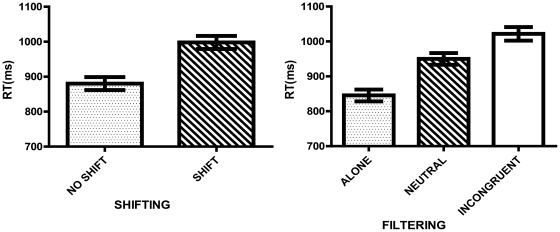
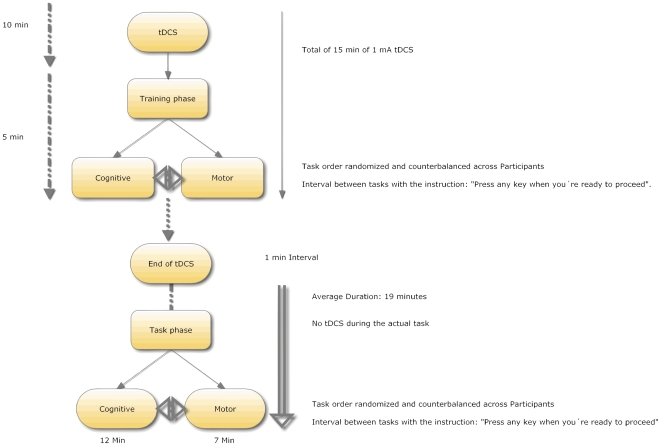
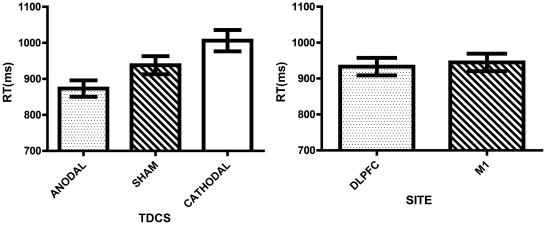
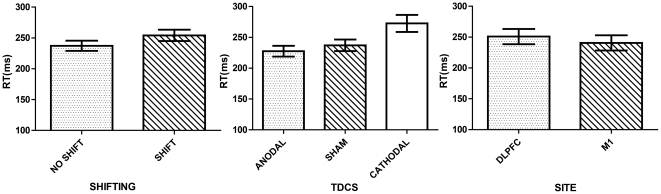
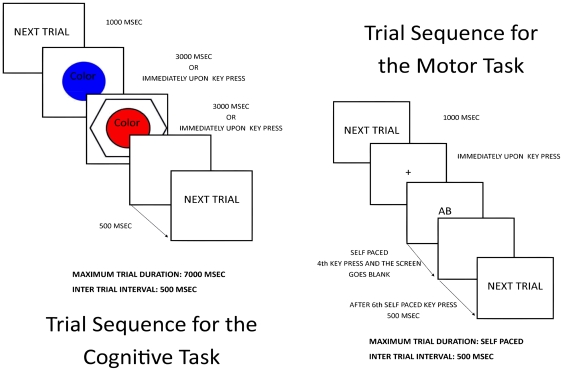
In this study, we tested the effects of transcranial Direct Current Stimulation (tDCS) on two set shifting tasks. Set shifting ability is defined as the capacity to switch between mental sets or actions and requires the activation of a distributed neural network. Thirty healthy subjects (fifteen per site) received anodal, cathodal and sham stimulation of the dorsolateral prefrontal cortex (DLPFC) or the primary motor cortex (M1). We measured set shifting in both cognitive and motor tasks. The results show that both anodal and cathodal single session tDCS can modulate cognitive and motor tasks. However, an interaction was found between task and type of stimulation as anodal tDCS of DLPFC and M1 was found to increase performance in the cognitive task, while cathodal tDCS of DLPFC and M1 had the opposite effect on the motor task. Additionally, tDCS effects seem to be most evident on the speed of changing sets, rather than on reducing the number of errors or increasing the efficacy of irrelevant set filtering.
在这项研究中,我们测试了经颅直流电刺激(tDCS)对两种转换任务的影响。转换任务能力被定义为在心理集或动作之间切换的能力,需要激活分布式神经网络。三十名健康受试者(每个部位各 15 名)接受了背外侧前额叶皮层(DLPFC)或初级运动皮层(M1)的阳极、阴极和假刺激。我们在认知和运动任务中测量了转换任务能力。结果表明,单次经颅直流电刺激(tDCS)既可以调节认知任务,也可以调节运动任务。然而,我们发现任务和刺激类型之间存在相互作用,即 DLPFC 和 M1 的阳极 tDCS 增加了认知任务的表现,而 DLPFC 和 M1 的阴极 tDCS 对运动任务产生了相反的影响。此外,tDCS 的效果似乎在改变集合的速度上最为明显,而不是减少错误的数量或增加无关集合过滤的效果。