Population Biology and Conservation Biology, Department of Ecology and Evolution, Uppsala University, Uppsala, Sweden.
PLoS One. 2011;6(8):e23438. doi: 10.1371/journal.pone.0023438. Epub 2011 Aug 30.
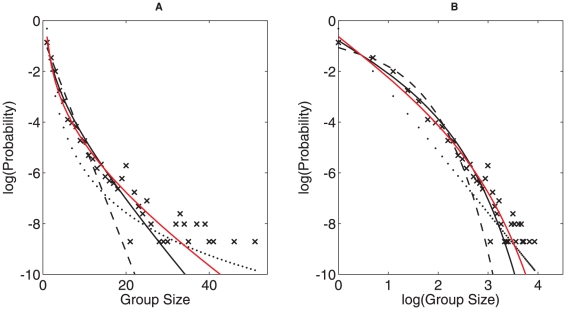
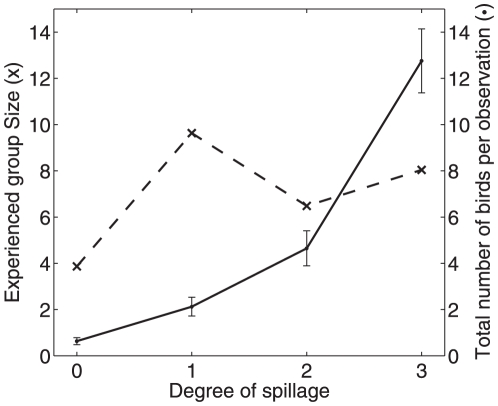
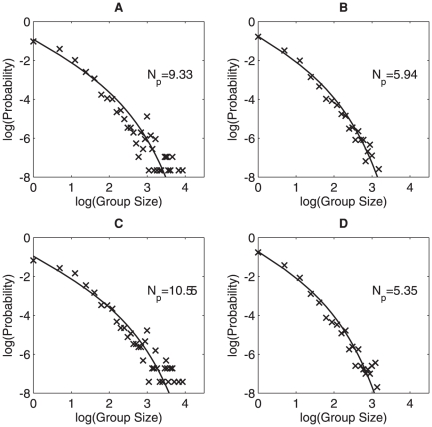
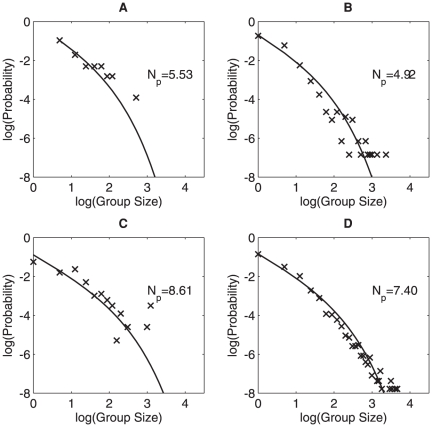
One of the most striking aspects of animal groups is their remarkable variation in size, both within and between species. While a number of mechanistic models have been proposed to explain this variation, there are few comprehensive datasets against which these models have been tested. In particular, we only vaguely understand how environmental factors and behavioral activities affect group-size distributions. Here we use observations of House sparrows (Passer domesticus) to investigate the factors determining group-size distribution. Over a wide range of conditions, we observed that animal group sizes followed a single parameter distribution known as the logarithmic distribution. This single parameter is the mean group size experienced by a randomly chosen individual (including the individual itself). For sparrows, the experienced mean group size, and hence the distribution, was affected by four factors: morning temperature, place, behavior and the degree of food spillage. Our results further indicate that the sparrows regulate the mean group size they experience, either by groups splitting more or merging less when local densities are high. We suggest that the mean experienced group size provides a simple but general tool for assessing the ecology and evolution of grouping.
动物群体最显著的特征之一是其大小在物种内和物种间存在显著差异。虽然已经提出了许多机械模型来解释这种变化,但很少有全面的数据集来检验这些模型。特别是,我们只是模糊地了解环境因素和行为活动如何影响群体大小分布。在这里,我们使用观察到的家麻雀(Passer domesticus)来研究决定群体大小分布的因素。在广泛的条件下,我们观察到动物群体大小遵循单一参数分布,称为对数分布。这个单一参数是随机选择的个体(包括个体本身)经历的平均群体大小。对于麻雀来说,所经历的平均群体大小,以及因此而产生的分布,受到四个因素的影响:早晨的温度、地点、行为和食物溢出的程度。我们的结果进一步表明,麻雀会调节它们所经历的平均群体大小,当局部密度较高时,通过更多地分裂或更少地合并来实现。我们认为,所经历的平均群体大小为评估群体的生态学和进化提供了一个简单但通用的工具。