Institute for Systems Neuroscience, University Medical Center Hamburg-Eppendorf (UKE) Hamburg, Germany.
Front Psychol. 2011 Sep 6;2:216. doi: 10.3389/fpsyg.2011.00216. eCollection 2011.
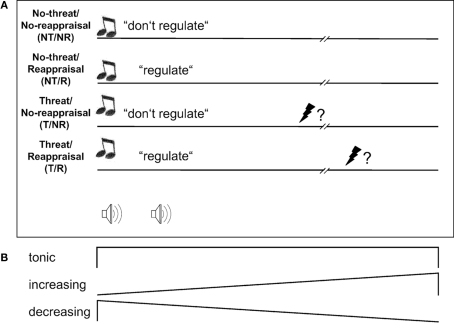
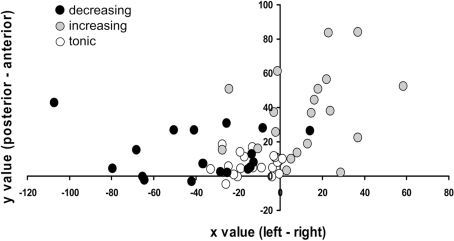
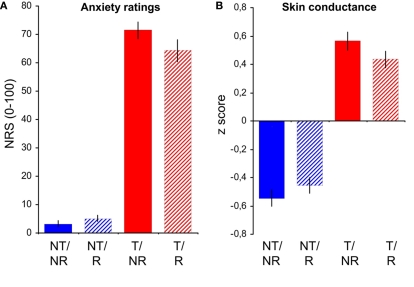
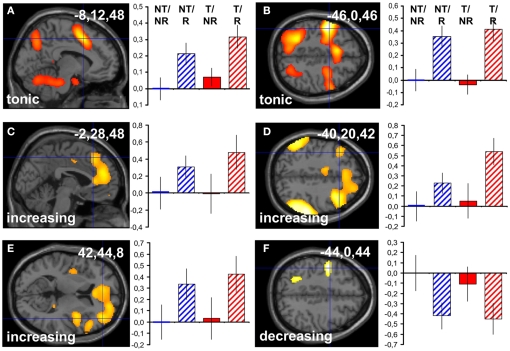
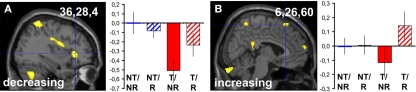
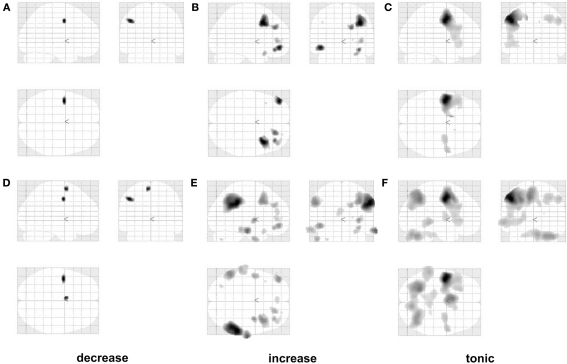
Reappraisal has been defined as a conscious, deliberate change in the way an emotional stimulus is interpreted, initiated in order to change its emotion-eliciting character (Gross, 2002). Reappraisal can be used to down-regulate negative emotions, including anxiety (reviewed in Kalisch, 2009). There is currently a strong interest in identifying the cognitive processes and neural substrates that mediate reappraisal. We have recently proposed a model (termed implementation-maintenance model or IMMO) that conceptualizes reappraisal as a temporally extended, dynamic, and multi-componential process (Kalisch, 2009). A key tenet of IMMO is that reappraisal episodes are marked by an early phase of implementation that may comprise strategy selection and retrieval of reappraisal material into working memory, and a later phase of maintenance that may comprise working memory and performance monitoring processes. These should be supported by dissociable neural networks. We here show, using a detachment-from-threat paradigm and concurrent functional magnetic resonance imaging, that reappraisal-related brain activity shifts from left posterior to right anterior parts of the lateral frontal cortex during the course of a reappraisal episode. Our data provide first empirical evidence for the existence of two separable reappraisal stages. Implications for further model development are discussed.
再评价被定义为一种有意识的、刻意的改变对情绪刺激的解释方式,其目的是改变情绪诱发的特征(Gross,2002)。再评价可用于下调负面情绪,包括焦虑(Kalisch,2009 综述)。目前,人们对识别介导再评价的认知过程和神经基质非常感兴趣。我们最近提出了一个模型(称为实施-维持模型或 IMMO),将再评价概念化为一个时间上扩展的、动态的、多成分的过程(Kalisch,2009)。IMMO 的一个关键原则是,再评价事件以实施的早期阶段为标志,该阶段可能包括策略选择和将再评价材料检索到工作记忆中,以及维持的后期阶段,该阶段可能包括工作记忆和绩效监测过程。这些应该由可分离的神经网络来支持。我们在这里使用威胁分离范式和并发功能磁共振成像显示,在再评价过程中,与再评价相关的大脑活动从左侧后颞叶皮层转移到右侧前颞叶皮层。我们的数据为存在两个可分离的再评价阶段提供了第一个经验证据。讨论了对进一步模型开发的影响。