The Neuropsychological Laboratory, CNS-Fed Paris, France.
Front Aging Neurosci. 2011 Sep 20;3:13. doi: 10.3389/fnagi.2011.00013. eCollection 2011.
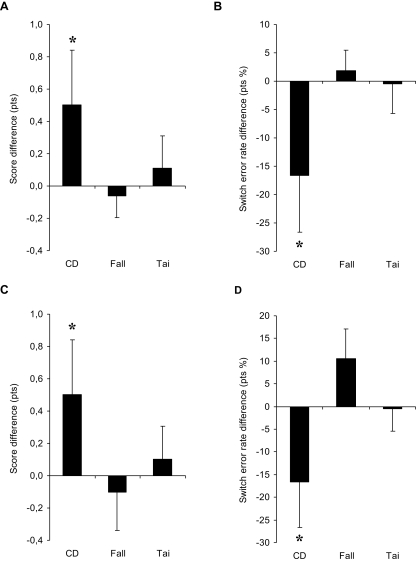
As society ages and frequency of dementia increases exponentially, counteracting cognitive aging decline is a challenging issue for countries of the developed world. Previous studies have suggested that physical fitness based on cardiovascular and strength training helps to improve attentional control in normal aging. However, how motor activity based on motor-skill learning can also benefit attentional control with age has been hitherto a neglected issue. This study examined the impact of contemporary dance (CD) improvisation on attentional control of older adults, as compared to two other motor training programs, fall prevention and Tai Chi Chuan. Participants performed setting, suppressing, and switching attention tasks before and after 5.7-month training in either CD or fall prevention or Tai Chi Chuan. Results indicated that CD improved switching but not setting or suppressing attention. In contrast, neither fall prevention nor Tai Chi Chuan showed any effect. We suggest that CD improvisation works as a training for change, inducing plasticity in flexible attention.
随着社会老龄化和痴呆症发病率呈指数级增长,对抗认知老化下降是发达国家面临的一个挑战。先前的研究表明,基于心血管和力量训练的身体健康有助于改善正常衰老过程中的注意力控制。然而,基于运动技能学习的运动活动如何也能随着年龄的增长而有益于注意力控制,这一直是一个被忽视的问题。本研究比较了当代舞(CD)即兴创作、防跌倒训练和太极拳对老年人注意力控制的影响。参与者在接受 5.7 个月的 CD、防跌倒训练或太极拳训练前后完成了设定、抑制和转换注意力任务。结果表明,CD 提高了转换注意力的能力,但对设定和抑制注意力的能力没有影响。相比之下,防跌倒训练和太极拳都没有显示出任何效果。我们认为,CD 即兴创作可以作为一种改变的训练方式,在灵活注意力中诱导出可塑性。